


KCET · Chemistry · Hydrogen
Water softening by Clark's process uses
- A \( \mathrm{CaHCO}_{3} \)
- B \( \mathrm{NaHCO}_{3} \)
- C \( \mathrm{Na}_{2} \mathrm{CO}_{3} \)
- D \( \mathrm{Ca}(\mathrm{OH})_{2} \)
Answer & Solution
Correct Answer
(D) \( \mathrm{Ca}(\mathrm{OH})_{2} \)
Step-by-step Solution
Detailed explanation
Clark's process is a commercial method of water softening. A calculated amount of quick lime is added to hard water,
bicarbonates are converted into insoluble calcium and magnesium carbonates which are filtered off.
\(\mathrm{CaO}+\mathrm{H}_{2} \mathrm{O} \rightarrow \mathrm{Ca}(\mathrm{OH})_{2}\)
\(\mathrm{Ca}\left(\mathrm{H} \mathrm{CO}_{3}\right)_{2}+\mathrm{Ca}(\mathrm{OH})_{2} \rightarrow 2 \mathrm{CaCO}_{3} \downarrow+2 \mathrm{H}_{2} \mathrm{O}\)
\(\mathrm{Mg}\left(\mathrm{HCO}_{3}\right)_{2}+\mathrm{Mg}(\mathrm{OH})_{2} \rightarrow 2 \mathrm{MgCO}_{3} \downarrow+2 \mathrm{H}_{2} \mathrm{O}\)
bicarbonates are converted into insoluble calcium and magnesium carbonates which are filtered off.
\(\mathrm{CaO}+\mathrm{H}_{2} \mathrm{O} \rightarrow \mathrm{Ca}(\mathrm{OH})_{2}\)
\(\mathrm{Ca}\left(\mathrm{H} \mathrm{CO}_{3}\right)_{2}+\mathrm{Ca}(\mathrm{OH})_{2} \rightarrow 2 \mathrm{CaCO}_{3} \downarrow+2 \mathrm{H}_{2} \mathrm{O}\)
\(\mathrm{Mg}\left(\mathrm{HCO}_{3}\right)_{2}+\mathrm{Mg}(\mathrm{OH})_{2} \rightarrow 2 \mathrm{MgCO}_{3} \downarrow+2 \mathrm{H}_{2} \mathrm{O}\)
See the Complete Solution
Get step-by-step explanations for this and 2.5 Lakh+ more JEE, NEET & CET questions.
- Unlock all solutions
- Practice the full chapter
- Track accuracy across PYQs
4.8 rated on Google Play · 14,000+ reviews
More questions from Chemistry
- Butylated hydroxy toluene as a food additive acts asKCET 2014 Medium
- Formation of coloured solution is possible when metal ion in the compound containsKCET 2007 Medium
- Which of the following crystals has the unit cell such that \(a=b \neq c\) and \(\alpha=\beta=90^{\circ}\),\(\gamma=120^{\circ} ?\)KCET 2024 Medium
- Maximum number of molecules of \(\mathrm{CH}_{3} \mathrm{I}\) that can react with a molecule of \(\mathrm{CH}_{3} \mathrm{NH}_{2}\) areKCET 2007 Medium
- Peroxide ion .......KCET 2010 Medium
- The rate of the reaction, \(\mathrm{CH}_3 \mathrm{COOC}_2 \mathrm{H}_5+\mathrm{NaOH} \longrightarrow \mathrm{CH}_3 \mathrm{COONa}+\mathrm{C}_2 \mathrm{H}_5 \mathrm{OH}\) is given by the equation, rate \(=k\left[\mathrm{CH}_3 \mathrm{COOC}_2 \mathrm{H}_5\right][\mathrm{NaOH}]\). If concentration is expressed in \(\mathrm{mol}^{-1}\), the unit of \(k\) isKCET 2022 Easy
More PYQs from KCET
- Which one of the following metallic oxide exhibit amphoteric nature ?KCET 2017 Medium
- In the diagram shown, the Zener diode has a reverse breakdown voltage of \(V_Z\). The current through the load resistance \(R_L\) is \(I_L\). The current through the Zener diode is
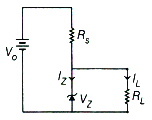 KCET 2024 Medium
 - Which one of the following is true?KCET 2011 Easy
- Which one of the following is not included under in-situ conservation?KCET 2020 Easy
- Which of the following is an empty set?KCET 2023 Easy
- In a human foetus the limbs and digits develop afterKCET 2015 Hard