


KCET · Chemistry · Hydrocarbons
\(9.65 \mathrm{C}\) of electric current is passed through fused anhydrous magnesium chloride. The magnesium metal thus, obtained is completely converted into a Grignard reagent. The number of moles of the Grignard reagent obtained is
- A \(5 \times 10^{-4}\)
- B \(1 \times 10^{-4}\)
- C \(5 \times 10^{-5}\)
- D \(1 \times 10^{-5}\)
Answer & Solution
Correct Answer
(C) \(5 \times 10^{-5}\)
Step-by-step Solution
Detailed explanation
\(\mathrm{MgCl}_{2} \longrightarrow \mathrm{Mg}^{2+}+2 \mathrm{Cl}^{-}\)
\(\mathrm{Mg}^{2+}+2 \mathrm{e}^{-} \longrightarrow \underset{1 \mathrm{~mol}}{\mathrm{Mg}}\) (at cathode)
\(\because 2 \mathrm{~F}(2 \times 96500 \mathrm{C}) \text { deposits } \mathrm{Mg}=1 \mathrm{~mol}\)
\(\therefore 9.65 \mathrm{C}(2 \times 96500 \mathrm{C}\) ) deposits \(\mathrm{Mg}=1 \mathrm{~mol}\)
\(=\frac{1 \times 9.65}{2 \times 96500}\)
\(=5 \times 10^{-5} \mathrm{~mol}\)
In order to prepare Grignard reagent, one mole of \(\mathrm{Mg}\) is used per mole of reagent obtained. Thus, by \(5 \times 10^{-5} \mathrm{~mol} \mathrm{Mg}, 5 \times 10^{-5}\) mole of Grignard reagent are obtained.
\(\mathrm{Mg}^{2+}+2 \mathrm{e}^{-} \longrightarrow \underset{1 \mathrm{~mol}}{\mathrm{Mg}}\) (at cathode)
\(\because 2 \mathrm{~F}(2 \times 96500 \mathrm{C}) \text { deposits } \mathrm{Mg}=1 \mathrm{~mol}\)
\(\therefore 9.65 \mathrm{C}(2 \times 96500 \mathrm{C}\) ) deposits \(\mathrm{Mg}=1 \mathrm{~mol}\)
\(=\frac{1 \times 9.65}{2 \times 96500}\)
\(=5 \times 10^{-5} \mathrm{~mol}\)
In order to prepare Grignard reagent, one mole of \(\mathrm{Mg}\) is used per mole of reagent obtained. Thus, by \(5 \times 10^{-5} \mathrm{~mol} \mathrm{Mg}, 5 \times 10^{-5}\) mole of Grignard reagent are obtained.
See the Complete Solution
Get step-by-step explanations for this and 2.5 Lakh+ more JEE, NEET & CET questions.
- Unlock all solutions
- Practice the full chapter
- Track accuracy across PYQs
4.8 rated on Google Play · 14,000+ reviews
More questions from Chemistry
- Which of the following is generally water insoluble?KCET 2019 Easy
- The calculated bond order of superoxide ion \(\left(\mathrm{O}_{2}^{-}\right)\)isKCET 2008 Easy
- In which one of the following, does the given amount of chlorine exert the least pressure in a vessel of capacity \(1 \mathrm{dm}^{3}\) at \(273 \mathrm{~K}\) ?KCET 2010 Easy
- Lattice enthalpy for \(\mathrm{NaCl}\) is \(+788 \mathrm{~kJ} \mathrm{~mol}^{-1}\) and \(\Delta H_{\text {hyd }}^{\circ}=-784 \mathrm{~kJ} \mathrm{~mol}^{-1}\). Enthalpy of solution of \(\mathrm{NaCl}\) isKCET 2023 Hard
- For the reaction, \(\mathrm{PCl}_5 \longrightarrow \mathrm{PCl}_3+\mathrm{Cl}_2\), rate and rate constant are \(1.02 \times 10^{-4} \mathrm{~mol} \mathrm{~L}^{-1} \mathrm{~s}^{-1}\) and \(3.4 \times 10^{-5} \mathrm{~s}^{-1}\) respectively at a given instant. The molar concentration of \(\mathrm{PCl}_5\) at that instant isKCET 2024 Medium
- The correct order of match between column \(X\) and column \(Y\) is
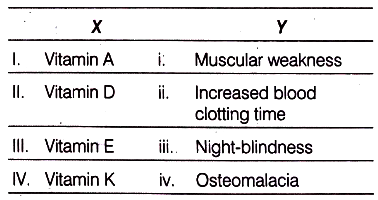 KCET 2023 Hard
More PYQs from KCET
- In the following circuit what are \(P\) and \(Q\)
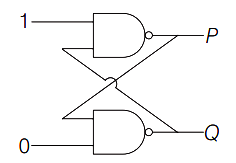 KCET 2020 Easy
 - Which of the following order is true regardingthe acidic nature of phenol?KCET 2017 Medium
- A reaction has both \( \Delta \mathrm{H} \) and \( \Delta \mathrm{S} \) - ve. The rate of reactionKCET 2017 Easy
- The area of the circle having its centre at \((3,4)\) and touching the line \(5 x+12 y-11=0\) isKCET 2013 Medium
- Let \( f: R \rightarrow R \) be defined by \( f(x)=\left\{\begin{array}{cc}2 x ; & x>3 \\ x^{2} ; & 1 < x \leq 3 \\ 3 x ; & x \leq 1\end{array}\right. \)
Then \( f(-1)+f(2)+f(4) \) isKCET 2018 Easy - Match List-I with List-II
Choose the correct answer from the options given below.List-I (Complex) List-II (Geometry) (a) \([\text{Co(NH}_3\text{)}_6]^{3+}\) (i) Trigonal bipyramidal (b) \([\text{NiCl}_4]^{2-}\) (ii) Octahedral (c) \([\text{Ni(CN)}_4]^{2-}\) (iii) Tetrahedral (d) \([\text{Fe(CO)}_5]\) (iv) Square planar KCET 2026 Medium