


JEE Mains · Physics · STD 11 - Friction
- JEE Mains 2022
- Hard
- MCQ
A block of mass \(2\,kg\) moving on a horizontal surface with speed of \(4\,ms ^{-1}\) enters a rough surface ranging from \(x =0.5\,m\) to \(x =1.5\,m\). The retarding force in this range of rough surface is related to distance by \(F =- kx\) where \(k =12\,Nm ^{-1}\). The speed of the block as it just crosses the rough surface will be ........... \(\,ms ^{-1}\)
Pick an option to check your answer.
Answer & Solution
Correct Answer
(C) \(2.0\)
Step-by-step Solution
Detailed explanation
\(a=\frac{- kx }{2}=\frac{-12 x }{2}=-6 x\)
\(\frac{ v d v }{ dx }=-6 x\)
\(\int \limits_{4}^{*} vdv =-\int \limits_{\frac{1}{2}}^{ s / 2} 6 xdx\)
\(\frac{ v ^{2}-4^{2}}{2}=-\frac{6}{2}\left[\left(\frac{3}{2}\right)^{2}-\left(\frac{1}{2}\right)^{2}\right]\)
\(v ^{2}-16=-6\left(\frac{9}{4}-\frac{1}{4}\right)\)
\(v ^{2}=16-6 \times 2=4\)
\(V =2\,m / s\)
More questions from Physics
- The surface charge density of a thin charged disc of radius \(R\) is \(\sigma \). The value of the electric field at the centre of the disc is \(\frac{\sigma }{{2\,{ \in _0}}}\). With respect to the field at the centre, the electric field along the axis at a distance \(R\) from the centre of the discJEE Mains 2013 Hard
- A sonometer wire oflength \(1.5\ m\) is made of steel. The tension in it produces an elastic strain of \(1 \%\). What is the fundamental frequency of steel if density and elasticity of steel are \(7.7 \times 10^3 \) \(kg/m^3\) and \(2.2 \times 10^{11}\) \(N/m^2\) respectively?JEE Mains 2013 Easy
- Identify the correct truth table of the given logical circuit.
 JEE Mains 2026 Medium
- In single slit diffraction pattern, the wavelength of light used is \(628\) nm and slit width is \(0.2\) mm, the angular width of central maximum is \(\alpha \times 10^{-2}\) degrees. The value of \(\alpha\) is _______.JEE Mains 2026 Medium
- A plane EM wave is propagating along \(\mathrm{x}\) direction. It has a wavelength of \(4 \mathrm{~mm}\). If electric field is in y direction with the maximum magnitude of \(60 \mathrm{Vm}^{-1}\), the equation for magnetic field is _______.JEE Mains 2024 Hard
- Two strings (A, B) having linear densities \(\mu_{ A }=2 \times 10^{-4} kg / m\) and \(\mu_{ B }=4 \times 10^{-4} kg / m\) and lengths \(L _{ A }=2.5 m\) and \(L _{ B }=1.5 m\) respectively are joined. Free ends of A and B are tied to two rigid supports C and D , respectively creating a tension of 500 N in the wire. Two identical pulses, sent from \(C\) and \(D\) ends, take time \(t_1\) and \(t_2\), respectively, to reach the joint. The ratio \(t_1 / t_2\) is :JEE Mains 2026 Medium
More PYQs from JEE Mains
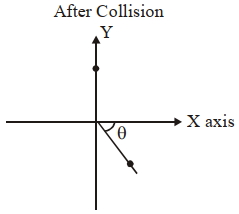
- A ball of mass \(10\, kg\) moving with a velocity \(10 \sqrt{3}\, ms ^{-1}\) along \(X-\)axis, hits another ball of mass \(20\, kg\) which is at rest. After collision, the first ball comes to rest and the second one disintegrates into two equal pieces. One of the pieces starts moving along \(Y-\) axis at a speed of \(10\, m / s\). The second piece starts moving at a speed of \(20\, m / s\) at an angle \(\theta\) (degree) with respect to the \(X-\)axis. The configuration of pieces after collision is shown in the figure. The value of \(\theta\) to the nearest integer is
 JEE Mains 2021 Hard
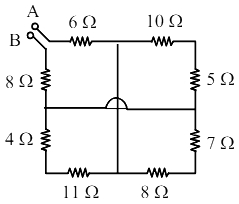
- The equivalent resistance between \(A\) and \(B\) is _______.
 JEE Mains 2024 Hard
- Match the List\(-I\) with List\(-II\)
Choose the correct answer from the options given belowList \(I\) List \(II\) \(A\) Microwaves \(I\) Radio active decay of the nucleus \(B\) Gamma rays \(II\) Rapid acceleration and deceleration of electron in aerials \(C\) Radio waves \(III\) Inner shell electrons \(D\) \(X\)-rays \(IV\) Klystron valve JEE Mains 2023 Medium - A beam of electrons of energy \(E\) scatters from a target having atomic spacing of \(1\, A\). The first maximum intensity occurs at \(\theta=60^{\circ} .\) Then \(E\) (in \(eV )\) is\(......\) (Planck constant \(h =6.64 \times 10^{-34}\, Js\) \(1 \,eV =1.6 \times 10^{-19}\,J\), electron mass \(\left. m =9.1 \times 10^{-31}\, kg \right)\)JEE Mains 2020 Medium
- Current passing through a wire as function of time is given as \(\mathrm{I}(\mathrm{t})=0.02 \mathrm{t}+0.01 \mathrm{~A}\). The charge that will flow through the wire from \(t=1 s\) to \(t=2 s\) is :JEE Mains 2025 Medium