


JEE Mains · Physics · STD 12 - 11. Dual nature of radiation and matter
If the two metals \(A\) and \(B\) are exposed to radiation of wavelength \(350\,nm\). The work functions of metals \(A\) and \(B\) are \(4.8\,eV\) and \(2.2\,eV\). Then choose the correct option
- A Metal \(B\) will not emit photo-electrons
- B Both metals \(A\) and \(B\) will emit photo-electrons
- C Both metals \(A\) and \(B\) will not emit photoelectrons
- D Metal \(A\) will not emit photo-electrons
Answer & Solution
Correct Answer
(D) Metal \(A\) will not emit photo-electrons
Step-by-step Solution
Detailed explanation
See the Complete Solution
Get step-by-step explanations for this and 2.5 Lakh+ more JEE, NEET & CET questions.
- Unlock all solutions
- Practice the full chapter
- Track accuracy across PYQs
4.8 rated on Google Play · 14,000+ reviews
More questions from Physics
- Given below are two statements. One is labelled as Assertion (A) and the other is labelled as Reason (R).
Assertion (A) :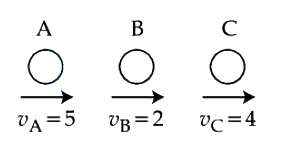
Three identical spheres of same mass undergo one dimensional motion as shown in figure with initial velocities \(v_{\mathrm{A}}=5 \mathrm{~m} / \mathrm{s}, v_{\mathrm{B}}=2 \mathrm{~m} / \mathrm{s}, v_{\mathrm{C}}=4 \mathrm{~m} / \mathrm{s}\). If we wait sufficiently long for elastic collision to happen, then \(v_{\mathrm{A}}=4 \mathrm{~m} / \mathrm{s}, v_{\mathrm{B}}=2 \mathrm{~m} / \mathrm{s}\), \(v_{\mathrm{C}}=5 \mathrm{~m} / \mathrm{s}\) will be the final velocities.
Reason (R): In an elastic collision between identical masses, two objects exchange their velocities.
In the light of the above statements, choose the correct answer from the options given below :JEE Mains 2025 Easy - Sand is being dropped from a stationary dropper at a rate of \(0.5\,kgs ^{-1}\) on a conveyor belt moving with a velocity of \(5\,ms ^{-1}\). The 10.Power needed to keep belt moving with the same velocity will be.JEE Mains 2022 Medium
- If the velocity of light \(c\), universal gravitational constant \(G\) and planck's constant \(h\) are chosen as fundamental quantities. The dimensions of mass in the new system isJEE Mains 2023 Hard
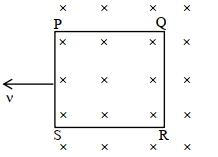
- A square loop \(\mathrm{PQRS}\) having \(10\) turns, area \(3.6 \times\) \(10^{-3} \mathrm{~m}^2\) and resistance \(100 \Omega\) is slowly and uniformly being pulled out of a uniform magnetic field of magnitude \(\mathrm{B}=0.5 \mathrm{~T}\) as shown. Work done in pulling the loop out of the field in \(1.0 \mathrm{~s}\) is _______ \(\times 10^{-6} \mathrm{~J}\).
 JEE Mains 2024 Hard
 - The bob of a simple pendulum has mass \(2\,g\) and a charge of \(5.0\,\mu C\). It is at rest in a uniform horizontal electric field of intensity \(2000\,\frac{V}{m}\). At equilibrium, the angle that the pendulum makes with the vertical is (take \(g = 10\,\frac{m}{{{s^2}}}\))JEE Mains 2019 Hard
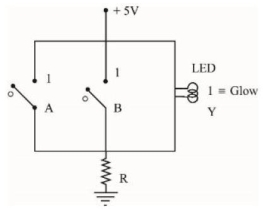
- Name the logic gate equivalent to the diagram attached
 JEE Mains 2023 Medium
More PYQs from JEE Mains
- If the function \(\mathrm{f}\) defined on \(\left(-\frac{1}{3}, \frac{1}{3}\right)\) by \(f(x)=\left\{\begin{array}{ll}{\frac{1}{x} \log _{e}\left(\frac{1+3 x}{1-2 x}\right)} & {, \text { when } x \neq 0} \\ {k} & {, \text { when } x=0}\end{array}\right.\) is continuous, then \(\mathrm{k}\) is equal toJEE Mains 2020 Hard
- A thin convex lens made from crown glass \(\left( {\mu = \frac{3}{2}} \right)\) has focal length \(f\). When it is measured in two different liquids having refractive indices \(\frac{4}{3}\) and \(\frac{5}{3}\) it has the focal lengths \(f_1\) and \(f_2\) respectively. The correct relation between the focal lengths is:JEE Mains 2014 Medium
- Light from a point source in air falls on a convex curved surface of radius \(20 \mathrm{~cm}\) and refractive index \(1.5.\) If the source is located at \(100 \mathrm{~cm}\) from the convex surface, the image will be formed at _______ \(\mathrm{cm}\) from the object.JEE Mains 2024 Hard
- The critical angle of a medium for a specific wavelength, if the medium has relative permittivity \(3\) and relative permeability \(\frac{4}{3}\) for this wavelength, will be.....\(^o\)JEE Mains 2020 Medium
- The momentum of an electron revolving in \(n ^{\text {th }}\) orbit is given by: (Symbols have their usual meanings)JEE Mains 2022 Easy
- Match List \(- I\) (Fundamental Experiment) with List \(- II\) (its conclusion) and select the correct option from the choices given below the list \(\begin{array}{|||} \hline List\,\,-1 & List\,\,-II\,\, \\ \hline a\,\,Franck-Hertz\,\,Experiment & i\,\,Particle\,\,nature\,\,of\,\,light \\ \hline b\,\,Photo\,\,-electric\,\,Experiment & ii\,\,Discrete\,\,energy \,\, levels\,\,of\,\,atom \\ \hline c\,\,Davison-Germer\,\,Experiment & iii\,\,Wave\,\,nature\,\,of\,\,electron \\ \hline & iv\,\,Structure\,\,of\,\,atom \\ \hline \end{array}\)JEE Mains 2015 Medium