


JEE Mains · Maths · STD 12 - 8. Application and integration
Let \(f: \mathbf{R} \rightarrow \mathbf{R}\) be a twice differentiable function such that \(f(x+y)=f(x) f(y)\) for all \(x, y \in \mathbf{R}\). If \(f^{\prime}(0)=4 \mathrm{a}\) and \(f\) satisfies \(f^{\prime \prime}(x)-3 \mathrm{a} f^{\prime}(x)-f(x)=0\), \(\mathrm{a}\gt0\), then the area of the region \(\mathrm{R}=\{(x, y) \mid 0 \leq y \leq f(\mathrm{a} x), 0 \leq x \leq 2\}\) is:
- A \(e^2-1\)
- B \(e^2+1\)
- C \(e^4+1\)
- D \(e^4-1\)
Answer & Solution
Correct Answer
(A) \(e^2-1\)
Step-by-step Solution
Detailed explanation
\(\begin{aligned} & f(x+y)=f(x) \cdot f(y) \\ & \Rightarrow f(x)=e^{\lambda x} f^{\prime}(0)=4 a \\ & \Rightarrow f^{\prime}(x)=\lambda e^{\lambda x} \Rightarrow \lambda=4 a \end{aligned}\) So, \(f(x)=e^{4 x}\)…
See the Complete Solution
Get step-by-step explanations for this and 2.5 Lakh+ more JEE, NEET & CET questions.
- Unlock all solutions
- Practice the full chapter
- Track accuracy across PYQs
4.8 rated on Google Play · 14,000+ reviews
More questions from Maths
- A hyperbola whose transverse axis is along the major axis of then conic, \(\frac{{{x^2}}}{3} + \frac{{{y^2}}}{4} = 4\) and has vertices at the foci of this conic . If the eccentricity of the hyperbola is \(\frac{3}{2}\) , then which of the following points does \(NOT\) lie on it ?JEE Mains 2016 Hard
- If \(\mathrm{y}=\mathrm{y}(\mathrm{x})\) is an implicit function of \(\mathrm{x}\) such that \(\log _{e}(x+y)=4 x y\), then \(\frac{d^{2} y}{d x^{2}}\) at \(x=0\) is equal to .... .JEE Mains 2021 Hard
- Let \(f(x)=2^x-x^2, x \in R\). If \(m\) and \(n\) are respectively the number of points at which the curves \(y=f(x)\) and \(y=f^{\prime}(x)\) intersects the \(x\)-axis, then the value of \(m+n\) isJEE Mains 2024 Hard
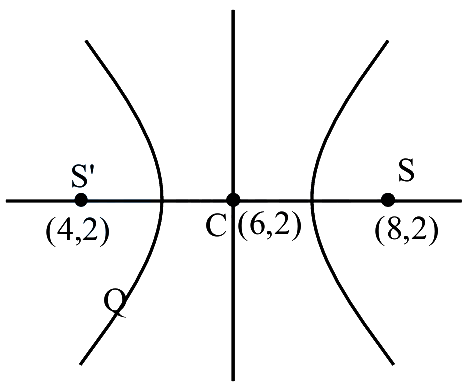
- If the equation of the hyperbola with foci \((4,2)\) and \((8,2)\) is \(3 x^2-y^2-\alpha x+\beta y+\gamma=0\), then \(\alpha+\beta+\gamma\) is equal to _____.
 JEE Mains 2025 Easy
 - Let \(A B C\) be an isosceles triangle in which \(A\) is at \((-1,0), \angle A=\frac{2 \pi}{3}, A B=A C\) and \(B\) is on the positive \(\mathrm{x}\)-axis. If \(\mathrm{BC}=4 \sqrt{3}\) and the line \(\mathrm{BC}\) intersects the line \(y=x+3\) at \((\alpha, \beta)\), then \(\frac{\beta^4}{\alpha^2}\) is :JEE Mains 2024 Hard
- If \(\tan 15^{\circ}+\frac{1}{\tan 75^{\circ}}+\frac{1}{\tan 105^{\circ}}+\tan 195^{\circ}=2 a\), then the value of \(\left(a+\frac{1}{a}\right)\) is :JEE Mains 2023 Hard
More PYQs from JEE Mains
- Let \(S=\left\{z \in C :\left|\frac{z-6 i}{z-2 i}\right|=1\right.\) and \(\left.\left|\frac{z-8+2 i}{z+2 i}\right|=\frac{3}{5}\right\}\). Then \(\sum_{z \in s}|z|^2\) is equal toJEE Mains 2026 Medium
- The coefficient of \(x ^{101}\) in the expression \((5+x)^{500}+x(5+x)^{499}+x^{2}(5+x)^{498}+\ldots . x^{500}\) \(x>0\), isJEE Mains 2022 Hard
- The number of four -digit numbers strictly greater than \(4321\) that can be formed using the digits \(0, 1, 2, 3, 4, 5\) (repetition of digits is allowed) isJEE Mains 2019 Hard
- If \(0 \le x \le \pi \) and \({81^{{{\sin }^2}x}} + {81^{{{\cos }^2}x}} = 30\), then \(x =\)JEE Mains 2021 Hard
- Let \(\mathrm{P}(4,4 \sqrt{3})\) be a point on the parabola \(y^2=4 \mathrm{a} x\) and PQ be a focal chord of the parabola. If M and \(N\) are the foot of perpendiculars drawn from \(P\) and \(Q\) respectively on the directrix of the parabola, then the area of the quadrilateral PQMN is equal to :JEE Mains 2025 Medium
- The distance of the point \(Q(0,2,-2)\) form the line passing through the point \(\mathrm{P}(5,-4,3)\) and perpendicular to the lines \(\overrightarrow{\mathrm{r}}=(-3 \hat{\mathrm{i}}+2 \hat{\mathrm{k}})\) \(\lambda(2 \hat{\mathrm{i}}+3 \hat{\mathrm{j}}+5 \hat{\mathrm{k}}), \lambda \in \mathbb{R}\) and \( \overrightarrow{\mathrm{r}}=(\hat{\mathrm{i}}-2 \hat{\mathrm{j}}+\hat{\mathrm{k}})+\) \(\mu(-\hat{i}+3 \hat{J}+2 \hat{K}), \mu \in \mathbb{R}\) isJEE Mains 2024 Hard