


JEE Mains · Maths · STD 11 - 14. probability
An urn contains \(6\) white and \(9\) black balls. Two successive draws of \(4\) balls are made without replacement. The probability, that the first draw gives all white balls and the second draw gives all black balls, is :
- A \(\frac{5}{256}\)
- B \(\frac{5}{715}\)
- C \(\frac{3}{715}\)
- D \(\frac{3}{256}\)
Answer & Solution
Correct Answer
(C) \(\frac{3}{715}\)
Step-by-step Solution
Detailed explanation
\(\frac{{ }^6 \mathrm{C}_4}{{ }^{15} \mathrm{C}_4} \times \frac{{ }^9 \mathrm{C}_4}{{ }^{11} \mathrm{C}_4}=\frac{3}{715}\) Hence option\((3)\) is correct.
See the Complete Solution
Get step-by-step explanations for this and 2.5 Lakh+ more JEE, NEET & CET questions.
- Unlock all solutions
- Practice the full chapter
- Track accuracy across PYQs
4.8 rated on Google Play · 14,000+ reviews
More questions from Maths
- Let the domain of the function
\(f(\mathrm{x})=\log _2 \log _4 \log _6\left(3+4 x-x^2\right)\) be \((\mathrm{a}, \mathrm{~b})\). If \(\int_0^{\mathrm{b}-\mathrm{a}}\left[\mathrm{x}^2\right] \mathrm{dx}=\mathrm{p}-\sqrt{\mathrm{q}}-\sqrt{\mathrm{r}}, \mathrm{p}, \mathrm{q},\) \(\mathrm{r} \in \mathbb{N}, \operatorname{gcd}(\mathrm{p}, \mathrm{q}, \mathrm{r})=1,\)
where [\(\cdot]\) is the greatest integer function, then \(\mathrm{p}+\mathrm{q}+\mathrm{r}\) is equal toJEE Mains 2025 Hard - Let \(x=2\) be a local minima of the function \(f(x)=2 x^4-18 x^2+8 x+12, x \in(-4,4)\). If \(M\) is local maximum value of the function \(f\) in \((-4,4)\), then \(M =\)JEE Mains 2023 Hard
- Number of integral terms in the expansion of \(\left\{7^{\left(\frac{1}{2}\right)}+11^{\left(\frac{1}{6}\right)}\right\}^{824}\) is equal to ...........JEE Mains 2024 Hard
- \( \text { If } S(x)=(1+x)+2(1+x)^2+3(1+x)^3+\ldots . \) \( +60(1+x)^{60}, x \neq 0 \text {, and }(60)^2 S(60)=a(b)^b+b\) where \(a, b N\), then \((a+b)\) equal to ...............JEE Mains 2024 Hard
- If the solution \(y=y(x)\) of the differential equation \(\left(\mathrm{x}^4+2 \mathrm{x}^3+3 \mathrm{x}^2+2 \mathrm{x}+2\right) \mathrm{dy}-\left(2 \mathrm{x}^2+2 \mathrm{x}+3\right) \mathrm{dx}=0\) satisfies \(y(-1)=-\frac{\pi}{4}\), then \(y(0)\) is equal to :JEE Mains 2024 Medium
- If the midpoint of a chord of the ellipse \(\frac{x^2}{9}+\frac{y^2}{4}=1\) is \((\sqrt{2}, 4 / 3)\), and the length of the chord is \(\frac{2 \sqrt{\alpha}}{3}\), then \(\alpha\) is :JEE Mains 2025 Medium
More PYQs from JEE Mains
- There are \(m\) men and two women participating in a chess tournament. Each participant plays two games with every other participant. If the number of games played by the men between themselves exceeds the number of games played between the men and the women by \(84,\) then the value of \(m\) isJEE Mains 2019 Hard
- From a lot of \(10\) items, which include \(3\) defective items, a sample of \(5\) items is drawn at random. Let the random variable \(\mathrm{X}\) denote the number of defective items in the sample. If the variance of \(X\) is \(\sigma^2\), then \(96 \sigma^2\) is equal to ....................JEE Mains 2024 Hard
- The number of elements in the set \(S = \left\{(r, k) : k \in \mathbb{Z} \text{ and } {}^{36}C_{r+1} = \dfrac{6\left({}^{35}C_r\right)}{(k^2 - 3)}\right\}\), is :JEE Mains 2026 Medium
- If the equation of the hyperbola with foci \((4,2)\) and \((8,2)\) is \(3 x^2-y^2-\alpha x+\beta y+\gamma=0\), then \(\alpha+\beta+\gamma\) is equal to _____.
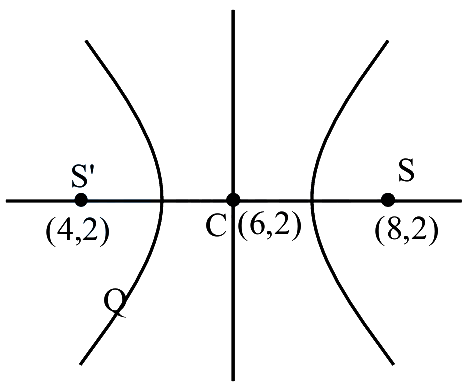 JEE Mains 2025 Easy
 - Let \(A\) be a \(3 \times 3\) matrix with \(\operatorname{det}( A )=4\). Let \(R _{ i }\) denote the \(i ^{\text {th }}\) row of \(A\). If a matrix \(B\) is obtained by performing the operation \(R _{2} \rightarrow 2 R _{2}+5 R _{3}\) on \(2 A ,\) then \(\operatorname{det}( B )\) is equal to ...... .JEE Mains 2021 Medium
- The number of times the digit \(3\) will be written when listing the integers from \(1\) to \(1000\) isJEE Mains 2021 Medium