


JEE Advanced · Physics · 17. Electrostatics
Paragraph:
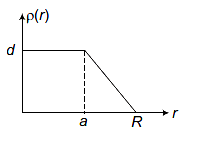
The nuclear charge \((\mathrm{Ze})\) is non-uniformly distributed within a nucleus of radius \(R\). The charge density \(\rho(r)\) [charge per unit volume] is dependent only on the radial distance \(r\) from the centre of the nucleus as shown in figure. The electric field is only along the radial direction.
Question:
For \(a=0\), the value of \(d\) (maximum value of \(\rho\) as shown in the figure) is
- A \(\frac{3 Z e}{4 \pi R^3}\)
- B \(\frac{3 Z e}{\pi R^3}\)
- C \(\frac{4 Z e}{3 \pi R^3}\)
- D \(\frac{Z e}{3 \pi R^3}\)
Answer & Solution
Correct Answer
(B) \(\frac{3 Z e}{\pi R^3}\)
Step-by-step Solution
Detailed explanation
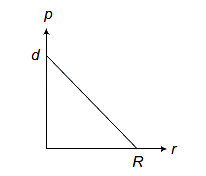
For \(a=0\)
\(\rho(r)=\left(-\frac{d}{R} \cdot r+d\right)\)
\(\text {Now } \int_0^R\left(4 \pi r^2\right)\left(d-\frac{d}{R} r\right) d r=\) \(\text { net charge }=Z e\)
Solving this equation, we get \(d=\frac{3 Z e}{\pi R^3}\)
\(\rho(r)=\left(-\frac{d}{R} \cdot r+d\right)\)
\(\text {Now } \int_0^R\left(4 \pi r^2\right)\left(d-\frac{d}{R} r\right) d r=\) \(\text { net charge }=Z e\)
Solving this equation, we get \(d=\frac{3 Z e}{\pi R^3}\)
See the Complete Solution
Get step-by-step explanations for this and 2.5 Lakh+ more JEE, NEET & CET questions.
- Unlock all solutions
- Practice the full chapter
- Track accuracy across PYQs
4.8 rated on Google Play · 14,000+ reviews
More questions from Physics
- An electric dipole with dipole moment is held fixed at the origin in the presence of an uniform electric field of magnitude If the potential is constant on a circle of radius centered at the origin as shown in figure, then the correct statement(s) is/are:
( is permittivity of free space, dipole size)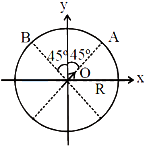 JEE Advanced 2019 Hard
 - Paragraph:
When a particle is restricted to move along \(x\)-axis between \(x=0\) and \(x=a\), where \(a\) is of nanometer dimension, its energy can take only certain specific values. The allowed energies of the particle moving in such a restricted region, correspond to the formation of standing waves with nodes at its ends \(x=0\) and \(x=a\). The wavelength of this standing wave is related to the liner momentum \(p\) of the particle according to the de Broglie relation. The energy of the particle of mass \(m\) is related to its linear momentum as \(E=\frac{p^2}{2 m}\). Thus, the energy of the particle can be denoted by a quantum number \(n\) taking values \(1,2,3, \ldots(n=1\), called the ground state) corresponding to the number of loops in the standing wave.
Use the model described above to answer the following three questions for a particle moving in the line \(x=0\) to \(x=a\) [Take \(h=6.6 \times 10^{-34} \mathrm{Js}\) and \(e=1.6 \times 10^{-19} \mathrm{C}\) ]
Question:
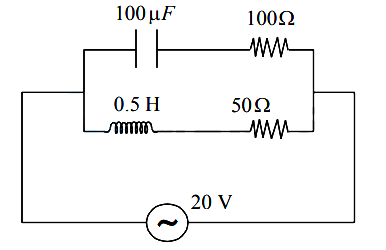
The allowed energy for the particle for a particular value of \(n\) is proportional toJEE Advanced 2009 Medium - In the given circuit, the \(\mathrm{AC}\) source has \(\omega=100 \mathrm{rad} / \mathrm{s}\). Considering the inductor and capacitor to be ideal, the correct choice(s) is (are)
 JEE Advanced 2012 Hard
 - Paragraph:
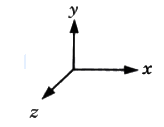
In a thin rectangular metallic strip a constant current \(I\) flows along the positive \(x\)-direction, as shown in the figure. The length, width and thickness of the strip are \(l, w\) and \(d\), respectively.
A uniform magnetic field \(\vec{B}\) is applied on the strip along the positive \(y\)-direction. Due to this, the charge carriers experience a net deflection along the \(z\)-direction. This results in accumulation of charge carriers on the surface \(P Q R S\) and appearance of equal and opposite charges on the face opposite to \(P Q R S\). A potential difference along the \(z\)-direction is thus developed. Charge accumulation continues until the magnetic force is balanced by the electric force. The current is assumed to be uniformly distributed on the cross section of the strip and carried by electrons.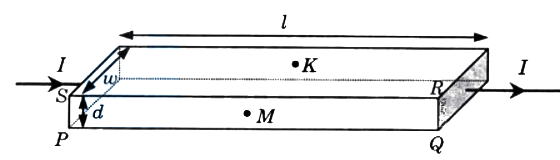
Question:
Consider two different metallic strips (\(1\) and \(2\)) of the same material. Their lengths are the same, widths are \(w_{1}\) and \(w_{2}\) and thicknesses are \(d_{1}\) and \(d_{2}\), respectively. Two points \(K\) and \(M\) are symmetrically located on the opposite faces parallel to the \(x-y\) plane (see figure). \(V_{1}\) and \(V_{2}\) are the potential differences between \(K\) and \(M\) in strips \(1\) and \(2\), respectively. Then, for a given current \(I\) flowing through them in a given magnetic field strength \(B\), the correct statement(s) is(are)JEE Advanced 2015 Medium - Half-life of a radio active substance ' \(A\) ' is 4 days. The probability that a nucleus will decay in two half-lives isJEE Advanced 2006 Easy
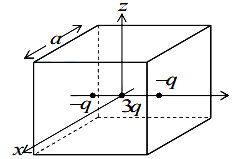
- A cubical region of side \(a\) has its centre at the origin. It encloses three fixed point charges, \(-q\) at \((0,-a / 4,0),+3 q\) at \((0,0,0)\) and \(-q\) at \((0,+a / 4,0)\). Choose the correct options(s)
 JEE Advanced 2012 Medium
More PYQs from JEE Advanced
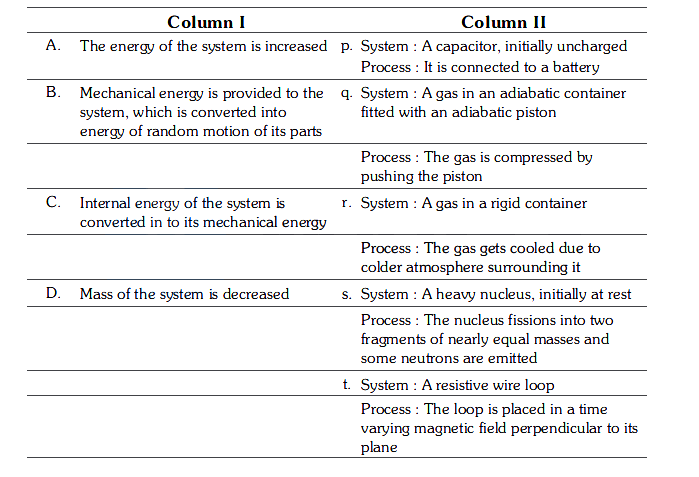
- Column-II gives certain systems undergoing a process. Column-I suggests changes in some of the parameters related to the system. Match the statements in Column-I to the appropriate process (es) from Column-II.
 JEE Advanced 2009 Medium
 - If the value of \(n(Y)+n(Z)\) is \(k^2\), then \(|k|\) is
Let \(S=\{1,2,3,4,5,6\}\) and \(X\) be the set of all relations \(R\) from \(S\) to \(S\) that satisfy both the following properties:
i. \(R\) has exactly 6 elements.
ii. For each \((a, b) \in R\), we have \(|a-b| \geq 2\).
Let \(Y=\{R \in X\) : The range of \(R\) has exactly one element \(\}\) and \(Z=\{R \in X: R\) is a function from \(S\) to \(S\}\).
Let \(n(A)\) denote the number of elements in a set \(A\).JEE Advanced 2024 Medium - Answer the following by appropriately matching the lists based on the information given in the paragraph.
A musical instrument is made using four different metal strings, and with mass per unit length and respectively. The instrument is played by vibrating the strings by varying the free length in between the range and It is found that in string- at free length and tension the fundamental mode frequency is
List-I gives the above four strings while list-II lists the magnitude of some quantity.String String String String
The length of the strings and are kept fixed at and respectively. Strings and are vibrated at their and harmonics, respectively such that all the strings have same frequency. The correct match for the tension in the four strings in the units of will be.JEE Advanced 2019 Easy - The image of an object, formed by a plano - convex lens at a distance of 8 m behind the lens, is real and is one-third the size of the object. The wavelength of light inside the lens is times the wavelength in free space. The radius of the curved surface of the lens isJEE Advanced 2013 Medium
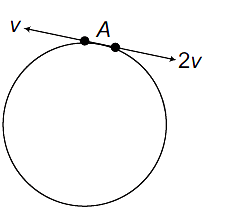
- Two small particles of equal masses start moving in opposite directions from a point \(A\) in a horizontal circular orbit. Their tangential velocities are \(v\) and \(2 v\) respectively, as shown in the figure. Between collisions, the particles move with constant speeds. After making how many elastic collisions, other than that at \(A\), these two particles will again reach the point \(A\) ?
 JEE Advanced 2009 Medium
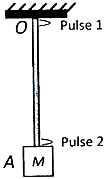
 - A block hangs vertically at the bottom end of a uniform rope of constant mass per unit length. The top end of the rope is attached to a fixed rigid support at O. A transverse wave pulse (Pulse 1) of wavelength is produced at point O on the rope. The pulse takes time to reach point A. If the wave pulse of wavelength is produced at point A (Pulse 2) without disturbing the position of M it takes time to reach point O. Which of the following options is/are correct?
 JEE Advanced 2017 Medium