


JEE Advanced · Physics · 24. Ray Optics
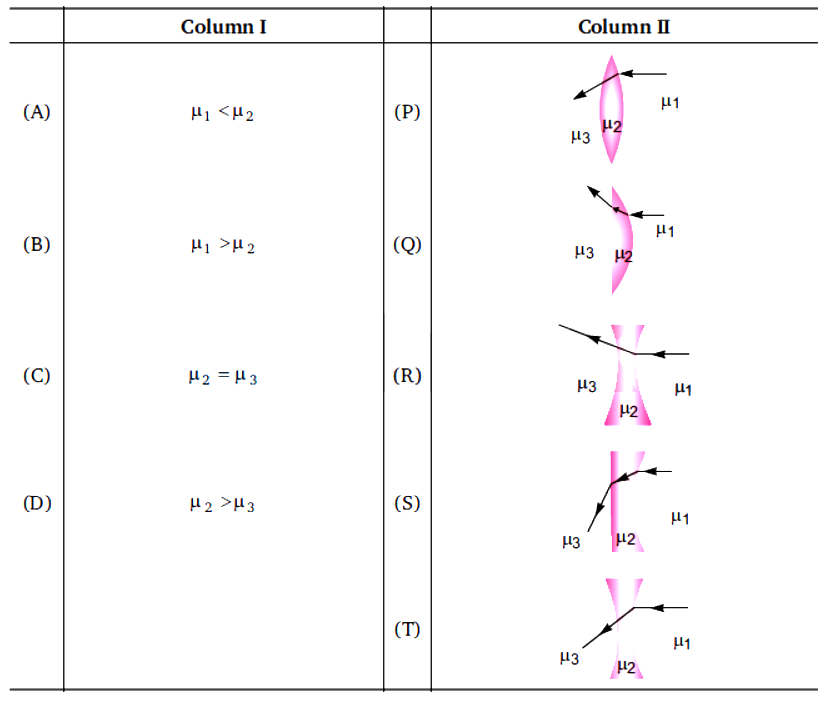
Two transparent media of refractive indices \(\mu_1\) and \(\mu_3\) have a solid lens shaped transparent material of refractive index \(\mu_2\) between them as shown in figures in Column II. A ray traversing these media is also shown in the figures. In Column I different relationships between \(\mu_1, \mu_2\) and \(\mu_3\) are given. Match them to the ray diagram shown in Column II.
- A (A) P,R, (B) Q,S,T, (C) P,R,T, (D) Q,S
- B (A) P, (B) Q,S, (C) P,R,T, (D) Q,R,S
- C (A) P,R, (B) Q,S, (C) P,T, (D) Q,R,S
- D (A) P, (B) Q,S,T, (C) P,T, (D) Q,S
Answer & Solution
Correct Answer
(A) (A) P,R, (B) Q,S,T, (C) P,R,T, (D) Q,S
Step-by-step Solution
Detailed explanation
(A) \(\rightarrow\) since \(\mu_1 < \mu_2\), the ray of light will bend towards normal after first refraction.
(B) \(\rightarrow \mu_1>\mu_2\), the ray of light will bend away from the normal after first refraction.
(C) \(\rightarrow\) since \(\mu_2=\mu_3\) means in second refraction there will be no change in the path of ray of light.
(D) \(\rightarrow\) Since \(\mu_2>\mu_3\), ray of light will bend away from the normal after second refraction.
Therefore the correct options are as under.
(A) \(\rightarrow\) P, R
(B) \(\rightarrow\) Q, S, T
(C) \(\rightarrow\) P, R, T
(D) \(\rightarrow\) Q, \(S\)
(B) \(\rightarrow \mu_1>\mu_2\), the ray of light will bend away from the normal after first refraction.
(C) \(\rightarrow\) since \(\mu_2=\mu_3\) means in second refraction there will be no change in the path of ray of light.
(D) \(\rightarrow\) Since \(\mu_2>\mu_3\), ray of light will bend away from the normal after second refraction.
Therefore the correct options are as under.
(A) \(\rightarrow\) P, R
(B) \(\rightarrow\) Q, S, T
(C) \(\rightarrow\) P, R, T
(D) \(\rightarrow\) Q, \(S\)
See the Complete Solution
Get step-by-step explanations for this and 2.5 Lakh+ more JEE, NEET & CET questions.
- Unlock all solutions
- Practice the full chapter
- Track accuracy across PYQs
4.8 rated on Google Play · 14,000+ reviews
More questions from Physics
- A silver sphere of radius \(1 \mathrm{~cm}\) and work function \(4.7 \mathrm{eV}\) is suspended from an insulating thread in free-space. It is under continuous illumination of \(200 \mathrm{~nm}\) wavelength light. As photoelectrons are emitted, the sphere gets charged and acquires a potential. The maximum number of photoelectrons emitted from the sphere is \(A \times 10^Z\) (where \(1 < A < 10\) ). The value of \(Z\) isJEE Advanced 2011 Medium
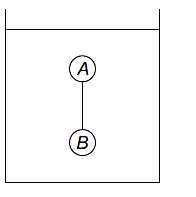
- Two solid spheres \(A\) and \(B\) of equal volumes but of different densities \(d_A\) and \(d_B\) are connected by a string. They are fully immersed in a fluid of density \(d_F\). They get arranged into an equilibrium state as shown in the figure with a tension in the string. The arrangement is possible only if
 JEE Advanced 2011 Hard
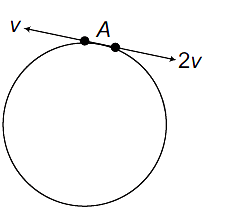
 - Two small particles of equal masses start moving in opposite directions from a point \(A\) in a horizontal circular orbit. Their tangential velocities are \(v\) and \(2 v\) respectively, as shown in the figure. Between collisions, the particles move with constant speeds. After making how many elastic collisions, other than that at \(A\), these two particles will again reach the point \(A\) ?
 JEE Advanced 2009 Medium
 - A solid horizontal surface is covered with a thin layer of oil. A rectangular block of mass is at rest on this surface. An impulse of is applied to the block at time so that it starts moving along the x-axis with a velocity , where is a constant and . The displacement of the block, in meter, at is __________. TakeJEE Advanced 2018 Medium
- A metal surface is illuminated by light of two different wavelengths 248 nm and 310 nm. The maximum speeds of the photoelectrons corresponding to these wavelengths are u1 and u2, respectively. If the ratio , the work function of the metal is nearlyJEE Advanced 2014 Medium
- A student is performing the experiment of resonance column. The diameter of the column tube is \(4 \mathrm{~cm}\). The frequency of the tuning fork is \(512 \mathrm{~Hz}\). The air temperature is \(38^{\circ} \mathrm{C}\) in which the speed of sound is \(336 \mathrm{~m} / \mathrm{s}\). The zero of the meter scale coincides with the top end of the resonance column tube. When the first resonance occurs, the reading of the water level in the column isJEE Advanced 2012 Hard
More PYQs from JEE Advanced
- Paragraph:
In a mixture of \(\mathrm{H}-\mathrm{H}^{+}\)gas \(\left(\mathrm{He}^{+}\right.\)is singly ionised \(\mathrm{He}\) atom), \(\mathrm{H}\) atoms and \(\mathrm{He}^{+}\)ions are excited to their respective first excited states. Subsequently, \(\mathrm{H}\) atoms transfer their total excitation energy to \(\mathrm{He}^{+}\)ions (by collisions). Assume that the Bohr model of atom is exactly valid.
Question:
The ratio of the kinetic energy of the \(n=2\) electron for the \(\mathrm{H}\) atom to that of \(\mathrm{He}^{+}\) ion isJEE Advanced 2008 Easy - Paragraph:
Redox reaction play a pivotal role in chemistry and biology. The values of standard redox potential \(\left(E^{\circ}\right)\) of two half-cell reactions decide which way the reaction is expected to proceed. A simple example is a Daniel cell in which zinc goes into solution and copper gets deposited. Given below are a set of half-cell reactions (acidic medium) along with their \(E^{\circ}(V\) with respect to normal hydrogen electrode) values. Using this data obtain the correct explanations to Questions 14-19.
\(\mathrm{I}_2+2 e^{-} \longrightarrow 2 \mathrm{I}^{-} E^{\circ}=0.54 \)
\( \mathrm{Cl}_2+2 e^{-} \longrightarrow 2 \mathrm{Cl}^{-} E^{\circ}=1.36 \)
\( \mathrm{Mn}^{3+}+e^{-} \longrightarrow \mathrm{Mn}^{2+} E^{\circ}=1.50 \)
\( \mathrm{Fe}^{3+}+e^{-} \longrightarrow \mathrm{Fe}^{2+} E^{\circ}=0.77 \)
\( \mathrm{O}_2+4 \mathrm{H}^{+}+4 e^{-} \longrightarrow 2 \mathrm{H}_2 \mathrm{O} E^{\circ}=1.23\)
Question:
Among the following, identify the correct statementJEE Advanced 2007 Easy - Let \(\alpha, \beta\) and \(\gamma\) be real numbers such that the system of linear equations
\[
\begin{array}{c}
x+2 y+3 z=\alpha \\
4 x+5 y+6 z=\beta \\
7 x+8 y+9 z=\gamma-1
\end{array}
\]
is consistent. Let \(|M|\) represent the determinant of the matrix
\[
M=\left[\begin{array}{ccc}
\alpha & 2 & \gamma \\
\beta & 1 & 0 \\
-1 & 0 & 1
\end{array}\right]
\]
Let \(P\) be the plane containing all those \((\alpha, \beta, \gamma)\) for which the above system of linear equations is consistent, and \(D\) be the square of the distance of the point \((0,1,0)\) from the plane \(P\).
The value of isJEE Advanced 2021 Medium - Paragraph:
Consider the lines: \(L_1: \frac{x+1}{3}=\frac{y+2}{1}=\frac{z+1}{2}, L_2: \frac{x-2}{1}=\frac{y+2}{2}=\frac{z-3}{3}\)Question:
The distance of the point \((1,1,1)\) from the plane passing through the point \((-1,-2,-1)\) and whose normal is perpendicular to both the lines \(L_1\) and \(L_2\), isJEE Advanced 2008 Easy - The total number of cyclic structural as well as stereoisomers possible for a compound with the molecular formula \(=\mathrm{C}_5 \mathrm{H}_{10}\) isJEE Advanced 2009 Medium
- For the following electrochemical cell at
\(\operatorname{Pt}( s ) \mid H _2(g, 1\) bar \() \mid H ^{+}( aq , 1 M ) \| M ^{4+}(\) aq. \(), M ^{2+}(\) aq. \() \mid \operatorname{Pt}( s )\)
when
Given:
The value of is -JEE Advanced 2016 Medium