


JEE Advanced · Physics · 7. COM & Collisions
Two particles, 1 and 2 , each of mass \(m\), are connected by a massless spring, and are on a horizontal frictionless plane, as shown in the figure. Initially, the two particles, with their center of mass at \(x_0\), are oscillating with amplitude \(a\) and angular frequency \(\omega\). Thus, their positions at time \(t\) are given by \(x_1(t)=\left(x_0+d\right)+a \sin \omega t\) and \(x_2(t)=\left(x_0-d\right)-a \sin \omega t\), respectively, where \(d>2 a\). Particle 3 of mass \(m\) moves towards this system with speed \(u_0=a \omega / 2\), and undergoes instantaneous elastic collision with particle 2 , at time \(t_0\). Finally, particles 1 and 2 acquire a center of mass speed \(v_{\mathrm{cm}}\) and oscillate with amplitude \(b\) and the same angular frequency \(\omega\).

If the collision occurs at time \(t_0=\pi /(2 \omega)\), then the value of \(4 b^2 / a^2\) will be ________ .
- A 4.3
- B 4.25
- C 4.35
- D 4.44
Answer & Solution
Correct Answer
(B) 4.25
Step-by-step Solution
Detailed explanation
\(t_0=\frac{\pi}{2 \omega}=\frac{T}{4}\)
Particles are at extreme position
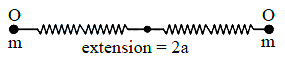
After collision

in C-frame
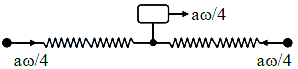

using WET,
\(\mathrm{W}_{\text {spring }}=\Delta \mathrm{K} \)
\( \frac{1}{2} \mathrm{k}(2 \mathrm{~b})^2-\frac{1}{2} \mathrm{k}(2 \mathrm{a})^2=2 \times \frac{1}{2} \mathrm{~m} \times\left(\frac{\mathrm{a} \omega}{4}\right)^2 \quad\)\((\mathrm{k}=\text { spring constant }) \)
\( 4 \mathrm{~kb}{ }^2-4 \mathrm{ka}^2=2 \times \mathrm{m} \times \frac{\mathrm{a}^2}{16} \times \frac{2 \mathrm{k}}{\mathrm{m}} \)
\( 4 \mathrm{~b}^2=\frac{17}{4} \mathrm{a}^2 \)
\( \frac{4 \mathrm{~b}^2}{\mathrm{a}^2}=4.25\)
Particles are at extreme position
After collision
in C-frame
using WET,
\(\mathrm{W}_{\text {spring }}=\Delta \mathrm{K} \)
\( \frac{1}{2} \mathrm{k}(2 \mathrm{~b})^2-\frac{1}{2} \mathrm{k}(2 \mathrm{a})^2=2 \times \frac{1}{2} \mathrm{~m} \times\left(\frac{\mathrm{a} \omega}{4}\right)^2 \quad\)\((\mathrm{k}=\text { spring constant }) \)
\( 4 \mathrm{~kb}{ }^2-4 \mathrm{ka}^2=2 \times \mathrm{m} \times \frac{\mathrm{a}^2}{16} \times \frac{2 \mathrm{k}}{\mathrm{m}} \)
\( 4 \mathrm{~b}^2=\frac{17}{4} \mathrm{a}^2 \)
\( \frac{4 \mathrm{~b}^2}{\mathrm{a}^2}=4.25\)
See the Complete Solution
Get step-by-step explanations for this and 2.5 Lakh+ more JEE, NEET & CET questions.
- Unlock all solutions
- Practice the full chapter
- Track accuracy across PYQs
4.8 rated on Google Play · 14,000+ reviews
More questions from Physics
- A solid sphere of mass and radius rolls without slipping on a fixed inclined plane with an angle of inclination from the horizontal. Two forces of magnitude each, parallel to the incline, act on the sphere, both at distance from the center of the sphere, as shown in the figure. The acceleration of the sphere down the plane is . (Take )
If the numerical value has more than two decimal places, truncate/round-off the value to TWO decimal places.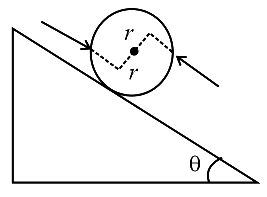 JEE Advanced 2022 Medium
 - Column I gives certain situations in which a straight metallic wire of resistance \(R\) is used and Column II gives some resulting effects. Match the statements in Column I with the statements in Column II and indicate your answer by darkening appropriate bubbles in the \(4 \times 4\) matrix given in the ORS.
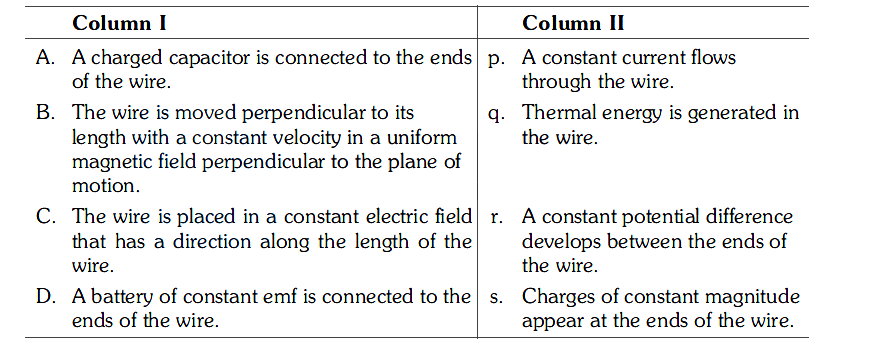 JEE Advanced 2007 Hard
 - Three very large plates of same area are kept parallel and close to each other. They are considered as ideal black surfaces and have very high thermal conductivity. The first and third plates are maintained at temperatures \(2 T\) and \(3 T\) respectively. The temperature of the middle (i.e. second) plate under steady state condition isJEE Advanced 2012 Medium
- A mixture of ideal gas containing moles of monatomic gas and mole of rigid diatomic gas is initially at pressure volume and temperature If the gas mixture is adiabatically compressed to a volume , then the correct statement(s) is/are,
(Given is gas constant)JEE Advanced 2019 Medium - The density of a solid ball is to be determined in an experiment. The diameter of the ball is measured with a screw gauge, whose pitch is \(0.5 \mathrm{~mm}\) and there are 50 divisions on the circular scale. The reading on the main scale is \(2.5 \mathrm{~mm}\) and that on the circular scale is 20 divisions. If the measured mass of the ball has a relative error of \(2 \%\), the relative percentage error in the density isJEE Advanced 2011 Medium
- A particle of mass \(m\) is under the influence of the gravitational field of a body of mass \(M(\gg m)\). The particle is moving in a circular orbit of radius \(r_0\) with time period \(T_0\) around the mass \(M\). Then, the particle is subjected to an additional central force, corresponding to the potential energy \(V_{\mathrm{c}}(r)=m \alpha / r^3\), where \(\alpha\) is a positive constant of suitable dimensions and \(r\) is the distance from the center of the orbit. If the particle moves in the same circular orbit of radius \(r_0\) in the combined gravitational potential due to \(M\) and \(V_{\mathrm{c}}(r)\), but with a new time period \(T_1\), then \(\left(T_1^2-T_0^2\right) / T_1^2\) is given by
[ \(G\) is the gravitational constant.]JEE Advanced 2024 Medium
More PYQs from JEE Advanced
- Let be given by
Then which of the following options is/are correct?JEE Advanced 2019 Medium - Four persons independently solve a certain problem correctly with probabilities . Then the probability that the problem is solved correctly by at least one of them isJEE Advanced 2013 Medium
- A long perfectly conducting wire is moving, with a velocity on a pair of horizontal rails of zero resistance. One side of the rails is connected to an inductor and a resistance as shown in figure. The horizontal rails, and lie in the same plane with a uniform magnetic field perpendicular to the plane. If the key is closed at certain instant, the current in the circuit after milli second is where the value of is_______.
[Assume the velocity of wire remains constant after key is closed. Given: where is base of the natural logarithm]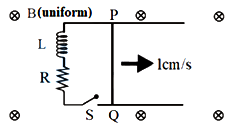 JEE Advanced 2019 Medium
 - A single slit diffraction experiment is performed to determine the slit width using the equation, \(\frac{b d}{D}=m \lambda\), where \(b\) is the slit width, \(D\) the shortest distance between the slit and the screen, \(d\) the distance between the \(m^{\text {th }}\) diffraction maximum and the central maximum, and \(\lambda\) is the wavelength. \(D\) and \(d\) are measured with scales of least count of 1 cm and 1 mm, respectively. The values of \(\lambda\) and \(m\) are known precisely to be 600 nm and 3, respectively. The maximum absolute error (in \(\mu \mathrm{m}\)) in the value of \(b\) estimated using the diffraction maximum that occurs for \(m=3\) with \(d=5 \mathrm{~mm}\) and \(D=1 \mathrm{~m}\) is ______.JEE Advanced 2025 Medium
- The number of all possible values of \(\theta\), where \(0 < \theta < \pi\), for which the system of equations
\((y+z) \cos 3 \theta=(x y z) \sin 3 \theta \) \( x \sin 3 \theta=\frac{2 \cos 3 \theta}{y}+\frac{2 \sin 3 \theta}{z}\) and \((x y z) \sin 3 \theta=(y+2 z) \cos 3 \theta\) \(+y \sin 3 \theta\) have a solution \(\left(x_0, y_0, z_0\right)\) with \(\quad y_0 z_0 \neq 0\), isJEE Advanced 2010 Medium - A line with positive direction cosines passes through the point \(P(2,-1,2)\) and makes equal angles with the coordinate axes. The line meets the plane \(2 x+y+z=9\) at point \(Q\). The length of the line segment \(P Q\) equalsJEE Advanced 2009 Easy