


JEE Advanced · Physics · 17. Electrostatics
Six infinitely large and thin non-conducting sheets are fixed in configurations I and II. As shown in the figure, the sheets carry uniform surface charge densities which are indicated in terms of \(\sigma_0\). The separation between any two consecutive sheets is \(1 \mu \mathrm{~m}\). The various regions between the sheets are denoted as \(1,2,3,4\) and 5. If \(\sigma_0=9 \mu \mathrm{C} / \mathrm{m}^2\), then which of the following statements is/are correct: (Take permittivity of free space \(\epsilon_0=9 \times 10^{-12} \mathrm{~F} / \mathrm{m}\)):
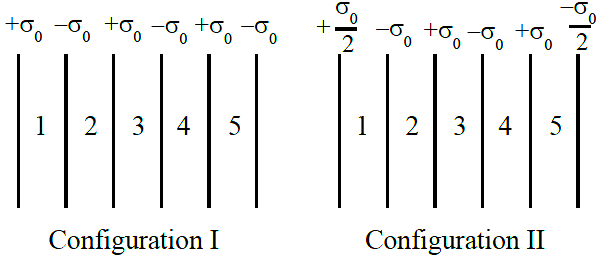
- A In region 4 of the configuration \(I\), the magnitude of the electric field is zero.
- B In region 3 of the configuration II, the magnitude of the electric field is \(\frac{\sigma_0}{\epsilon_0}\).
- C Potential difference between the first and the last sheets of the configuration I is 5 V .
- D Potential difference between the first and the last sheets of the configuration II is zero.
Answer & Solution
Correct Answer
(A) In region 4 of the configuration \(I\), the magnitude of the electric field is zero.
Step-by-step Solution
Detailed explanation
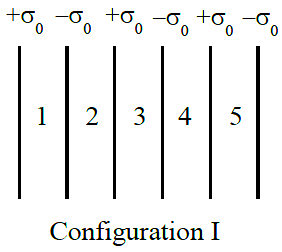
\(\begin{aligned}\left(\mathrm{E}_4\right)_{\mathrm{I}}= & \frac{\sigma_0}{2 \epsilon_0}[1-1+1-1-1+1]=0 \\ \left(\mathrm{~V}_{\text {First }}\right)_{\mathrm{I}} & =\frac{-\sigma_0}{2 \epsilon_0}[-1+2-3+4-5] \mathrm{d} \\ & =\frac{-\sigma_0}{2 \epsilon_0}[-3] \mathrm{d}=\frac{\sigma_0 3 \mathrm{~d}}{2 \epsilon_0}\end{aligned}\)
\(\left(V_{\text {Last }}\right)_I =\frac{-\sigma_0}{2 \epsilon_0}[1-2+3-4+5] \)
\( =\frac{\sigma_0}{2 \epsilon_0}[-3 \mathrm{~d}]\)
\(\left(V_{\text {First }}-V_{\text {Last }}\right)_I =\frac{3 \sigma_0 \mathrm{~d}}{\epsilon_0} \)
\( =\frac{3 \times 9 \times 10^{-6} \times 1 \times 10^{-6}}{9 \times 10^{-12}}=3 \mathrm{volt}\)
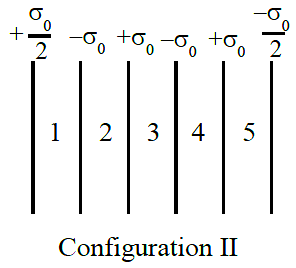
\(\left(\mathrm{E}_3\right)_{\text {II }}= \frac{\sigma_0}{2 \epsilon_0}\left[\frac{1}{2}-1+1+1-1+\frac{1}{2}\right]=\frac{\sigma_0}{2 \epsilon_0} \)
\( =\frac{-\sigma_0}{2 \epsilon_0}\left[-1+2-3+4-\frac{5}{2}\right] \mathrm{d} \)
\( =\frac{-\sigma_0}{2 \epsilon_0}[2-2.5] \mathrm{d}=\frac{\sigma_0 \mathrm{~d}}{4 \epsilon_0} \)
\( \left(\mathrm{V}_{\text {Last }}\right)_{\text {II }} =\frac{-\sigma_0}{2 \epsilon_0}\left[1-2+3-4+\frac{5}{2}\right] \mathrm{d} \)
\( =\frac{-\sigma_0}{2 \epsilon_0}[6.5-6] \mathrm{d}=\frac{-\sigma_0 \mathrm{~d}}{4 \epsilon_0} \)
\( \left(\mathrm{~V}_{\text {First }}-\mathrm{V}_{\text {Last }}\right)_{\text {II }}=\frac{\sigma_0 \mathrm{~d}}{2 \epsilon_0} \neq 0\)
See the Complete Solution
Get step-by-step explanations for this and 2.5 Lakh+ more JEE, NEET & CET questions.
- Unlock all solutions
- Practice the full chapter
- Track accuracy across PYQs
4.8 rated on Google Play · 14,000+ reviews
More questions from Physics
- Statement \(1 \mathrm{In}\) a Meter Bridge experiment, null point for an unknown resistance is measured. Now, the unknown resistance is put inside an enclosure maintained at a higher temperature. The null point can be obtained at the same point as before by decreasing the value of the standard resistance.
and Statement 2 Resistance of a metal increase with increase in temperature.JEE Advanced 2008 Medium - For an isosceles prism of angle and refractive index it is found that, the angle of minimum deviation is . Which of the following options is/are correct?JEE Advanced 2017 Medium
- Paragraph:
A thermal power plant produces electric power of \(600 \mathrm{~kW}\) at \(4000 \mathrm{~V}\), which is to be transported to a place \(20 \mathrm{~km}\) away from the power plant for consumers' usage. It can be transported either directly with a cable of large current carrying capacity or by using a combination of step-up and step-down transformers at the two ends. The drawback of the direct transmission is the large energy dissipation. In the method using transformers, the dissipation is much smaller. In this method, a step-up transformer is used at the plant side so that the current is reduced to a smaller value. At the consumers' end, a step-down transformer is used to supply power to the consumers at the specified lower voltage. It is reasonable to assume that the power cable is purely resistive and the transformers are ideal with a power factor unity. All the currents and voltages mentioned are rms values.
Question:
If the direct transmission method with a cable of resistance \(0.4 \Omega \mathrm{km}^{-1}\) is used, the power dissipation (in %) during transmission isJEE Advanced 2013 Medium - The image of an object, formed by a plano - convex lens at a distance of 8 m behind the lens, is real and is one-third the size of the object. The wavelength of light inside the lens is times the wavelength in free space. The radius of the curved surface of the lens isJEE Advanced 2013 Medium
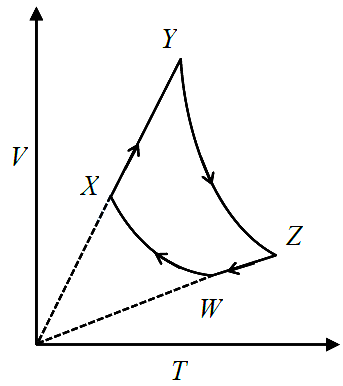
- An ideal monatomic gas of n moles is taken through a cycle \(W X Y Z W\) consisting of consecutive adiabatic and isobaric quasi-static processes, as shown in the schematic \(V-T\) diagram. The volume of the gas at \(W, X\) and \(Y\) points are, \(64 \mathrm{~cm}^3, 125 \mathrm{~cm}^3\) and \(250 \mathrm{~cm}^3\), respectively. If the absolute temperature of the gas \(T_W\) at the point \(W\) is such that \(n R T_W=1 \mathrm{~J}\) ( R is the universal gas constant), then the amount of heat absorbed (in J ) by the gas along the path \(X Y\) is \(\qquad\)
 JEE Advanced 2025 Hard
 - List I contains four combinations of two lenses ( 1 and 2 ) whose focal lengths (in cm ) are indicated in the figures. In all cases, the object is placed 20 cm from the first lens on the left, and the distance between the two lenses is 5 cm . List II contains the positions of the final images.
Which one of the following options is correct?List - I List - II (I) 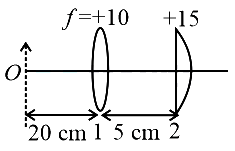
(P) Final image is formed at 7.5 cm on the right side of lens 2. (II) 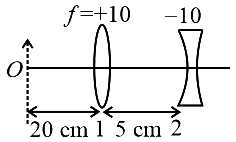
(Q) Final image is formed at 60.0 cm on the right side of lens 2. (III) 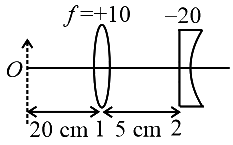
(R) Final image is formed at 30.0 cm on the left side of lens 2. (IV) 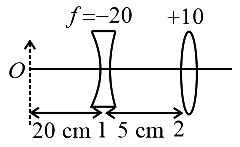
(S) Final image is formed at
6.0 cm on the right side of lens 2.(T) Final image is formed at 30.0 cm on the right side of lens 2. JEE Advanced 2022 Hard
More PYQs from JEE Advanced
- If a chord, which is not a tangent, of the parabola has the equation , and midpoint (h, k), then which of the following is (are) possible value(s) of and ?
JEE Advanced 2017 Easy - \[
\text { Let } M \text { be a } 3 \times 3 \text { matrix satisfying }
\]
\[
M\left[\begin{array}{l}
0 \\
1 \\
0
\end{array}\right]=\left[\begin{array}{c}
-1 \\
2 \\
3
\end{array}\right], M\left[\begin{array}{c}
1 \\
-1 \\
0
\end{array}\right]=\left[\begin{array}{c}
1 \\
1 \\
-1
\end{array}\right] \text { and } M\left[\begin{array}{l}
1 \\
1 \\
1
\end{array}\right]=\left[\begin{array}{c}
0 \\
0 \\
12
\end{array}\right]
\]
Then, the sum of the diagonal entries of \(M\) isJEE Advanced 2011 Easy - Students I, II and III perform an experiment for measuring the acceleration due to gravity \((g)\) using a simple pendulum. They use different lengths of the pendulum and/or record time for different number of oscillations. The observations are shown in the table.
Least count for length \(=0.1 \mathrm{~cm}\)
Least count for time \(=0.1 \mathrm{~s}\)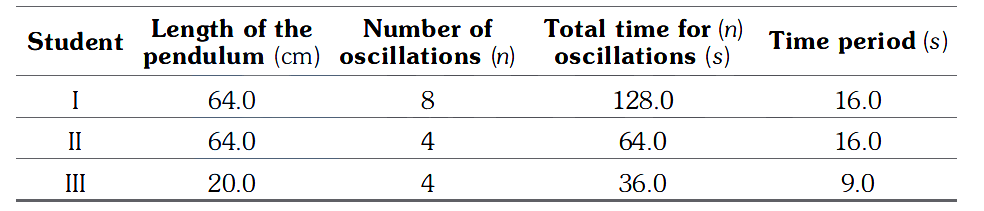
If \(E_{\mathrm{I}}, E_{\mathrm{II}}\) and \(E_{\mathrm{III}}\) are the percentage errors in \(g\), i.e., \(\left(\frac{\Delta g}{g} \times 100\right)\) for students I, II and III, respectively.JEE Advanced 2008 Medium - Paragraph:
Copper is the most noble of the first row transition metals and occurs in small deposits in several countries. Ores of copper include chalcanthite \(\left(\mathrm{CuSO}_4 \cdot 5 \mathrm{H}_2 \mathrm{O}\right)\), atacamite \(\left(\mathrm{Cu}_2 \mathrm{Cl}(\mathrm{OH})_3\right)\), cuprite \(\left(\mathrm{Cu}_2 \mathrm{O}\right)\), copper glance \(\left(\mathrm{Cu}_2 \mathrm{~S}\right)\) and malachite \(\left(\mathrm{Cu}_2(\mathrm{OH})_2 \mathrm{CO}_3\right)\). However, 80\% of the world copper production comes from the ore chalcopyrite \(\left(\mathrm{CuFeS}_2\right)\). The extraction of copper from chalcopyrite involves partial roasting, removal of iron and self-reduction.
Question:
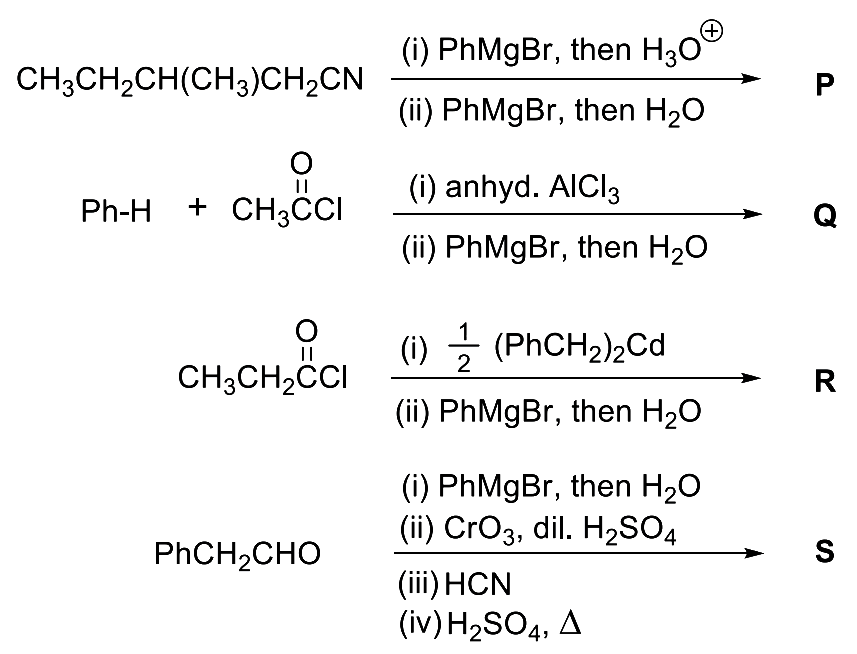
Partial roasting of chalcopyrite producesJEE Advanced 2010 Hard - In the following reactions, P, Q, R and S are the major products.
The correct statement(s) about P, Q, R and S is(are)JEE Advanced 2023 Hard - Electrolysis of dilute aq. \(\mathrm{NaCl}\) solution was carried out by passing \(10 \mathrm{~mA}\) current. The time required to liberate \(0.01\) mole of \(\mathrm{H}_2\) gas at the cathode is (1 Faraday \(=96500 \mathrm{C} \mathrm{mol}^{-1}\) )JEE Advanced 2008 Hard