


JEE Advanced · Physics · 29. Experimental Physics
Students I, II and III perform an experiment for measuring the acceleration due to gravity \((g)\) using a simple pendulum. They use different lengths of the pendulum and/or record time for different number of oscillations. The observations are shown in the table.
Least count for length \(=0.1 \mathrm{~cm}\)
Least count for time \(=0.1 \mathrm{~s}\)
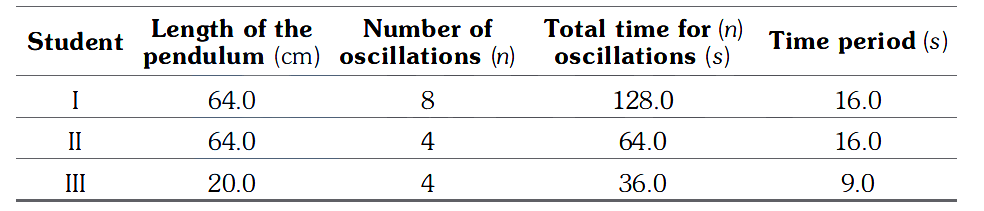
If \(E_{\mathrm{I}}, E_{\mathrm{II}}\) and \(E_{\mathrm{III}}\) are the percentage errors in \(g\), i.e., \(\left(\frac{\Delta g}{g} \times 100\right)\) for students I, II and III, respectively.
- A \(E_{\mathrm{I}}=0\)
- B \(E_{\mathrm{I}}\) is minimum
- C \(E_{\mathrm{I}}=E_{\mathrm{II}}\)
- D \(E_{\mathrm{II}}\) is maximum
Answer & Solution
Correct Answer
(B) \(E_{\mathrm{I}}\) is minimum
Step-by-step Solution
Detailed explanation
\(T =2 \pi \sqrt{\frac{l}{g}} \quad \text { or } \quad \frac{t}{n}=2 \pi \sqrt{\frac{l}{g}} \)
\( \therefore \quad g =\frac{\left(4 \pi^2\right)\left(n^2\right) l}{t^2}\)
\(\%\) error in \(g=\frac{\Delta g}{g} \times 100=\left(\frac{\Delta l}{l}+\frac{2 \cdot \Delta t}{t}\right) \times 100\)
\(E_{\mathrm{I}}=\left(\frac{0.1}{64}+\frac{2 \times 0.1}{128}\right) \times 100=0.3125 \% \)
\( E_{\mathrm{II}}=\left(\frac{0.1}{64}+\frac{2 \times 0.1}{64}\right) \times 100=0.46875 \% \quad\)\(E_{\mathrm{III}}=\left(\frac{0.1}{20}+\frac{2 \times 0.1}{36}\right) \times 100=1.055 \%\)
Hence, \(E_{\mathrm{I}}\) is minimum.
\(\therefore\) correct option is (b).
\( \therefore \quad g =\frac{\left(4 \pi^2\right)\left(n^2\right) l}{t^2}\)
\(\%\) error in \(g=\frac{\Delta g}{g} \times 100=\left(\frac{\Delta l}{l}+\frac{2 \cdot \Delta t}{t}\right) \times 100\)
\(E_{\mathrm{I}}=\left(\frac{0.1}{64}+\frac{2 \times 0.1}{128}\right) \times 100=0.3125 \% \)
\( E_{\mathrm{II}}=\left(\frac{0.1}{64}+\frac{2 \times 0.1}{64}\right) \times 100=0.46875 \% \quad\)\(E_{\mathrm{III}}=\left(\frac{0.1}{20}+\frac{2 \times 0.1}{36}\right) \times 100=1.055 \%\)
Hence, \(E_{\mathrm{I}}\) is minimum.
\(\therefore\) correct option is (b).
See the Complete Solution
Get step-by-step explanations for this and 2.5 Lakh+ more JEE, NEET & CET questions.
- Unlock all solutions
- Practice the full chapter
- Track accuracy across PYQs
4.8 rated on Google Play · 14,000+ reviews
More questions from Physics
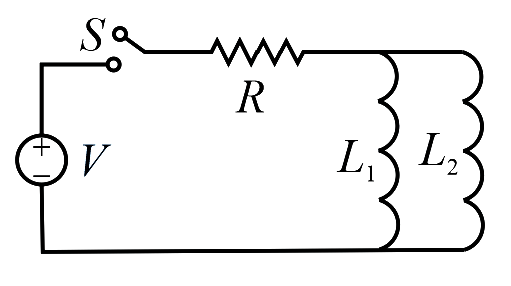
- A source of constant voltage is connected to a resistance and two ideal inductors and through a switch as shown. There is no mutual inductance between the two inductors. The switch is initially open. At , the switch is closed and current begins to flow. Which of the following options is/are correct?
 JEE Advanced 2017 Hard
 - Using the expression , one calculates the values of by measuring the corresponding angle in the range to . The wavelength is exactly known and the error in is constant for all the values of . As increases from ,JEE Advanced 2013 Easy
- An ideal gas is expanding such that \(p T^2=\) constant. The coefficient of volume expansion of the gas isJEE Advanced 2008 Medium
- The circuit shown in the figure contains an inductor \(L\), a capacitor \(C_0\), a resistor \(R_0\) and an ideal battery. The circuit also contains two keys \(\mathrm{K}_1\) and \(\mathrm{K}_2\). Initially, both the keys are open and there is no charge on the capacitor. At an instant, key \(K_1\) is closed and immediately after this the current in \(R_0\) is found to be \(I_1\). After a long time, the current attains a steady state value \(I_2\). Thereafter, \(\mathrm{K}_2\) is closed and simultaneously \(\mathrm{K}_1\) is opened and the voltage across \(C_0\) oscillates with amplitude \(V_0\) and angular frequency \(\omega_0\).
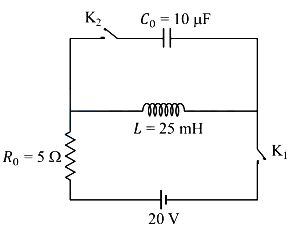
Match the quantities mentioned in List-I with their values in List-II and choose the correct option.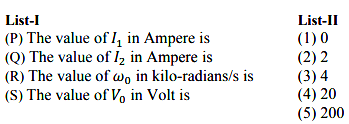 JEE Advanced 2024 Hard
 - A human body has a surface area of approximately . The normal body temperature is above the surrounding room temperature . Take the room temperature to be . For , the value of (where is the Stefan-Boltzmann constant). Which of the following options is/are correct?JEE Advanced 2017 Easy
- A horizontal forceis applied at the centre of mass of a cylindrical object of massand radius, perpendicular to its axis as shown in the figure. The coefficient of friction between the object and the ground is. The centre of mass of the object has an acceleration. The acceleration due to gravity is. Given that the object rolls without slipping, which of the following statement(s) is (are) correct?
 JEE Advanced 2021 Hard
More PYQs from JEE Advanced
- A small object is placed at the centre of a large evacuated hollow spherical container. Assume the container is maintained at . At time , the temperature of the object is . The temperature of the object becomes at and at . Assume the object and the container to be ideal black bodies. The heat capacity of the object does not depend on temperature. The ratio _________ .JEE Advanced 2021 Medium
- Paragraph:
Read the following passage and answer the questions.
Let \(A B C D\) be a square of side length 2 units. \(C_2\) is the circle through vertices \(A, B, C, D\) and \(C_1\) is the circle touching all the sides of square \(A B C D\). \(L\) is the line through \(A\).Question:
A line \(M\) through \(A\) is drawn parallel to \(B D\). Points \(S\) moves such that its distances from the line \(B D\) are the vertex \(A\) are equal. If locus of \(S\) cuts \(M\) at \(T_2\) and \(T_3\) and \(A C\) at \(T_1\), then area of \(\Delta T_1 T_2 T_3\) isJEE Advanced 2006 Medium - For non-negative integers let
Assuming takes values in which of the following options is/are correct?JEE Advanced 2019 Medium - Length, breadth and thickness of a strip having a uniform cross section are measured to be 10.5 cm , 0.05 mm , and \(6.0 \mu \mathrm{~m}\), respectively. Which of the following option(s) give(s) the volume of the strip in \(\mathrm{cm}^3\) with correct significant figures:JEE Advanced 2025 Easy
- Let \(f:(-1,1) \rightarrow I R\) be such that \(f(\cos 4 \theta)=\frac{2}{2-\sec ^{2} \theta}\) for \(\theta \in\left(0, \frac{\pi}{4}\right) \cup\left(\frac{\pi}{4}, \frac{\pi}{2}\right)\). Then the value (s) of \(f\left(\frac{1}{3}\right)\) is (are)JEE Advanced 2012 Medium
- A plano-convex lens is made of a material of refractive index n. When a small object is placed 30 cm away in front of the curved surface of the lens, an image of double the size of the object is produced. Due to reflection from the convex surface of the lens, another faint image is observed at a distance of 10 cm away from the lens. Which of the following statement(s) is (are) true?JEE Advanced 2016 Hard