


JEE Advanced · Chemistry · 2. Atomic Structure
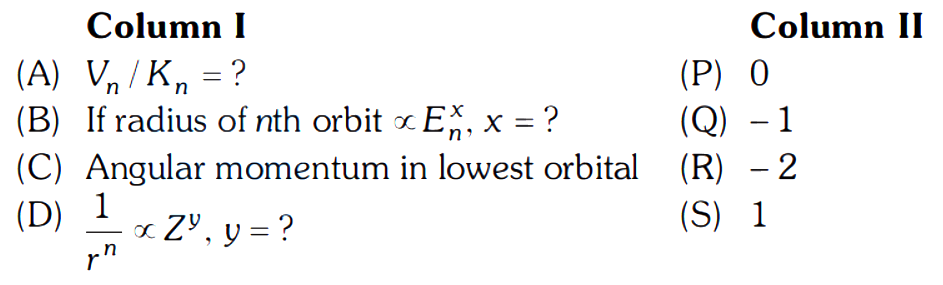
According to Bohr's theory \(E_n=\) Total energy, \(K_n=\) Kinetic energy, \(V_n=\) Potential energy, \(r_n=\) Radius of \(n\)th orbit
- A (A) R, (B) Q, (C) P, (D) Q
- B (A) S, (B) R, (C) R, (D) S
- C (A) R, (B) Q, (C) P, (D) S
- D (A) S, (B) P, (C) R, (D) Q
Answer & Solution
Correct Answer
(C) (A) R, (B) Q, (C) P, (D) S
Step-by-step Solution
Detailed explanation
According to Bohr's theory,
Total energy is \(E_n=K_n+V_n\)
Kinetic energy \(=K_n=\frac{1}{8 \pi \varepsilon_0} \cdot \frac{Z e^2}{r}\)
Potential energy \(=V_n=\frac{1}{4 \pi \varepsilon_0} \cdot \frac{Z e^2}{r}\)
\(\therefore \quad E_n=\frac{1}{8 \pi \varepsilon_0} \cdot \frac{Z e^2}{r}-\frac{1}{4 \pi \varepsilon_0} \cdot \frac{Z e^2}{r}\)
Radius of \(n\)th orbit \(\left(r_n\right)=\frac{n^2 h^2 \varepsilon_0}{\pi m Z e^2}\)
\(E_n=-\frac{m e^4}{8 \varepsilon_0^2 h^2} \times \frac{1}{n^2} \)
(A) \(\frac{V_n}{K_n}=\frac{-\frac{1}{4 \pi \varepsilon_0} \cdot \frac{Z e^2}{r}}{\frac{1}{8 \pi \varepsilon_0} \cdot \frac{Z e^2}{r}}=-2\)
Hence, \((A)\) match with \((R)\).
(B) \(E_n \propto \frac{1}{n^2}\) or \(E_n \propto \frac{1}{r_n}\)
Radius of \(n\)th orbit \(r_n \propto E_n^x\) \(\therefore \quad x=-1\)
Hence, (B) match with (Q).
(C) Angular momentum \(=\frac{h}{2 \pi} \sqrt{l(l+1) l}=0,1,2, \ldots\)
For the lower orbit \(n=1\)
\(\therefore \quad l=0\) and \(m=0\)
Hence, angular momentum of lowest orbit \(=\frac{h}{2 \pi} \sqrt{0(0 H)}=0\)
(C) match with (P)
(D) \(\frac{1}{r^n} \propto Z^y\) as \(r_n \propto \frac{1}{Z} \therefore y=1\)
Hence, (D) match with (S).
Total energy is \(E_n=K_n+V_n\)
Kinetic energy \(=K_n=\frac{1}{8 \pi \varepsilon_0} \cdot \frac{Z e^2}{r}\)
Potential energy \(=V_n=\frac{1}{4 \pi \varepsilon_0} \cdot \frac{Z e^2}{r}\)
\(\therefore \quad E_n=\frac{1}{8 \pi \varepsilon_0} \cdot \frac{Z e^2}{r}-\frac{1}{4 \pi \varepsilon_0} \cdot \frac{Z e^2}{r}\)
Radius of \(n\)th orbit \(\left(r_n\right)=\frac{n^2 h^2 \varepsilon_0}{\pi m Z e^2}\)
\(E_n=-\frac{m e^4}{8 \varepsilon_0^2 h^2} \times \frac{1}{n^2} \)
(A) \(\frac{V_n}{K_n}=\frac{-\frac{1}{4 \pi \varepsilon_0} \cdot \frac{Z e^2}{r}}{\frac{1}{8 \pi \varepsilon_0} \cdot \frac{Z e^2}{r}}=-2\)
Hence, \((A)\) match with \((R)\).
(B) \(E_n \propto \frac{1}{n^2}\) or \(E_n \propto \frac{1}{r_n}\)
Radius of \(n\)th orbit \(r_n \propto E_n^x\) \(\therefore \quad x=-1\)
Hence, (B) match with (Q).
(C) Angular momentum \(=\frac{h}{2 \pi} \sqrt{l(l+1) l}=0,1,2, \ldots\)
For the lower orbit \(n=1\)
\(\therefore \quad l=0\) and \(m=0\)
Hence, angular momentum of lowest orbit \(=\frac{h}{2 \pi} \sqrt{0(0 H)}=0\)
(C) match with (P)
(D) \(\frac{1}{r^n} \propto Z^y\) as \(r_n \propto \frac{1}{Z} \therefore y=1\)
Hence, (D) match with (S).
See the Complete Solution
Get step-by-step explanations for this and 2.5 Lakh+ more JEE, NEET & CET questions.
- Unlock all solutions
- Practice the full chapter
- Track accuracy across PYQs
4.8 rated on Google Play · 14,000+ reviews
More questions from Chemistry
- The stoichiometric reaction of of dimethyldichlorosilane with water results in a tetrameric cyclic product in yield. The weight (in ) of obtained is ____________
\(\left[\right.\)Use, molar mass\(.\left(\text{gmol} ^{-1}\right):\text H =1,\text C =12,\)\(\text O =16, \text{Si} =28, \text{Cl} =35.5]\)JEE Advanced 2023 Hard - Which of the following statement(s) is(are) true?JEE Advanced 2019 Medium
- One mole of an ideal monoatomic gas undergoes two reversible processes and as shown in the given figure:
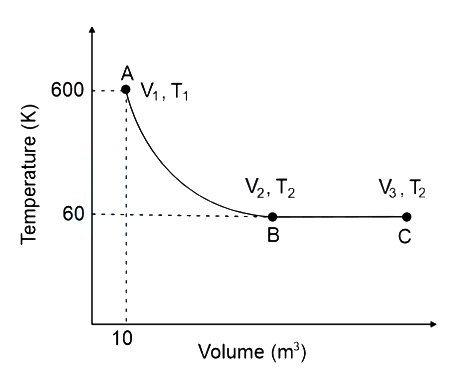
is an adiabatic process. If the total heat absorbed in the entire process and is , the value of is
[Use molar heat capacity of the gas at constant pressure, ]JEE Advanced 2023 Medium - Match the specified conditions in solids listed in Column I with their properties in Column II. Indicate your answer by darkening the appropriate bubbles of the \(4 \times 4\) matrix given in the ORS.
Column I Column II A. Simple cubic and face-centered cubic p. Have these cell parameters \(a=b=c \text { and } \alpha=\beta=\gamma\) B. Cubic and rhombohedral q. Are two crystal systems C. Cubic and tetragonal r. Have only two crystallographic angles of \(90^{\circ}\) D. Hexagonal and monoclinic s. Belong to same crystal system JEE Advanced 2007 Easy - Paragraph:
An aqueous solution of a mixture of two inorganic salts, when treated with dilute \(H C\) ?, gave a precipitate \((\boldsymbol{P})\) and a filtrate \((\boldsymbol{Q})\). The precipitate \(\boldsymbol{P}\) was found to dissolve in hot water. The filtrate \((\boldsymbol{Q})\) remained unchanged, when treated with \(\mathrm{H}_{2} \mathrm{~S}\) in a dilute mineral acid medium. However, it gave a precipitate \((\boldsymbol{R})\) with \(H_{2} S\) in an ammoniacal medium. The precipitate \(\boldsymbol{R}\) gave a coloured solution \((\boldsymbol{S})\), when treated with \(\mathrm{H}_{2} \mathrm{O}_{2}\) in an aqueous \(\mathrm{NaOH}\) medium.
Question:
The coloured solution \(\boldsymbol{S}\) containsJEE Advanced 2013 Medium - The correct statement(s) for the following addition reactions is(are)
 JEE Advanced 2017 Hard
More PYQs from JEE Advanced
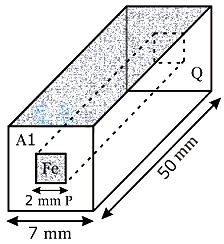
- In an aluminum (Al) bar of square cross section, a square hole is drilled and is filled with iron (Fe) as shown in the figure. The electrical resistivities of Al and Fe are and , respectively. The electrical resistance between the two faces P and Q of the composite bar is
 JEE Advanced 2015 Medium
 - One mole of an ideal gas expands adiabatically from an initial state to final state . Another mole of the same gas expands isothermally from a different initial state to the same final state . The ratio of the specific heats at constant pressure and constant volume of this ideal gas is . What is the ratio ?JEE Advanced 2023 Easy
- With respect to graphite and diamond, which of the statement(s) given below is (are) correct?JEE Advanced 2012 Easy
- The total number of diprotic acids among the following is
\(\begin{array}{lll}\mathrm{H}_3 \mathrm{PO}_4 & \mathrm{H}_2 \mathrm{SO}_4 & \mathrm{H}_3 \mathrm{PO}_3 \\ \mathrm{H}_2 \mathrm{CO}_3 & \mathrm{H}_2 \mathrm{~S}_2 \mathrm{O}_7 & \mathrm{H}_3 \mathrm{BO}_3 \\ \mathrm{H}_3 \mathrm{PO}_2 & \mathrm{H}_2 \mathrm{CrO}_4 & \mathrm{H}_2 \mathrm{SO}_3\end{array}\)JEE Advanced 2010 Hard - Hyperconjugation involves overlap of the following orbitalsJEE Advanced 2008 Easy
- is reduced to by usingJEE Advanced 2015 Easy