


JEE Advanced · Mathematics · 28. Area Under Curves
The area of the region
is
- A
- B
- C
- D
Answer & Solution
Correct Answer
(A)
Step-by-step Solution
Detailed explanation
The region is a quadrilateral Now, area of the quadrilateral area of triangle area of the triangle
See the Complete Solution
Get step-by-step explanations for this and 2.5 Lakh+ more JEE, NEET & CET questions.
- Unlock all solutions
- Practice the full chapter
- Track accuracy across PYQs
4.8 rated on Google Play · 14,000+ reviews
More questions from Mathematics
- Let the vectors \(\mathbf{P Q}, \mathbf{Q R}, \mathbf{R S}, \mathbf{S T}, \mathbf{T U}\) and UP represent the sides of a regular hexagon.
Statement I PQ \(\times(\mathbf{R S}+\mathbf{S T}) \neq \mathbf{0}\)
Statement II \(\mathbf{P Q} \times \mathbf{R S}=\mathbf{0}\) and \(\mathbf{P Q} \times \mathbf{S Q} \neq \mathbf{0}\)JEE Advanced 2007 Medium - Let be given by
Then which of the following options is/are correct?JEE Advanced 2019 Medium - Paragraph:
A fair die is tossed repeatedly until a six is obtained. Let \(X\) denotes the number of tosses required.Question:
The probability that \(X \geq 3\) equalsJEE Advanced 2009 Easy - Paragraph:
Let \(p\) be an odd prime number and \(T_p\) be the following set of \(2 \times 2\) matrices
\[
T_p=\left\{A=\left[\begin{array}{ll}
a & b \\
c & a
\end{array}\right] ; a, b, c \in\{0,1,2, \ldots, p-1\}\right\}
\]Question:
The number of \(A\) in \(T_p\) such that \(A\) is either symmetric or skew-symmetric or both, and det \((A)\) is divisible by \(p\) isJEE Advanced 2010 Hard - Let \(A_n=\left(\frac{3}{4}\right)-\left(\frac{3}{4}\right)^2+\left(\frac{3}{4}\right)^3+\ldots+(-1)^{n-1}\)\(\left(\frac{3}{4}\right)^n\) and \(B_n=1-A_n\). Find a least odd natural number \(n_0\), so that \(B_n>A_n, \forall n \geq n_0\).JEE Advanced 2006 Medium
- The maximum value of the function \(f(x)=2 x^3-15 x^2+36 x-48\) on the set \(A=\left\{x \mid x^2+20 \leq 9 x\right\}\) isJEE Advanced 2009 Hard
More PYQs from JEE Advanced
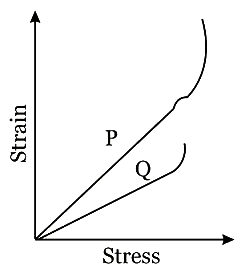
- In plotting stress versus strain curves for two materials \(P\) and \(Q\), a student by mistake puts strain on the \(y\)-axis and stress on the \(x\)-axis as shown in the figure. Then the correct statement(s) is(are)
 JEE Advanced 2015 Medium
 - Paragraph:
The reaction of compound \(\mathbf{P}\) with \(\mathrm{CH}_{3} \mathrm{MgBr}\) (excess) in \(\left(\mathrm{C}_{2} \mathrm{H}_{5}\right)_{2} \mathrm{O}\) followed by addition of \(\mathrm{H}_{2} \mathrm{O}\) gives \(\mathbf{Q}\). The compound \(\mathbf{Q}\) on treatment with \(\mathrm{H}_{2} \mathrm{SO}_{4}\) at \(0^{\circ} \mathrm{C}\) gives \(\mathbf{R}\). The reaction of \(\mathbf{R}\) with \(\mathrm{CH}_{3} \mathrm{COCl}\) in the presence of anhydrous \(\mathrm{AlCl}_{3}\) in \(\mathrm{CH}_{2} \mathrm{Cl}_{2}\) followed by treatment with \(\mathrm{H}_{2} \mathrm{O}\) produces compound \(\mathbf{S}\). [Et in compound \(\mathbf{P}\) is ethyl group]
Question :
The reactions, \(\mathbf{Q}\) to \(\mathbf{R}\) and \(\mathbf{R}\) to \(\mathbf{S}\), areJEE Advanced 2017 Hard - If \(x^2-10 a x-11 b=0\) have roots \(c\) and \(d\) and \(x^2-10 c x-11 d=0\) have roots \(a\) and \(b\), then, find \(a+b+c+d\).JEE Advanced 2006 Hard
- Paragraph :
A uniform thin cylindrical disk of mass \(M\) and radius \(R\) is attached to two identical massless springs of spring constant \(k\) which are fixed to the wall as shown in the figure. The springs are attached to the axle of the disk symmetrically on either side at a distance \(d\) from its centre. The axle is massless and both the springs and the axle are in a horizontal plane. The unstretched length of each spring is \(L\). The disk is initially at its equilibrium position with its centre of mass \((C M)\) at a distance Lfrom the wall. The disk rolls without slipping with velocity \(\mathbf{v}_0=v_0 \hat{\mathbf{i}}\) The coefficient of friction is \(\mu\).
1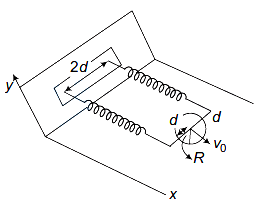
Question :
The centre of mass of the disk undergoes simple harmonic motion with angular frequency \(\omega\) equal toJEE Advanced 2008 Hard - The \(\beta\)-decay process, discovered around 1900 , is basically the decay of a neutron \((n)\). In the laboratory, a proton \((p)\) and an electron \(\left(e^{-}\right)\)are observed as the decay products of the neutron. Therefore, considering the decay of a neutron as a two-body decay process, it was predicted theoretically that the kinetic energy of the electron should be a constant. But experimentally, it was observed that the electron kinetic energy has continuous spectrum. Considering a three-body decay process, i.e.
\(n \rightarrow p+e^{-}+\bar{v}_{e}\), around 1930, Pauli explained the observed electron energy spectrum. Assuming the anti-neutrino \(\left(\bar{v}_{e}\right)\) to be massless and possessing negligible energy, and the neutron to be at rest, momentum and energy conservation principles are applied. From this calculation, the maximum kinetic energy of the electron is \(0.8 \times 10^{6} \mathrm{eV}\). The kinetic energy carried by the proton is only the recoil energy.
Question:
If the anti-neutrino had a mass of \(3 \mathrm{eV} / \mathrm{c}^{2}\) (where \(\mathrm{c}\) is the speed of light) instead of zero mass, what should be the range of the kinetic energy, \(K\), of the electron?JEE Advanced 2012 Hard - When the following aldohexose exists in its D-configuration, the total number of stereoisomers in its pyranose form is :
\(\mathrm{CHO}-\mathrm{CH}_{2}-\mathrm{CHOH}-\mathrm{CHOH}-\mathrm{CHOH}\) \(-~\mathrm{CH}_{2} \mathrm{OH}\)JEE Advanced 2012 Hard