


JEE Advanced · Physics · 28. Nuclear Physics
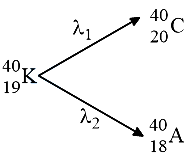
In a radioactive sample, nuclei either decay into stable nuclei with decay constant per year or into stable nuclei with decay constant per year. Given that in this sample all the stable and nuclei are produced by the nuclei only. In time years, if the ratio of the sum of stable and nuclei to the radioactive nuclei is the value of t will be : [Given ]
- A
- B
- C
- D
Answer & Solution
Correct Answer
(D)
Step-by-step Solution
Detailed explanation
Given that, decays in two stable Nuclei. Let there be active nuclei of present at and none of and present of .
Where (decay constant for ) and
(decay constant for )
These form two parallel nuclear reactions.
Equivalent decay consent,
Now, number of active nuclei of left at
And according to Law of Radioactivity,
........(i)
Now, according to question,
Then using equation (i)
\(\Rightarrow \ln 100=\lambda t \Rightarrow t=\frac{2 \ln 10}{\lambda}=\frac{2 \times 2.3}{5 \times 10^{-10}}\) \(=9.2 \times 10^{10}\) years
Where (decay constant for ) and
(decay constant for )
These form two parallel nuclear reactions.
Equivalent decay consent,
Now, number of active nuclei of left at
And according to Law of Radioactivity,
........(i)
Now, according to question,
Then using equation (i)
\(\Rightarrow \ln 100=\lambda t \Rightarrow t=\frac{2 \ln 10}{\lambda}=\frac{2 \times 2.3}{5 \times 10^{-10}}\) \(=9.2 \times 10^{10}\) years
See the Complete Solution
Get step-by-step explanations for this and 2.5 Lakh+ more JEE, NEET & CET questions.
- Unlock all solutions
- Practice the full chapter
- Track accuracy across PYQs
4.8 rated on Google Play · 14,000+ reviews
More questions from Physics
- A particle of mass \(m\) is moving in a circular orbit under the influence of the central force \(F(r)=-k r\), corresponding to the potential energy \(V(r)=k r^2 / 2\), where \(k\) is a positive force constant and \(r\) is the radial distance from the origin. According to the Bohr's quantization rule, the angular momentum of the particle is given by \(L=n \hbar\), where \(\hbar=h /(2 \pi), h\) is the Planck's constant, and \(n\) a positive integer. If \(v\) and \(E\) are the speed and total energy of the particle, respectively, then which of the following expression(s) is(are) correct?JEE Advanced 2024 Medium
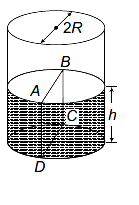
- Water is filled up to a height \(h\) in a beaker of radius \(R\) as shown in the figure. The density of water is \(\rho\), the surface tension of water is \(T\) and the atmospheric pressure is \(p_0\). Consider a vertical section \(A B C D\) of the water column through a diameter of the beaker. The force on water on one side of this section by water on the other side of this section has magnitude.
 JEE Advanced 2007 Hard
 - Two identical non-conducting solid spheres of same mass and charge are suspended in air from a common point by two non-conducting, massless strings of same length. At equilibrium, the angle between the strings is . The spheres are now immersed in a dielectric liquid of density and dielectric constant . If the angle between the strings remains the same after the immersion, thenJEE Advanced 2020 Hard
- The density of a solid ball is to be determined in an experiment. The diameter of the ball is measured with a screw gauge, whose pitch is \(0.5 \mathrm{~mm}\) and there are 50 divisions on the circular scale. The reading on the main scale is \(2.5 \mathrm{~mm}\) and that on the circular scale is 20 divisions. If the measured mass of the ball has a relative error of \(2 \%\), the relative percentage error in the density isJEE Advanced 2011 Medium
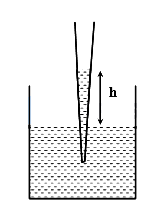
- A glass capillary tube is of the shape of a truncated cone with an apex angle so that its two ends have cross-sections of different radii. When dipped in water vertically, the water rises in it to a height , where the radius of its cross-section is . If the surface tension of water is , its density is , and its contact angle with glass is , then the value of will be ( is the acceleration due to gravity)
 JEE Advanced 2014 Hard
 - Paragraph :
When a particle of mass \(m\) moves on the \(x\)-axis in a potential of the form \(V(x)=k x^2\), it performs simple harmonic motion.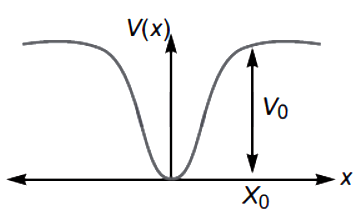
The corresponding time period is proportional to \(\sqrt{\frac{m}{k}}\), as can be seen easily using dimensional analysis. However, the motion of a particle can be periodic even when its potential energy increases on both sides of \(x=0\) in a way different from \(k x^2\) and its total energy is such that the particle does not escape to infinity. Consider a particle of mass \(\mathrm{m}\) moving on the \(x\)-axis. Its potential energy is \(V(x)=\alpha x^4(\alpha>0)\) for \(|x|\) near the origin and becomes a constant equal to \(V_0\) for \(|x| \geq X_0\) (see figure).
Question :
For periodic motion of small amplitude \(A\), the time period \(T\) of this particle is proportional toJEE Advanced 2010 Hard
More PYQs from JEE Advanced
- The value of
\(6+\log _{\frac{3}{2}}\)\(\left(\frac{1}{3 \sqrt{2}} \sqrt{4-\frac{1}{3 \sqrt{2}} \sqrt{4-\frac{1}{3 \sqrt{2}} \sqrt{4-\frac{1}{3 \sqrt{2}}} \cdots}}\right)\) isJEE Advanced 2012 Medium - Amongst the following, the total number of compounds whose aqueous solution turns red litmus paper blue is
\(\begin{array}{llll}
\mathrm{KCN} & \mathrm{K}_2 \mathrm{SO}_4 & \left(\mathrm{NH}_4\right)_2 \mathrm{C}_2 \mathrm{O}_4 & \mathrm{NaCl} \\
\mathrm{Zn}\left(\mathrm{NO}_3\right)_2 & \mathrm{FeCl}_3 & \mathrm{~K}_2 \mathrm{CO}_3 & \mathrm{NH}_4 \mathrm{NO}_3 \\
\mathrm{LiCN} & & &
\end{array}\)JEE Advanced 2010 Hard - Paragraph:
Let \(A, B, C\) be three sets of complex numbers as defined below.
\(A=\{z ; \operatorname{lm} z \geq 1\} ; B=\{z:|z-2-i|=3\} ;\) \(C=\{z: \operatorname{Re}((1-i) z)=\sqrt{2}\}\).
Question:
The number of elements in the set \(A \cap B \cap C\) isJEE Advanced 2008 Hard - Paragraph:
A small block of mass \(M\) moves on a frictionless surface of an inclined plane, as shown in figure. The angle of the incline suddenly changes from \(60^{\circ}\) to \(30^{\circ}\) at point \(B\). The block is initially at rest at \(A\). Assume that collisions between the block and the incline are totally inelastic \(\left(g=10 \mathrm{~m} / \mathrm{s}^2\right)\)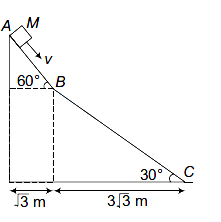
Question:
The speed of the block at point \(C\), immediately before it leaves the second incline isJEE Advanced 2008 Hard - Consider an obtuse angled triangle in which the difference between the largest and the smallest angle is and whose sides are in arithmetic progression. Suppose that the vertices of this triangle lie on a circle of radius .
(There are two questions based on , the question given below is one of them)
Then the inradius of the triangle isJEE Advanced 2023 Medium - The number of structural isomers for \(\mathrm{C}_6 \mathrm{H}_{14}\) isJEE Advanced 2007 Medium