


JEE Advanced · Physics · 27. Atomic Physics
Highly excited states for hydrogen like atoms (also called Rydberg states) with nuclear charge Ze are defined by their principal quantum number n, where n >> 1. Which of the following statement(s) is (are) true?
- A Relative change in the radii of two consecutive orbitals does not depend on Z
- B Relative change in the radii of two consecutive oribitals varies as 1/n
- C Relative change in the energy of two consecutive orbitals varies as 1/
- D Relative change in the angular momenta of two consecutive orbitals varies as 1/n
Answer & Solution
Correct Answer
(A) Relative change in the radii of two consecutive orbitals does not depend on Z
Step-by-step Solution
Detailed explanation
As radius
As energy
As angular momentum
As energy
As angular momentum
See the Complete Solution
Get step-by-step explanations for this and 2.5 Lakh+ more JEE, NEET & CET questions.
- Unlock all solutions
- Practice the full chapter
- Track accuracy across PYQs
4.8 rated on Google Play · 14,000+ reviews
More questions from Physics
- A block of mass another mass , are placed together (see figure) on an inclined plane with angle of inclination . Various values of are given in List I. The coefficient of friction between the block and the plane is always zero. The coefficient of static and dynamic friction between the block and the plane are equal to . In List II expressions for the friction on the block are given. Match the correct expression of the friction in List II with the angles given in List I, and choose the correct option. The acceleration due to gravity is denoted by g.
[Useful information: ]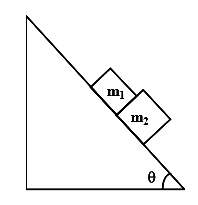
List I List II A. B. C. D. JEE Advanced 2014 Medium - A steel wire of diameter 0.5 mm and Young's modulus \(2 \times 10^{11} Nm ^{-2}\) carries a load of mass M . The length of the wire with the load is 1.0 m . A vernier scale with 10 divisions is attached to the end of this wire. Next to the steel wire is a reference wire to which a main scale, of least count 1.0 mm , is attached. The 10 divisions of the vernier scale correspond to 9 divisions of the main scale. Initially, the zero of vernier scale coincides with the zero of main scale. If the load on the steel wire is increased by \(1.2 k g\), the vernier scale division which coincides with a main scale division is _____________ . Take \(g =10 m s^{-1}\) and \(\pi=3.2\).JEE Advanced 2018 Hard
- To find the distance d over which a signal can be seen clearly in foggy conditions, a railways engineer uses dimensional analysis and assumes that the distance depends on the mass density of the fog, intensity (power/area) S of the light from the signal and its frequency f. The engineer finds that d is proportional to . The value of n isJEE Advanced 2014 Easy
- A biconvex lens of focal length \(f\) forms a circular image of radius \(r\) of sun in focal plane. Then, which option is correct?JEE Advanced 2006 Medium
- Paragraph :
When liquid medicine of density \(\rho\) is to be put in the eye, it is done with the help of a dropper. As the bulb on the top of the dropper is pressed, a drop forms at the opening of the dropper. We wish to estimate the size of the drop.
We first assume that the drop formed at the opening is spherical because that requires a minimum increase in its surface energy. To determine the size, we calculate the net vertical force due to the surface tension \(T\) when the radius of the drop is \(R\). When this force becomes smaller than the weight of the drop, the drop gets detached from the dropper.
Question :
If \(r=5 \times 10^{-4} \mathrm{~m}, \rho=10^3 \mathrm{~kg} \mathrm{~m}^{-3}\), \(g=10 \mathrm{~ms}^{-2}, T=0.11 \mathrm{Nm}^{-1}\), the radius of the drop when it detaches from the dropper is approximatelyJEE Advanced 2010 Easy - Paragraph :
A special metal \(S\) conducts electricity without any resistance. A closed wire loop, made of \(S\), does not allow any change in flux through itself by inducing a suitable current to generate a compensating flux. The induced current in the loop cannot decay due to its zero resistance. This current gives rise to a magnetic moment which in turn repels the source of magnetic field or flux. Consider such a loop, of radius \(a\), with its center at the origin. A magnetic dipole of moment \(m\) is brought along the axis of this loop from infinity to a point at distance \(r(\gg a)\) from the center of the loop with its north pole always facing the loop, as shown in the figure below.
The magnitude of magnetic field of a dipole \(m\), at a point on its axis at distance \(r\), is \(\frac{\mu_{0}}{2 \pi} \frac{m}{r^{3}}\), where \(\mu_{0}\) is the permeability of free space. The magnitude of the force between two magnetic dipoles with moments, \(m_{1}\) and \(m_{2}\), separated by a distance \(r\) on the common axis, with their north poles facing each other, is \(\frac{k m_{1} m_{2}}{r^{4}}\), where \(k\) is a constant of appropriate dimensions. The direction of this force is along the line joining the two dipoles.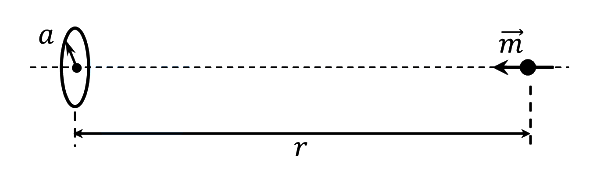
Question :
The work done in bringing the dipole from infinity to a distancefrom the centre of the loop by the given process is proportional to:JEE Advanced 2021 Hard
More PYQs from JEE Advanced
- Columns 1, 2 and 3 contain conics, equations of tangents to the conics and points of contact, respectively.
For , if a tangent is drawn to a suitable conic (Column 1) at the point of contact , then which of the following options is the only Correct combination for obtaining its equation?Column 1 Column 2 Column 3 (I) (i) (P) (II) (ii) (Q) (III) (iii) (R) (IV) (iv) (S) JEE Advanced 2017 Hard - If \(|z|=1\) and \(z \neq \pm 1\), then all the values of \(\frac{z}{1-z^2}\) lie onJEE Advanced 2007 Medium
- List-I shows four configurations, each consisting of a pair of ideal electric dipoles. Each dipole has a dipole moment of magnitude \(p\), oriented as marked by arrows in the figures. In all the configurations the dipoles are fixed such that they are at a distance \(2 r\) apart along the \(x\) direction. The midpoint of the line joining the two dipoles is \(X\). The possible resultant electric fields \(\vec{E}\) at \(X\) are given in List-II. Choose the option that describes the correct match between the entries in List-I to those in List-II.
List-I List-II \((P)\) 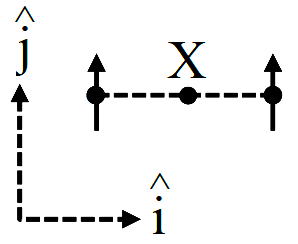
\((1)\) \(\vec{E}=0\) \((Q)\) 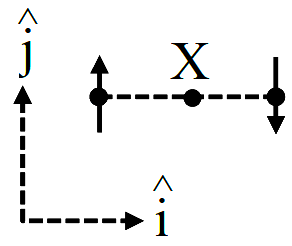
\((2)\) \(\vec{E}=-\frac{p}{2 \pi \epsilon_0 \mathrm{r}^3} \hat{\mathrm{j}}\) \((R)\) 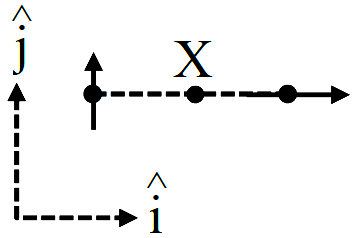
\((3)\) \(\vec{E}=-\frac{p}{4 \pi \epsilon_0 \mathrm{r}^3}(\hat{\mathrm{i}}-\hat{\mathrm{j}})\) \((S)\) 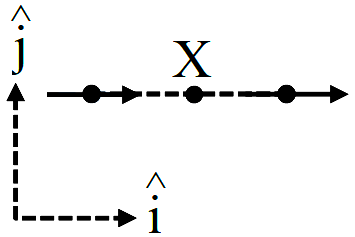
\((4)\) \(\vec{E}=\frac{p}{4 \pi \epsilon_0 \mathrm{r}^3}(2 \hat{\mathrm{i}}-\hat{\mathrm{j}})\) \((5)\) \(\vec{E}=\frac{p}{\pi \epsilon_0 \mathrm{r}^3} \hat{\mathrm{i}}\) JEE Advanced 2025 Hard - After completion of the reactions (I and II), the organic compound(s) in the reaction mixtures is(are):
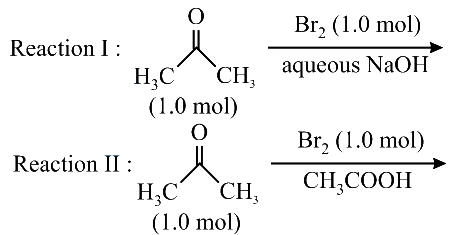
 JEE Advanced 2013 Hard
 - In the scheme given below, the total number of intramolecular aldol condensation products formed from ' \(Y\) ' is
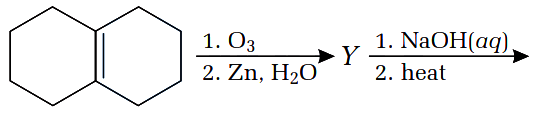 JEE Advanced 2010 Hard
 - The compound (s) that exhibit (s) geometrical isomerism is (are)JEE Advanced 2009 Easy