


JEE Advanced · Physics · 21. EMI
A conducting square loop of side \(L\), mass \(M\) and resistance \(R\) is moving in the \(X Y\) plane with its edges parallel to the \(X\) and \(Y\) axes. The region \(y \geq 0\) has a uniform magnetic field, \(\vec{B}=B_0 k\). The magnetic field is zero everywhere else. At time \(t=0\), the loop starts to enter the magnetic field with an initial velocity \(v_0 \hat{\jmath} \mathrm{~m} / \mathrm{s}\), as shown in the figure. Considering the quantity \(K=\frac{B_0^2 L^2}{R M}\) in appropriate units, ignoring self-inductance of the loop and gravity, which of the following statements is/are correct:
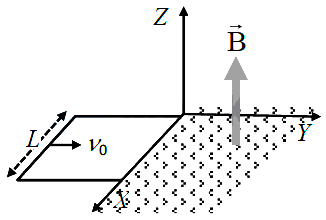
- A If \(v_0=1.5 K L\), the loop will stop before it enters completely inside the region of magnetic field.
- B When the complete loop is inside the region of magnetic field, the net force acting on the loop is zero.
- C If \(v_0=\frac{K L}{10}\), the loop comes to rest at \(t=\left(\frac{1}{K}\right) \ln \left(\frac{5}{2}\right)\).
- D If \(v_0=3 K L\), the complete loop enters inside the region of magnetic field at time \(t=\left(\frac{1}{K}\right) \ln \left(\frac{3}{2}\right)\).
Answer & Solution
Correct Answer
(D) If \(v_0=3 K L\), the complete loop enters inside the region of magnetic field at time \(t=\left(\frac{1}{K}\right) \ln \left(\frac{3}{2}\right)\).
Step-by-step Solution
Detailed explanation
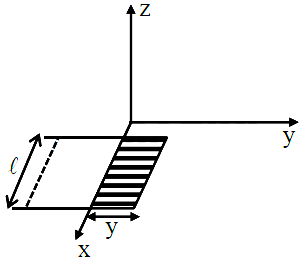
\(\Rightarrow \frac{-\mathrm{d} \phi}{\mathrm{dt}}=\frac{\mathrm{d}}{\mathrm{dt}}\left(\mathrm{B}_0 \times \ell \times \mathrm{y}\right)=\mathrm{BV} \ell\)
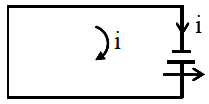
\(\begin{aligned} & \overrightarrow{\mathrm{F}}=\mathrm{B}(\hat{\mathrm{i}})(\ell)(-\hat{\mathrm{j}}) \\ & \mathrm{ma}=-\mathrm{B}_0\left[\frac{\mathrm{~B}_0 \mathrm{~V} \ell}{\mathrm{R}}\right](\ell) \\ & \mathrm{a}=-\frac{\mathrm{B}_0^2 \ell^2 \mathrm{~V}}{\mathrm{mR}}\end{aligned}\)
\(\begin{aligned} & \text { Also } K=\frac{B_0^2 \ell^2 V}{R M} \\ & \text { So }[a=-k v] \\ & \frac{d v}{d t}=-k v \\ & \int_{v_0}^v \frac{d v}{d t}=\int_0^t-k d t \\ & \ell n \frac{v}{v_0}=-k t\end{aligned}\)
\(\left[\mathrm{v}=\mathrm{v}_0 \mathrm{e}^{-\mathrm{kt}}\right]\) \(\left[\mathrm{v}=\mathrm{v}_0 \mathrm{e}^{-\mathrm{kt}}\right]\) \(\ldots .(\mathrm{i})\)
\(\frac{\mathrm{dx}}{\mathrm{dt}}=\mathrm{v}_0 \mathrm{e}^{-\mathrm{kt}} \quad(\mathrm{x} \leq \ell)\)
\(\begin{aligned} & \int_0^{\mathrm{x}} \mathrm{dx}=\int_0^{\mathrm{t}} \mathrm{v}_0 \mathrm{e}^{-\mathrm{kt}} \mathrm{dt} \\ & =\frac{\mathrm{v}_0}{\mathrm{k}}\left(1-\mathrm{e}^{-\mathrm{kt}}\right)\end{aligned}\)
When \(x=\ell\)
\(\ell=\frac{\mathrm{V}_0}{\mathrm{k}}\left(1-\mathrm{e}^{-\mathrm{kt}}\right)\)
Option (D) \(\left(\mathrm{v}_0=3 \mathrm{k} \ell\right)\)
\(\begin{aligned} & \ell=\frac{3 \mathrm{k} \ell}{\mathrm{k}}\left(1-\mathrm{e}^{-\mathrm{kt}}\right) \\ & \frac{1}{3}=1-\mathrm{e}^{-\mathrm{kt}} \\ & \mathrm{f} \frac{2}{3}=2 \mathrm{e}^{-\mathrm{kt}} \\ & -\mathrm{kt}=8 \mathrm{n}\left(\frac{2}{3}\right) \\ & \mathrm{t}=\frac{1}{\mathrm{k}} \ell \mathrm{n}\left(\frac{2}{3}\right)\end{aligned}\)
Complete loop will enter at \(\mathrm{t}=\frac{1}{\mathrm{k}} \ln \left(\frac{2}{3}\right)\)
Option (B)
\(\frac{\mathrm{d} \phi}{\mathrm{dt}}=0, \underline{\underline{\mathrm{e}}}=0, \mathrm{i}=0, \mathrm{~F}=0\)
Ans. B,D)
See the Complete Solution
Get step-by-step explanations for this and 2.5 Lakh+ more JEE, NEET & CET questions.
- Unlock all solutions
- Practice the full chapter
- Track accuracy across PYQs
4.8 rated on Google Play · 14,000+ reviews
More questions from Physics
- An annular disk of mass , inner radius and outer radius is placed on a horizontal surface with coefficient of friction , as shown in the figure. At some time, an impulse is applied at a height above the center of the disk. If then the disk rolls without slipping along the -axis. Which of the following statement(s) is(are) correct?
 JEE Advanced 2023 Hard
 - A string of length and mass is under tension . When the string vibrates, two successive harmonics are found to occur at frequencies and . The value of tension is _____ newton.JEE Advanced 2023 Easy
- A block of mass M has a circular cut with a frictionless surface as shown. The block rests on the horizontal frictionless surface of a fixed table. Initially the right edge of the block is at , in a coordinate system fixed to the table. A point mass m is released from rest at the topmost point of the path as shown and it slides down. When the mass loses contact with the block its position is x and velocity is v. At that instant which of the following options is correct?
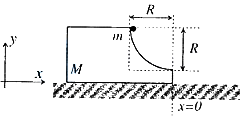 JEE Advanced 2017 Easy
 - Paragraph:
Light guidance in an optical fiber can be understood by considering a structure comprising of thin solid glass cylinder of refractive index \(n_{1}\) surrounded by a medium of lower refractive index \(n_{2}\). The light guidance in the structure takes place due to successive total internal reflections at the interface of the media \(n_{1}\) and \(n_{2}\) as shown in the figure. All rays with the angle of incidence \(i\) less than a particular value \(i_{m}\) are confined in the medium of refractive index \(n_{1}\). The numerical aperture (NA) of the structure is defined as \(\sin i_{m}\).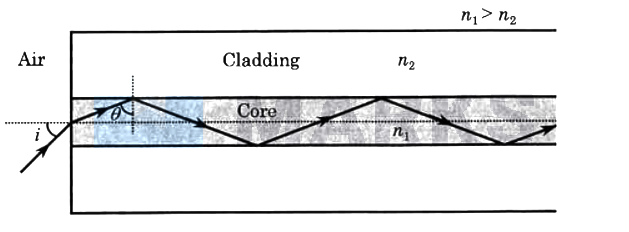
Question:
If two structures of same cross-sectional area, but different numerical apertures \(N A_{1}\) and \(N A_{2}\left(N A_{2} < N A_{1}\right)\) are joined longitudinally, the numerical aperture of the combined structure isJEE Advanced 2015 Medium - A planar structure of length and width is made of two different optical media of refractive indices and as shown in figure. If a ray entering from end will emerge from end only if the total internal reflection condition is met inside the structure. For if the incident angle is varied, the maximum time taken by a ray to exit the plane is where is ____.
[Speed of light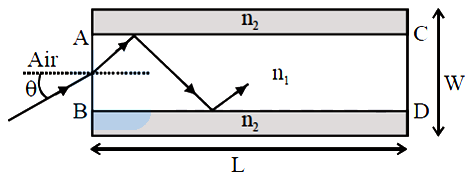 JEE Advanced 2019 Medium
 - In the circuit shown, initially there is no charge on capacitors and keys and are open. The values of the capacitors are and
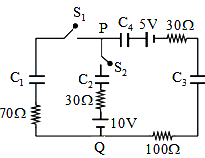
Which of the statement(s) is/are correct?JEE Advanced 2019 Hard
More PYQs from JEE Advanced
- For the following electrochemical cell at
\(\operatorname{Pt}( s ) \mid H _2(g, 1\) bar \() \mid H ^{+}( aq , 1 M ) \| M ^{4+}(\) aq. \(), M ^{2+}(\) aq. \() \mid \operatorname{Pt}( s )\)
when
Given:
The value of is -JEE Advanced 2016 Medium - Let \(\omega \neq 1\) be a cube root of unity and \(S\) be the set of all non-singular matrices of the form \(\left[\begin{array}{ccc}1 & a & b \\ \omega & 1 & c \\ \omega^2 & \omega & 1\end{array}\right]\), where each of \(a, b\) and \(c\) is either \(\omega\) or \(\omega^2\). Then, the number of distinct matrices in the set \(S\) isJEE Advanced 2011 Easy
- For (the set of all real numbers), , Then a =JEE Advanced 2013 Hard
- Complete reaction of acetaldehyde with excess formaldehyde, upon heating with conc. \(\mathrm{NaOH}\) solution, gives \(\mathbf{P}\) and \(\mathbf{Q}\). Compound \(\mathbf{P}\) does not give Tollens' test, whereas \(\mathbf{Q}\) on acidification gives positive Tollens' test. Treatment of \(\mathbf{P}\) with excess cyclohexanone in the presence of catalytic amount of \(p\)-toluenesulfonic acid (PTSA) gives product \(\mathbf{R}\).
Sum of the number of methylene groups \(\left(-\mathrm{CH}_2-\right)\) and oxygen atoms in \(\mathbf{R}\) is ________.JEE Advanced 2024 Medium - Aqueous solutions of \(\mathrm{HNO}_3, \mathrm{KOH}\), \(\mathrm{CH}_3 \mathrm{COOH}\), and \(\mathrm{CH}_3 \mathrm{COONa}\) of identical concentrations are provided. The pair(s) of solutions which form a buffer upon mixing is(are)JEE Advanced 2010 Medium
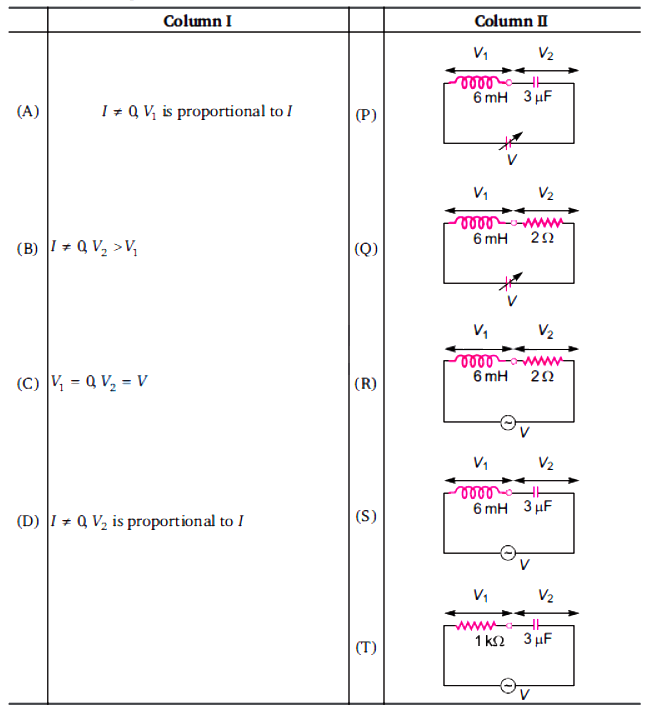
- You are given many resistances, capacitors and inductors. These are connected to a variable DC voltage source (the first two circuits) or an AC voltage source of \(50 \mathrm{~Hz}\) frequency (the next three circuits) in different ways as shown in Column II. When a current \(I\) (steady state for DC or rms for \(A C\) ) flows through the circuit, the corresponding voltage \(V_1\) and \(V_2\) (indicated in circuits) are related as shown in Column I. Match the two
 JEE Advanced 2010 Hard