


JEE Advanced · Mathematics · 25. AOD
Let the function \(f: \mathbb{R} \rightarrow \mathbb{R}\) be defined by
\(f(x)=\frac{\sin x}{e^{\pi x}} \frac{\left(x^{2023}+2024 x+2025\right)}{\left(x^2-x+3\right)}+\frac{2}{e^{\pi x}} \frac{\left(x^{2023}+2024 x+2025\right)}{\left(x^2-x+3\right)}\).
Then the number of solutions of \(f(x)=0\) in \(\mathbb{R}\) is
- A 5
- B 3
- C 1
- D 9
Answer & Solution
Correct Answer
(C) 1
Step-by-step Solution
Detailed explanation
\(f(x)=\frac{\left(x^{2023}+2024 x+2025\right)}{e^{\pi x}\left(x^2-x+3\right)}(\sin x+2)\)
\(\because(\sin x+2)\) is never zero
\(\therefore\) for \(x^{2023}+2024 x+2025=0\)
\(\begin{aligned} & \text { let } \phi(\mathrm{x})=\mathrm{x}^{2023}+2024 \mathrm{x}+2025 \\ & \phi^{\prime}(\mathrm{x})=2023 \mathrm{x}^{2022}+2024>0 \forall \mathrm{x} \in \mathrm{R}\end{aligned}\)
\(\therefore \phi(\mathrm{x})\) is an Strictly Increasing function
\(\therefore \phi(\mathrm{x})=0\) for exactly one value of \(\mathrm{x}\)
\(\therefore \mathrm{f}(\mathrm{x})=0\) has one solution
\(\because(\sin x+2)\) is never zero
\(\therefore\) for \(x^{2023}+2024 x+2025=0\)
\(\begin{aligned} & \text { let } \phi(\mathrm{x})=\mathrm{x}^{2023}+2024 \mathrm{x}+2025 \\ & \phi^{\prime}(\mathrm{x})=2023 \mathrm{x}^{2022}+2024>0 \forall \mathrm{x} \in \mathrm{R}\end{aligned}\)
\(\therefore \phi(\mathrm{x})\) is an Strictly Increasing function
\(\therefore \phi(\mathrm{x})=0\) for exactly one value of \(\mathrm{x}\)
\(\therefore \mathrm{f}(\mathrm{x})=0\) has one solution
See the Complete Solution
Get step-by-step explanations for this and 2.5 Lakh+ more JEE, NEET & CET questions.
- Unlock all solutions
- Practice the full chapter
- Track accuracy across PYQs
4.8 rated on Google Play · 14,000+ reviews
More questions from Mathematics
- If the line divides the area of the region into two equal parts, thenJEE Advanced 2017 Medium
- Columns 1, 2 and 3 contain conics, equations of tangents to the conics and points of contact, respectively.
The tangent to a suitable conic (Column 1) at is found to be , then which of the following options is the only Correct combination?Column 1 Column 2 Column 3 (I) (i) (P) (II) (ii) (Q) (III) (iii) (R) (IV) (iv) (S) JEE Advanced 2017 Hard - Paragraph:
Let \(A, B, C\) be three sets of complex numbers as defined below.
\(A=\{z ; \operatorname{lm} z \geq 1\} ; B=\{z:|z-2-i|=3\} ;\) \(C=\{z: \operatorname{Re}((1-i) z)=\sqrt{2}\}\).
Question:
Let \(z\) be any point in \(A \cap B \cap C\). The \(|z+1-i|^2+|z-5-i|^2\) lies betweenJEE Advanced 2008 Easy - Lines \(L_1: y-x=0\) and \(L_2: 2 x+y=0\) intersect the line \(L_3: y+2=0\) at \(P\) and \(Q\), respectively. The bisector of the acute angle between \(L_1\) and \(L_2\) intersects \(L_3\) at \(R\).
Statement I The ratio \(P R: R Q\) equals \(2 \sqrt{2}: \sqrt{5}\).
Statement II In any triangle, bisector of an angle divides the triangle into two similar triangles.JEE Advanced 2007 Medium - Let and be functions defined by
(i)
(ii) , where the inverse trigonometric function assumes values in
(iii) , where, for denotes the greatest integer less than or equal to ,
(iv)
The correct option is :LIST-I LIST-II A. the function is P. NOT continuous at B. The function is Q. continuous at and NOT differentiable at C. The function is R. differentiable at and its derivative is NOT continuous at D. The function is S. differentiable at and its derivative is continuous at JEE Advanced 2018 Medium - Paragraph:
Let \(M=\left\{(x, y) \in \mathbb{R} \times \mathbb{R}: x^{2}+y^{2} \leq r^{2}\right\}\),
where \(r>0 .\) Consider the geometric progression \(a_{n}=\frac{1}{2^{n-1}}, n=1,2,3, \ldots .\) Let \(S_{0}=0\) and, for \(n \geq 1\), let \(S_{n}\) denote the sum of the first \(n\) terms of this progression. For \(n \geq 1\), let \(C_{n}\) denote the circle with center \(\left(S_{n-1}, 0\right)\) and radius \(a_{n}\), and \(D_{n}\) denote the circle with center \(\left(S_{n-1}, S_{n-1}\right)\) and radius \(a_{n}\).
Question:
Consider \(M\) with \(r=\frac{\left(2^{199}-1\right) \sqrt{2}}{2^{198}} .\) The number of all those circles \(D_{n}\) that are inside \(M\) isJEE Advanced 2021 Medium
More PYQs from JEE Advanced
- Molar volume \(\left(V_m\right)\) of a van der Waals gas can be calculated by expressing the van der Waals equation as a cubic equation with \(V_m\) as the variable. The ratio (in \(\mathrm{mol} \mathrm{dm}^{-3}\) ) of the coefficient of \(V_m^2\) to the coefficient of \(V_m\) for a gas having van der Waals constants \(a=6.0 \mathrm{dm}^6 \mathrm{~atm} \mathrm{~mol}^{-2}\) and \(b=0.060 \mathrm{dm}^3 \mathrm{~mol}^{-1}\) at 300 K and 300 atm is _____ .
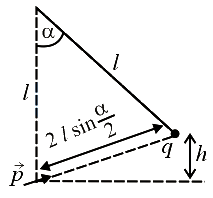
Use: Universal gas constant \((R)=0.082 \mathrm{dm}^3 \mathrm{~atm} \mathrm{~mol}{ }^{-1} \mathrm{~K}^{-1}\)JEE Advanced 2025 Easy - A point charge of mass is suspended vertically by a string of length A point dipole of dipole moment is now brought towards from infinity so that the charge moves away. The final equilibrium position of the system including the direction of the dipole, the angles and distances is shown in the figure below. If the work done in bringing the dipole to this position is , where is the acceleration due to gravity, then the value of is ____________ (Note that for three coplanar forces keeping a point mass in equilibrium, is the same for all forces, where is any one of the forces and is the angle between the other two forces)
 JEE Advanced 2020 Hard
 - Which one of the following statement is WRONG in the context of X-rays generated from X-ray tube?JEE Advanced 2008 Hard
- Paragraph:
An aqueous solution of a mixture of two inorganic salts, when treated with dilute \(H C\) ?, gave a precipitate \((\boldsymbol{P})\) and a filtrate \((\boldsymbol{Q})\). The precipitate \(\boldsymbol{P}\) was found to dissolve in hot water. The filtrate \((\boldsymbol{Q})\) remained unchanged, when treated with \(\mathrm{H}_{2} \mathrm{~S}\) in a dilute mineral acid medium. However, it gave a precipitate \((\boldsymbol{R})\) with \(H_{2} S\) in an ammoniacal medium. The precipitate \(\boldsymbol{R}\) gave a coloured solution \((\boldsymbol{S})\), when treated with \(\mathrm{H}_{2} \mathrm{O}_{2}\) in an aqueous \(\mathrm{NaOH}\) medium.
Question:
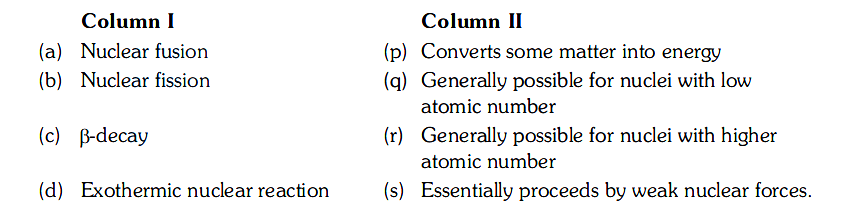
The coloured solution \(\boldsymbol{S}\) containsJEE Advanced 2013 Medium - Match the following columns
 JEE Advanced 2006 Medium
 - Let and be real numbers such that and . If the complex number satisfies then which of the following is (are) possible value (s) ofJEE Advanced 2017 Medium