


JEE Advanced · Mathematics · 2. Quadratic Equations
Paragraph:
Let \(p, q\) be integers and let \(\alpha, \beta\) be the roots of the equation, \(x^{2}-x-1=0\), where \(\alpha \neq \beta\). For \(n=0,1,2, \ldots\), let \(a_{n}=p \alpha^{n}+q \beta^{n}\)
FACT: If \(a\) and \(b\) are rational numbers and \(a+b \sqrt{5}=0\), then \(a=0=b\).
Question:
If \(a_{4}=28\), then \(p+2 q=\)
- A
- B
- C
- D
Answer & Solution
Correct Answer
(C)
Step-by-step Solution
Detailed explanation
\(\therefore a_4=28 \Rightarrow p \alpha^4\) \(+~q \beta^4=p(3 \alpha+2)+q(3 \beta+2)=28\)
\(\Rightarrow p(3 \alpha+2)+q(3-3 \alpha+2)=28\)
\(\Rightarrow \alpha(3 p-3 q)+2 p+5 q=28 \quad\) (as \(\alpha \in Q^c\) ) (as it is root of quadratic equation)
\(\Rightarrow p=q, 2 p+5 q=28 \Rightarrow p=q=4\)
\(\therefore p+2 q=12\)
See the Complete Solution
Get step-by-step explanations for this and 2.5 Lakh+ more JEE, NEET & CET questions.
- Unlock all solutions
- Practice the full chapter
- Track accuracy across PYQs
4.8 rated on Google Play · 14,000+ reviews
More questions from Mathematics
- Circle(s) touching -axis at a distance from the origin and having an intercept of length on -axis is (are)JEE Advanced 2013 Easy
- Let and be functions satisfying for all If then which of the following statements is/are TRUE?JEE Advanced 2020 Hard
- Let be non-zero real numbers that are, respectively, the and terms of a harmonic progression. Consider the system of linear equations
The correct option is:List- List- If , then the system of linear equations has as a solution If , then the system of linear equations has as a solution If , then the system of linear equations has infinitely many solutions If , then the system of linear equations has no solution at least one solution JEE Advanced 2022 Medium - If \(e_1\) is the eccentricity of the ellipse \(\frac{x^2}{16}+\frac{y^2}{25}=1\) and \(e_2\) is the eccentricity of the hyperbola passing through the focii of the ellipse and \(e_1 e_2=1\), then equation of the hyperbola isJEE Advanced 2006 Easy
- Let \(I=\int \frac{e^x}{e^{4 x}+e^{2 x}+1} d x, J=\int \frac{e^{-x}}{e^{-4 x}+e^{-2 x}+1} d x\).
Then, for an arbitrary constant \(C\), the value of \(J-I\) equalsJEE Advanced 2008 Easy - For \(r=0,1, \ldots, 10\), let \(A_r, B_r\) and \(C_r\) denote, respectively, the coefficient of \(x^r\) in the expansions of \((1+x)^{10}\), \((1+x)^{20}\) and \((1+x)^{30}\). Then \(\sum_{r=1}^{10} A_r\left(B_{10} B_r-C_{10} A_r\right)\) is equal toJEE Advanced 2010 Medium
More PYQs from JEE Advanced
- A number is chosen at random from the set . Let be the probability that the chosen number is a multiple of 3 or . Then the value of is ____.JEE Advanced 2021 Easy
- A particle of mass is moving in the -plane such that its velocity at a point is given as where is a non-zero constant. What is the force acting on the particle?JEE Advanced 2023 Hard
- The total number(s) of stable conformers with non-zero dipole moment for the following compound is(are)
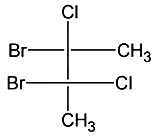 JEE Advanced 2014 Hard
 - An aqueous solution of X is added slowly to an aqueous solution of Y as shown in List I. The variation in conductivity of these reactions is given in List II. Match List I with List II and select the correct using answer the code given below the lists :
List - I List - II a. \(\underset{\quad\quad~~ X }{( C _2 H _5)_3 N}+\underset{ Y }{CH _3 COOH}\) p. Conductivity decreases and then increases b. \(\underset{\quad\quad~~ X }{KI (0.1 M )}+\underset{ Y }{AgNO _3(0.01 M )}\) q. Conductivity decreases and then does not change much c. \(\underset{\text X }{CH _3 COOH}+\underset{\text Y }{KOH}\) r. Conductivity increases and then
does not change muchd. \(\underset{\text X }{NaOH}+\underset{\text Y }{HI}\) s. Conductivity does not change much and
then increasesJEE Advanced 2013 Medium - A train moving with a uniform velocity of approaches another train standing on a platform. An observer moves with a uniform velocity of towards as shown in figure. Both the trains are blowing whistles of same frequency When is away from and distance between and is the number of beats heard by is____
[Speed of the sound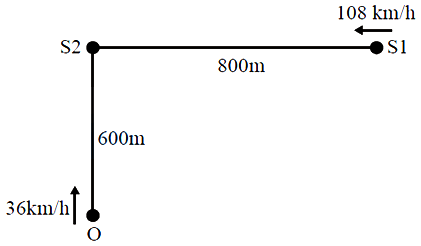 JEE Advanced 2019 Hard
 - Let . Then Sn can take value(s)JEE Advanced 2013 Hard