


JEE Advanced · Mathematics · 6. Binomial Theorem
For \(r=0,1, \ldots, 10\), let \(A_r, B_r\) and \(C_r\) denote, respectively, the coefficient of \(x^r\) in the expansions of \((1+x)^{10}\), \((1+x)^{20}\) and \((1+x)^{30}\). Then \(\sum_{r=1}^{10} A_r\left(B_{10} B_r-C_{10} A_r\right)\) is equal to
- A \(B_{10}-C_{10}\)
- B \(A_{10}\left(B_{10}^2-C_{10} A_{10}\right)\)
- C \(0\)
- D \(C_{10}-B_{10}\)
Answer & Solution
Correct Answer
(D) \(C_{10}-B_{10}\)
Step-by-step Solution
Detailed explanation
\(A_r=\) Coefficient of \(x^r\) in
\((1+x)^{10}={ }^{10} C_r \)
\( B_r=\text { Coefficient of } x^r \text { in } \)
\( (1+x)^{20}={ }^{20} C_r \)
\( C_r=\text { Coefficient of } x^r \text { in } \)
\( (1+x))^{30}={ }^{30} C_r \)
\( \therefore \sum_{r=1}^{10} A_r\left(B_{10} B_r-C_{10} A_r\right) \)
\( =\sum_{r=1}^{10} A_r B_{10} B_r-\sum_{r=1}^{10} A_r C_{10} A_r \)
\( =\sum_{r=1}^{10}{ }^{10} C_r{ }^{20} C_{10}{ }^{20} C_r \)
\( -\sum_{r=1}^{10}{ }^{10} C_r{ }^{30} C_{10}{ }^{10} C_r \)
\( =\sum_{r=1}^{10}{ }^{10} C_{10-r}{ }^{20} C_{10}{ }^{20} C_r \)
\( -\sum_{r=1}^{10}{ }^{10} C_{10-r}{ }^{30} C_{10}{ }^{10} C_r \)
\(={ }^{20} C_{10} \sum_{r=1}^{10}{ }^{10} C_{10-r} \cdot{ }^{20} C_r \)
\( -{ }^{30} C_{10} \sum_{r=1}^{10}{ }^{10} C_{10-r}{ }^{10} C_r \)
\( ={ }^{20} C_{10}\left({ }^{30} C_{10}-1\right)-{ }^{30} C_{10}\left({ }^{20} C_{10}-1\right) \)
\( ={ }^{30} C_{10}-{ }^{20} C_{10}=C_{10}-B_{10}\)
\((1+x)^{10}={ }^{10} C_r \)
\( B_r=\text { Coefficient of } x^r \text { in } \)
\( (1+x)^{20}={ }^{20} C_r \)
\( C_r=\text { Coefficient of } x^r \text { in } \)
\( (1+x))^{30}={ }^{30} C_r \)
\( \therefore \sum_{r=1}^{10} A_r\left(B_{10} B_r-C_{10} A_r\right) \)
\( =\sum_{r=1}^{10} A_r B_{10} B_r-\sum_{r=1}^{10} A_r C_{10} A_r \)
\( =\sum_{r=1}^{10}{ }^{10} C_r{ }^{20} C_{10}{ }^{20} C_r \)
\( -\sum_{r=1}^{10}{ }^{10} C_r{ }^{30} C_{10}{ }^{10} C_r \)
\( =\sum_{r=1}^{10}{ }^{10} C_{10-r}{ }^{20} C_{10}{ }^{20} C_r \)
\( -\sum_{r=1}^{10}{ }^{10} C_{10-r}{ }^{30} C_{10}{ }^{10} C_r \)
\(={ }^{20} C_{10} \sum_{r=1}^{10}{ }^{10} C_{10-r} \cdot{ }^{20} C_r \)
\( -{ }^{30} C_{10} \sum_{r=1}^{10}{ }^{10} C_{10-r}{ }^{10} C_r \)
\( ={ }^{20} C_{10}\left({ }^{30} C_{10}-1\right)-{ }^{30} C_{10}\left({ }^{20} C_{10}-1\right) \)
\( ={ }^{30} C_{10}-{ }^{20} C_{10}=C_{10}-B_{10}\)
See the Complete Solution
Get step-by-step explanations for this and 2.5 Lakh+ more JEE, NEET & CET questions.
- Unlock all solutions
- Practice the full chapter
- Track accuracy across PYQs
4.8 rated on Google Play · 14,000+ reviews
More questions from Mathematics
- Let
Let be all the points of local maximum of and be all the points of local minimum of
Then which of the following options is/are correct?JEE Advanced 2019 Hard - Let \(I=\left(\begin{array}{ll}1 & 0 \\ 0 & 1\end{array}\right)\) and \(P=\left(\begin{array}{ll}2 & 0 \\ 0 & 3\end{array}\right)\). Let \(Q=\left(\begin{array}{ll}\mathrm{x} & \mathrm{y} \\ \mathrm{z} & 4\end{array}\right)\) for some non-zero real numbers \(x, y\), and \(z\), for which there is \(2 \times 2\) matrix \(R\) with all entries being non-zero real numbers, such that \(Q R=R P\). Then which of the following statements is (are) TRUE?JEE Advanced 2025 Medium
- Paragraph:
If a continuous \(f\) defined on the real line \(R\), assume positive and negative values in \(R\), then the equation \(f(x)=0\) has a root in \(R\). For example, if it is known that a continuous function \(f\) on \(R\) is positive at some point and its minimum values is negative, then the equation \(f(x)=0\) has a root in \(R\).
Consider \(f(x)=k e^x-x\) for all real \(x\), where \(k\) is real constant.Question:
The line \(y=x\) meets \(y=k e^x\) for \(k \leq 0\) atJEE Advanced 2007 Medium - Let \(S\) be the focus of the parabola \(y^{2}=8 \mathrm{x}\) and let \(P Q\) be the common chord of the circle \(x^{2}+y^{2}-2 x-4 y=0\) and the given parabola. The area of the triangle \(P Q S\) isJEE Advanced 2012 Medium
- Paragraph:
Let \(p\) be an odd prime number and \(T_p\) be the following set of \(2 \times 2\) matrices
\[
T_p=\left\{A=\left[\begin{array}{ll}
a & b \\
c & a
\end{array}\right] ; a, b, c \in\{0,1,2, \ldots, p-1\}\right\}
\]Question:
The number of \(A\) in \(T_p\) such that \(\operatorname{det}(A)\) is not divisible by \(p\), isJEE Advanced 2010 Easy - If \(\lim _{x \rightarrow \infty}\left(\frac{x^{2}+x+1}{x+1}-a x-b\right)=4\), thenJEE Advanced 2012 Hard
More PYQs from JEE Advanced
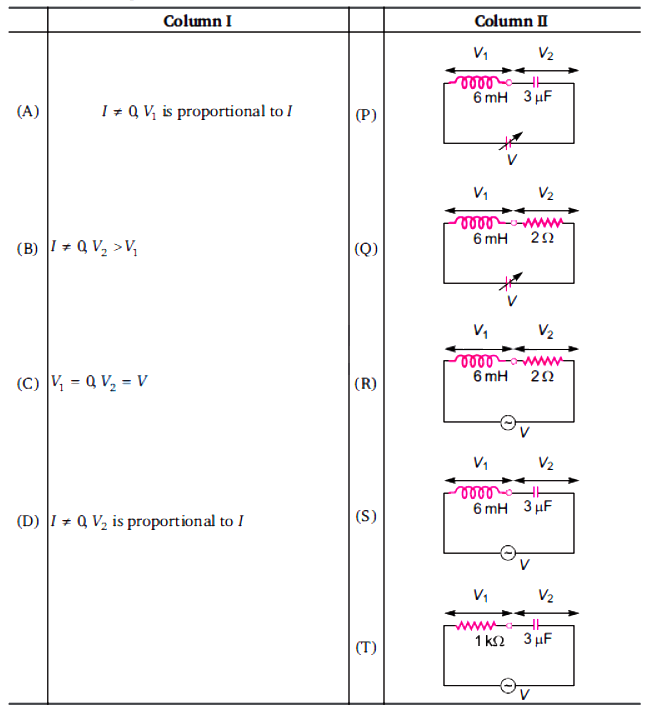
- You are given many resistances, capacitors and inductors. These are connected to a variable DC voltage source (the first two circuits) or an AC voltage source of \(50 \mathrm{~Hz}\) frequency (the next three circuits) in different ways as shown in Column II. When a current \(I\) (steady state for DC or rms for \(A C\) ) flows through the circuit, the corresponding voltage \(V_1\) and \(V_2\) (indicated in circuits) are related as shown in Column I. Match the two
 JEE Advanced 2010 Hard
 - Paragraph :
The capacitor of capacitance \(C\) can be charged (with the help of a resistance \(R\) ) by a voltage source \(V\), by closing switch \(S_1\) while keeping switch \(S_2\) open. The capacitor can be connected in series with an inductor \(L\) by closing switch \(S_2\) and opening \(S_1\).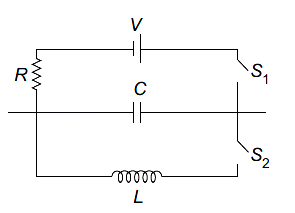
Question :
If the total charge stored in the \(L C\) circuit is \(Q_0\), then for \(t \geq 0\)JEE Advanced 2006 Hard - Consider an obtuse angled triangle in which the difference between the largest and the smallest angle is and whose sides are in arithmetic progression. Suppose that the vertices of this triangle lie on a circle of radius .
(There are two questions based on , the question given below is one of them)
Then the inradius of the triangle isJEE Advanced 2023 Medium - Plotting against for aqueous solutions of a monobasic weak acid resulted in a straight line with axis intercept of and slope of . The ratio is
JEE Advanced 2023 Hard - An ideal gas is expanding such that \(p T^2=\) constant. The coefficient of volume expansion of the gas isJEE Advanced 2008 Medium
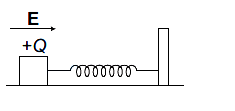
- A wooden block performs SHM on a frictionless surface with frequency \(v_0\). The block carries a charge \(+Q\) on its surface. If now a uniform electric field \(\mathbf{E}\) is switched on as shown, then the SHM of the block will be
 JEE Advanced 2011 Easy