


JEE Advanced · Mathematics · 30. Vector Algebra
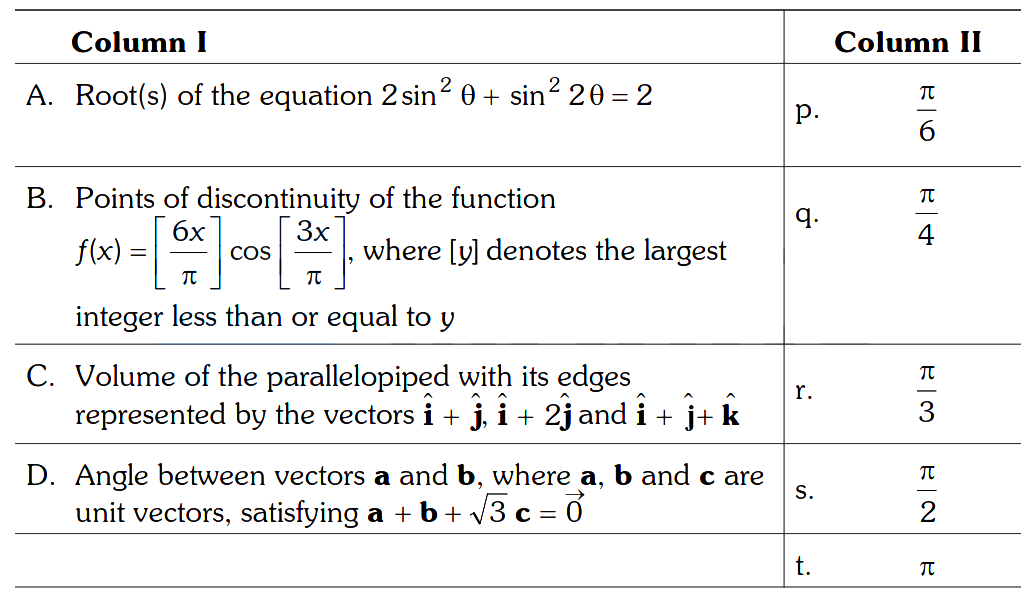
Match the statements/expressions given in Column I with the values given in Column II.
- A
(A) q,s, (B) p,r,s,t, (C) t, (D) r
- B
(A) p,s, (B) q,r,s, (C) s, (D) q
- C
(A) q,s, (B) q,r,s, (C) t, (D) r
- D
(A) p,s, (B) p,r,s,t, (C) t, (D) q
Answer & Solution
Correct Answer
(A)
(A) q,s, (B) p,r,s,t, (C) t, (D) r
Step-by-step Solution
Detailed explanation
(a) \(2 \sin ^2 \theta+\sin ^2 2 \theta=2\)
\(\Rightarrow \quad \sin ^2 2 \theta=2 \cos ^2 \theta\)
\(\Rightarrow \quad 4 \sin ^2 \theta \cos ^2 \theta=2 \cos ^2 \theta\)
\(\Rightarrow \quad \cos ^2 \theta=0\) or \(\sin ^2 \theta=\frac{1}{2}\)
\(\Rightarrow \quad \cos \theta=0\) or \(\sin \theta=\pm \frac{1}{\sqrt{2}}\)
\(\Rightarrow \quad \theta=\pm \frac{\pi}{4}\) or \(\frac{\pi}{2}\)
(b) \(f(x)=\left[\frac{6 x}{\pi}\right] \cos \left[\frac{3 x}{\pi}\right]\)
Possible points of discontinuity of \(\left[\frac{6 x}{\pi}\right]\) are
\[
\begin{gathered}
\frac{6 x}{\pi}=n, n \in I \\
\Rightarrow \quad x=\frac{n \pi}{6} \Rightarrow x=\frac{\pi}{6}, \frac{\pi}{3}, \frac{\pi}{2}, \pi \\
\lim _{x \rightarrow \pi^{-} / 6} f(x)=0 \cos 0=0 \\
\lim _{x \rightarrow \pi^{+} / 6} f(x)=1 \cos 0=1
\end{gathered}
\]
\(\therefore\) Discontinuous at \(x=\frac{\pi}{6}\).
Similarly, discontinuous at \(x=\frac{\pi}{3}, \frac{\pi}{2}, \pi\).
(c) Here, \(V=\left\|\begin{array}{lll}1 & 1 & 0 \\ 1 & 2 & 0 \\ 1 & 1 & \pi\end{array}\right\|=\pi\) cubic unit
(d) Given, \(\mathbf{a}+\mathbf{b}+\sqrt{3} \mathbf{c}=\mathbf{0}\)
\[
\begin{array}{ll}
\Rightarrow & \mathbf{a}+\mathbf{b}=-\sqrt{3} \mathbf{c} \\
\Rightarrow & |\mathbf{a}+\mathbf{b}|^2=\mid \sqrt{3} \mathbf{c}^2
\end{array}
\]
\[
\begin{array}{lrl}
\Rightarrow & a^2+b^2+2 \mathbf{a} \cdot \mathbf{b}=3 c^2 \\
\Rightarrow & 2+2 \cos \theta=3 \\
\Rightarrow & \cos \theta=\frac{1}{2} \Rightarrow \theta=\frac{\pi}{3}
\end{array}
\]
\(\Rightarrow \quad \sin ^2 2 \theta=2 \cos ^2 \theta\)
\(\Rightarrow \quad 4 \sin ^2 \theta \cos ^2 \theta=2 \cos ^2 \theta\)
\(\Rightarrow \quad \cos ^2 \theta=0\) or \(\sin ^2 \theta=\frac{1}{2}\)
\(\Rightarrow \quad \cos \theta=0\) or \(\sin \theta=\pm \frac{1}{\sqrt{2}}\)
\(\Rightarrow \quad \theta=\pm \frac{\pi}{4}\) or \(\frac{\pi}{2}\)
(b) \(f(x)=\left[\frac{6 x}{\pi}\right] \cos \left[\frac{3 x}{\pi}\right]\)
Possible points of discontinuity of \(\left[\frac{6 x}{\pi}\right]\) are
\[
\begin{gathered}
\frac{6 x}{\pi}=n, n \in I \\
\Rightarrow \quad x=\frac{n \pi}{6} \Rightarrow x=\frac{\pi}{6}, \frac{\pi}{3}, \frac{\pi}{2}, \pi \\
\lim _{x \rightarrow \pi^{-} / 6} f(x)=0 \cos 0=0 \\
\lim _{x \rightarrow \pi^{+} / 6} f(x)=1 \cos 0=1
\end{gathered}
\]
\(\therefore\) Discontinuous at \(x=\frac{\pi}{6}\).
Similarly, discontinuous at \(x=\frac{\pi}{3}, \frac{\pi}{2}, \pi\).
(c) Here, \(V=\left\|\begin{array}{lll}1 & 1 & 0 \\ 1 & 2 & 0 \\ 1 & 1 & \pi\end{array}\right\|=\pi\) cubic unit
(d) Given, \(\mathbf{a}+\mathbf{b}+\sqrt{3} \mathbf{c}=\mathbf{0}\)
\[
\begin{array}{ll}
\Rightarrow & \mathbf{a}+\mathbf{b}=-\sqrt{3} \mathbf{c} \\
\Rightarrow & |\mathbf{a}+\mathbf{b}|^2=\mid \sqrt{3} \mathbf{c}^2
\end{array}
\]
\[
\begin{array}{lrl}
\Rightarrow & a^2+b^2+2 \mathbf{a} \cdot \mathbf{b}=3 c^2 \\
\Rightarrow & 2+2 \cos \theta=3 \\
\Rightarrow & \cos \theta=\frac{1}{2} \Rightarrow \theta=\frac{\pi}{3}
\end{array}
\]
See the Complete Solution
Get step-by-step explanations for this and 2.5 Lakh+ more JEE, NEET & CET questions.
- Unlock all solutions
- Practice the full chapter
- Track accuracy across PYQs
4.8 rated on Google Play · 14,000+ reviews
More questions from Mathematics
- Let be a differentiable function such that its derivative is continuous and . If is defined by and if , then the value of is_______JEE Advanced 2020 Medium
- Let and be two vectors. Consider a vector If the projection of on the vector is then the minimum value of equalsJEE Advanced 2019 Hard
- Consider the cube in the first octant with sides and OR of length , along the x-axis, y-axis and z-axis, respectively, where is the origin. Let be the centre of the cube and be the vertex of the cube opposite to the origin such that lies on the diagonal . If and , then the value of is ______.JEE Advanced 2018 Easy
- Considering only the principal values of the inverse trigonometric functions, the value of is _______. (If the numerical value has more than two decimal places, truncate/round-off the value to TWO decimal places)JEE Advanced 2022 Easy
- For any two points \(M\) and \(N\) in the \(X Y\)-plane, let \(\overrightarrow{M N}\) denote the vector from \(M\) to \(N\), and \(\overrightarrow{0}\) denote the zero vector. Let \(P, Q\) and \(R\) be three distinct points in the \(X Y\)-plane. Let \(S\) be a point inside the triangle \(\triangle P Q R\) such that \(\overrightarrow{S P}+5 \overrightarrow{S Q}+6 \overrightarrow{S R}=\overrightarrow{0}\). Let \(E\) and \(F\) be the mid-points of the sides \(P R\) and \(Q R\), respectively. Then the value of \(\frac{\text { length of the line segment } E F}{\text { length of the line segment } E S}\) is ________JEE Advanced 2025 Easy
- \[
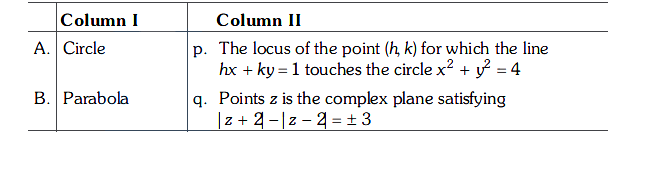
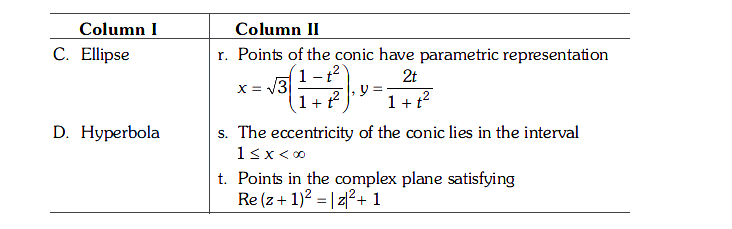
\text { Match the conics in Column I with the statements/expressions in Column II. }
\]
 JEE Advanced 2009 Easy
More PYQs from JEE Advanced
- Consider the parabola . Let be the focus of the parabola. A pair of tangents drawn to the parabola from the point meet the parabola at and . Let and be points on the lines and respectively such that is perpendicular to and is perpendicular to . Then, which of the following is/are TRUE?JEE Advanced 2022 Medium
- Let \(f(\theta)=\sin \left[\tan ^{-1}\left(\frac{\sin \theta}{\sqrt{\cos 2 \theta}}\right)\right]\), where \(-\frac{\pi}{4} < \theta < \frac{\pi}{4}\). Then, the value of \(\frac{d}{d(\tan \theta)}(f(\theta))\) isJEE Advanced 2011 Medium
- Paragraph:
Box \(1\) contains three cards bearing numbers \(1,2,3\); box \(2\) contains five cards bearing numbers \(1,2,3,4,5\); and box \(3\) contains seven cards bearing numbers \(1,2,3,4,5,6,7\). A card is drawn from each of the boxes. Let \(x_{i}\) be the number on the card drawn from the \(i^{t h}\) box, \(i=1,2,3\).
Question:
The probability that \(x_{1}+x_{2}+x_{3}\) is odd, isJEE Advanced 2014 Medium - Paragraph:
Let \(F_{1}\left(x_{1}, 0\right)\) and \(F_{2}\left(x_{2}, 0\right)\), for \(x_{1}<0\) and \(x_{2}>0\), be the foci of the ellipse \(\frac{x^{2}}{9}+\frac{y^{2}}{8}=1 .\) Suppose a parabola having vertex at the origin and focus at \(F_{2}\) intersects the ellipse at point \(M\) in the first quadrant and at point \(N\) in the fourth quadrant.
Question:
The orthocentre of the triangle \(F_{1} M N\) isJEE Advanced 2016 Medium - \(\mathrm{NiCl}_{2}\left\{\mathrm{P}\left(\mathrm{C}_{2} \mathrm{H}_{5}\right)_{2}\left(\mathrm{C}_{6} \mathrm{H}_{5}\right)\right\}_{2}\) exhibits temperature depend-ent magnetic behaviour (paramagnetic/diamagnetic). The coordination geometries of \(\mathrm{Ni}^{2+}\) in the paramagnetic and diamagnetic states are respectivelyJEE Advanced 2012 Medium
- In the given diagram, a monoatomic gas is first compressed adiabatically from state state . Then it expands isothermally from state to state . [Given : ].
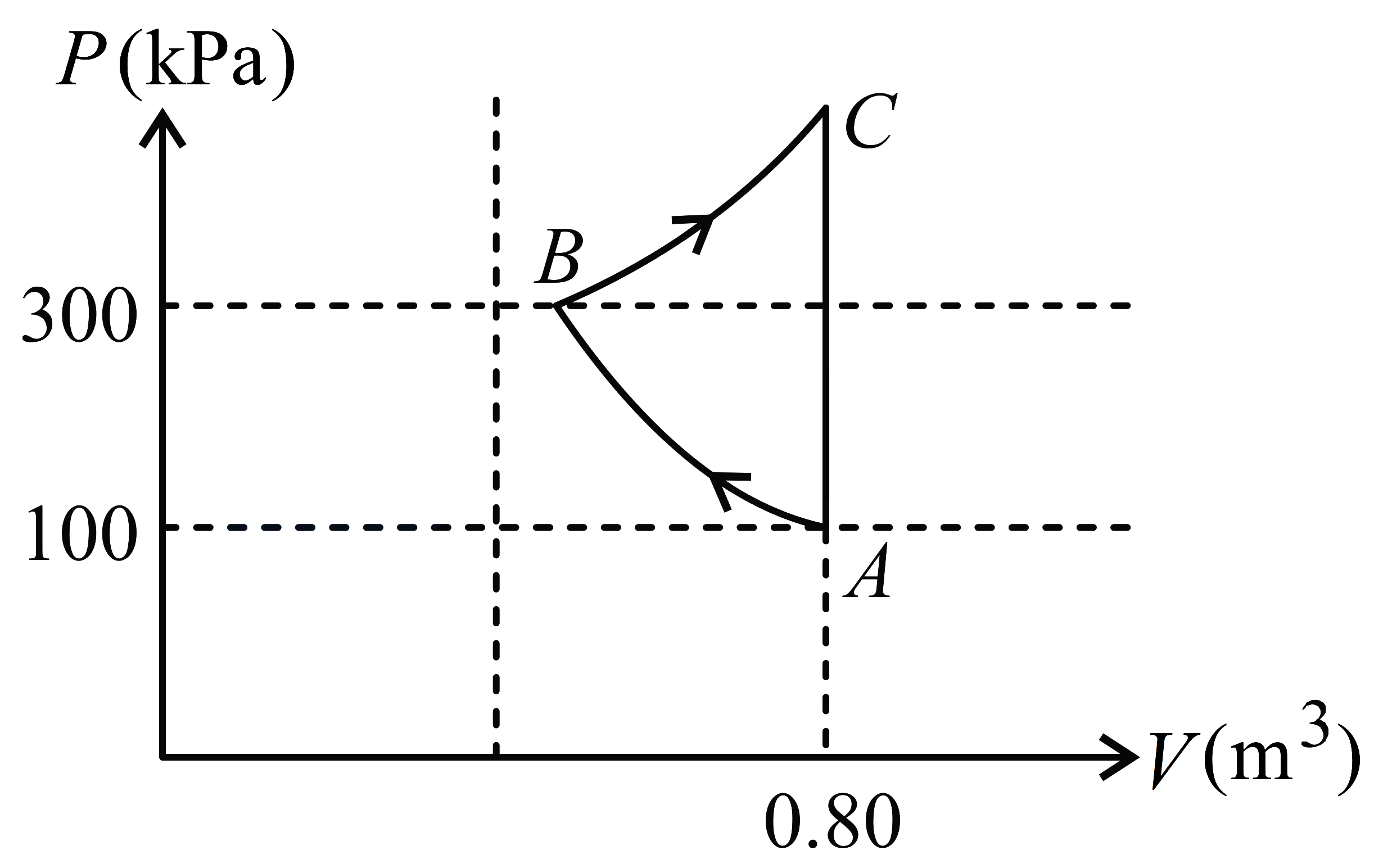
Which of the following statement(s) is(are) correct?JEE Advanced 2022 Hard