


JEE Advanced · Mathematics · 3. Complex Numbers
Let \(z_1\) and \(z_2\) be two distinct complex numbers and let \(z=(1-t) z_1+t z_2\) for some real number \(t\) with \(0 < t < 1\). If \(\arg (w)\) denotes the principal argument of a non-zero complex number \(w\), then
- A \(\left|z-z_1\right|+\left|z-z_2\right|=\left|z_1-z_2\right|\)
- B \(\arg \left(z-z_1\right)=\arg \left(z-z_2\right)\)
- C \(\left|\begin{array}{cc}z-z_1 & \bar{z}-\bar{z}_1 \\ z_2-z_1 & \bar{z}_2-\bar{z}_1\end{array}\right|=0\)
- D \(\arg \left(z-z_1\right)=\arg \left(z_2-z_1\right)\)
Answer & Solution
Correct Answer
(A) \(\left|z-z_1\right|+\left|z-z_2\right|=\left|z_1-z_2\right|\)
Step-by-step Solution
Detailed explanation
Given, \(z=\frac{(1-t) z_1+t z_2}{(1-t)+t}\)
Clearly, \(z\) divides \(z_1\) and \(z_2\) in the ratio of \(t:(1-t), 0 < t < 1\)
\( \Rightarrow A P+B P=A B \)
\( \text { ie, }\left|z-z_1\right|+\left|z-z_2\right|=\left|z_1-z_2\right| \)
\( \Rightarrow \text {Option (a) is true. } \)
\( \text {and } \arg \left(z-z_1\right) =\arg \left(z_2-z\right) \)
\( =\arg \left(z_2-z_1\right) \)
\(\Rightarrow\) (b) is false and (d) is true.
Also, \(\arg \left(z-z_1\right)=\arg \left(z_2-z_1\right)\)
\( \Rightarrow \arg \left(\frac{z-z_1}{z_2-z_1}\right)=0 \)
\( \therefore \frac{z-z_1}{z_2-z_1} \text { is purely real. } \)
\( \Rightarrow \frac{z-z_1}{z_2-z_1}=\frac{\bar{z}-\bar{z}_1}{\bar{z}_2-\bar{z}_1} \)
\( \text {or }|z-z_1 \bar{z}-\bar{z}_1 \)
\( z_2-z_1 \bar{z}_2-\bar{z}_1|=0 \)
\(\therefore\) Option (c) is correct.
Hence, (a, c, d) is the correct option.
Clearly, \(z\) divides \(z_1\) and \(z_2\) in the ratio of \(t:(1-t), 0 < t < 1\)
\( \Rightarrow A P+B P=A B \)
\( \text { ie, }\left|z-z_1\right|+\left|z-z_2\right|=\left|z_1-z_2\right| \)
\( \Rightarrow \text {Option (a) is true. } \)
\( \text {and } \arg \left(z-z_1\right) =\arg \left(z_2-z\right) \)
\( =\arg \left(z_2-z_1\right) \)
\(\Rightarrow\) (b) is false and (d) is true.
Also, \(\arg \left(z-z_1\right)=\arg \left(z_2-z_1\right)\)
\( \Rightarrow \arg \left(\frac{z-z_1}{z_2-z_1}\right)=0 \)
\( \therefore \frac{z-z_1}{z_2-z_1} \text { is purely real. } \)
\( \Rightarrow \frac{z-z_1}{z_2-z_1}=\frac{\bar{z}-\bar{z}_1}{\bar{z}_2-\bar{z}_1} \)
\( \text {or }|z-z_1 \bar{z}-\bar{z}_1 \)
\( z_2-z_1 \bar{z}_2-\bar{z}_1|=0 \)
\(\therefore\) Option (c) is correct.
Hence, (a, c, d) is the correct option.
See the Complete Solution
Get step-by-step explanations for this and 2.5 Lakh+ more JEE, NEET & CET questions.
- Unlock all solutions
- Practice the full chapter
- Track accuracy across PYQs
4.8 rated on Google Play · 14,000+ reviews
More questions from Mathematics
- For non-negative integers let
Assuming takes values in which of the following options is/are correct?JEE Advanced 2019 Medium - If \(f^{\prime \prime}(x)=-f(x)\), where \(f(x)\) is a continuous double differentiable function and \(g(x)=f^{\prime}(x)\). If \(F(x)=\left(f\left(\frac{x}{2}\right)\right)^2+\left(g\left(\frac{x}{2}\right)\right)^2\) and \(F(5)=5\), then \(F(10)\) isJEE Advanced 2006 Medium
- Consider the square in the figure. Let be the points of intersections (dots in the picture) in some order. We say that and are friends if they are adjacent along a row or along a column. Assume that each point has an equal chance of being chosen.
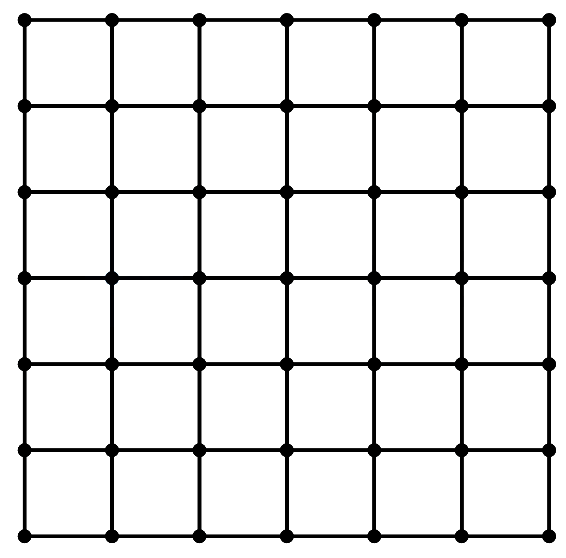
(There are two questions based on , the question given below is one of them)
Two distinct points are chosen randomly out of the points . Let be the probability that they are friends. Then the value of isJEE Advanced 2023 Medium - Consider the region \(R=\left\{(x, y) \in \mathbb{R} \times \mathbb{R}: x \geq 0\right.\) and \(\left.y^{2} \leq 4-x\right\}\). Let \(\mathcal{F}\) be the family of all circles that are contained in \(R\) and have centers on the \(x\)-axis. Let \(C\) be the circle that has largest radius among the circles in \(\mathcal{F}\). Let \((\alpha, \beta)\) be a point where the circle \(C\) meets the curve \(y^{2}=4-x\).
The radius of the circles is____.JEE Advanced 2021 Easy - Paragraph:
A fair die is tossed repeatedly until a six is obtained. Let \(X\) denotes the number of tosses required.Question:
The probability that \(X \geq 3\) equalsJEE Advanced 2009 Easy - The value of thenJEE Advanced 2017 Hard
More PYQs from JEE Advanced
- The tangent \(P T\) and the normal \(P N\) to the parabola \(y^2=4 a x\) at a point \(P\) onJEE Advanced 2009 Medium
- Let denote the determinant of a square matrix . Let be the function defined by where
Let be a quadratic polynomial whose roots are the maximum and minimum values of the function , and . Then, which of the following is/are TRUE ?JEE Advanced 2022 Hard - A train is moving along a straight line with a constant acceleration a. A boy standing in the train throws a ball forward with a speed of \(10 \mathrm{~m} / \mathrm{s}\), at an angle of \(60^{\circ}\) to the horizontal. The boy has to move forward by \(1.15 \mathrm{~m}\) inside the train to catch the ball back at the initial height. The acceleration of the train in \(\mathrm{m} / \mathrm{s}^2\), isJEE Advanced 2011 Medium
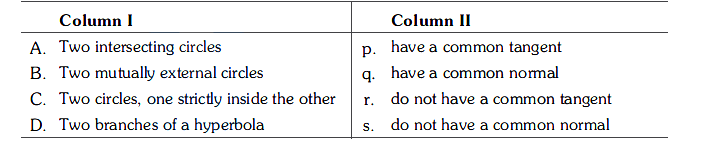
- Match the statements in Column I with the properties Column II.
 JEE Advanced 2007 Easy
 - In the determination of Young's modulus \(\left(Y=\frac{4 M L g}{\pi l d^{2}}\right)\) by using Searle's method, a wire of length \(L=2 \mathrm{~m}\) and diameter \(d=0.5 \mathrm{~mm}\) is used. For a load \(M=2.5 \mathrm{~kg}\), an extension \(l=0.25 \mathrm{~mm}\) in the length of the wire is observed. Quantities \(d\) and \(l\) are measured using a screw gauge and a micrometer, respectively. They have the same pitch of \(0.5 \mathrm{~mm}\). The number of divisions on their circular scale is 100 . The contributions to the maximum probable error of the \(Y\) measurementJEE Advanced 2012 Easy
- Among the following compounds, the most acidic isJEE Advanced 2011 Medium