


JEE Advanced · Mathematics · 16. Limits
Let \(S\) be the set of all \((\alpha, \beta) \in \mathbb{R} \times \mathbb{R}\) such that
\(\lim _{x \rightarrow \infty} \frac{\sin \left(x^2\right)\left(\log _e x\right)^\alpha \sin \left(\frac{1}{x^2}\right)}{x^{\alpha \beta}\left(\log _e(1+x)\right)^\beta}=0\).
Then which of the following is (are) correct?
- A \((-1,3) \in S\)
- B \((-1,1) \in S\)
- C \((1,-1) \in S\)
- D \((1,-2) \in S\)
Answer & Solution
Correct Answer
(C) \((1,-1) \in S\)
Step-by-step Solution
Detailed explanation
\(\begin{aligned} & \lim _{x \rightarrow \infty} \frac{\sin x^2 \cdot\left(\log _e x\right)^\alpha \cdot \sin \frac{1}{x^2}}{x^{\alpha \beta} \cdot\left(\log _e(1+x)\right)^\beta}=0 \\ & \lim _{x \rightarrow \infty} \frac{\left(\log _e x\right)^\alpha}{\left(\log _e(x+1)\right)^\beta \cdot x^{\alpha \beta+2}}=0\end{aligned}\)
\(\begin{aligned} & \lim _{x \rightarrow \infty}\left(\frac{\log _e x}{\log _e(x+1)}\right)^\beta \cdot \frac{\left(\log _e x\right)^{\alpha-\beta}}{x^{\alpha \beta+2}}=0 \\ & \lim _{x \rightarrow \infty} \frac{\left(\log _e x\right)^{\alpha-\beta}}{x^{\alpha \beta+2}}=0 \quad \text { Put } \log _e x=t \\ & \lim _{t \rightarrow \infty} \frac{t^{\alpha-\beta}}{\left(e^t\right)^{\alpha \beta+2}}=0\end{aligned}\)
As we know \(\lim _{x \rightarrow \infty} \frac{x}{e^x}=0\)
\(\alpha \beta+2>0 \Rightarrow \alpha \beta>-2\)
\(\begin{aligned} & \lim _{x \rightarrow \infty}\left(\frac{\log _e x}{\log _e(x+1)}\right)^\beta \cdot \frac{\left(\log _e x\right)^{\alpha-\beta}}{x^{\alpha \beta+2}}=0 \\ & \lim _{x \rightarrow \infty} \frac{\left(\log _e x\right)^{\alpha-\beta}}{x^{\alpha \beta+2}}=0 \quad \text { Put } \log _e x=t \\ & \lim _{t \rightarrow \infty} \frac{t^{\alpha-\beta}}{\left(e^t\right)^{\alpha \beta+2}}=0\end{aligned}\)
As we know \(\lim _{x \rightarrow \infty} \frac{x}{e^x}=0\)
\(\alpha \beta+2>0 \Rightarrow \alpha \beta>-2\)
See the Complete Solution
Get step-by-step explanations for this and 2.5 Lakh+ more JEE, NEET & CET questions.
- Unlock all solutions
- Practice the full chapter
- Track accuracy across PYQs
4.8 rated on Google Play · 14,000+ reviews
More questions from Mathematics
- Paragraph:
Let \(A_1, G_1, H_1\) denote the arithmetic, geometric and harmonic means respectively, of two distinct positive numbers. For \(n \geq 2\), let \(A_{n-1}\) and \(H_{n-1}\) has arithmetic, geometric and harmonic means as \(A_n, G_n, H_n\), respectively.
Question:
Which one of the following statements is correct?JEE Advanced 2007 Medium - Which of the following is (are) NOT the square of a matrix with real entries?JEE Advanced 2017 Easy
- For how many values of , the circle and the coordinate axes have exactly three common points?JEE Advanced 2017 Medium
- Three lines
and
are given. For which point(s) and can we find a point on and a point on so that and are collinear?JEE Advanced 2019 Medium - Paragraph:
Consider the function \(f:(-\infty, \infty) \rightarrow(-\infty, \infty)\) defined by \(f(x)=\frac{x^2-a x+1}{x^2+a x+1} ; 0 < a < 2\)Question:
Let \(g(x)=\int_0^{e^x} \frac{f^{\prime}(t)}{1+t^2} d t\). Which of the following is true ?JEE Advanced 2008 Medium - Let
Let be all the points of local maximum of and be all the points of local minimum of
Then which of the following options is/are correct?JEE Advanced 2019 Hard
More PYQs from JEE Advanced
- Two identical glass rods and (refractive index = 1.5) have one convex end of radius of curvature 10 cm. They are placed with the curved surfaces at a distance d as shown in the figure, with their axes (shown by the dashed line) aligned. When a point source of light is placed inside rod on its axis at a distance of 50 cm from the curved face, the light rays emanating from it are found to be parallel to the axis inside . The distance is
 JEE Advanced 2015 Hard
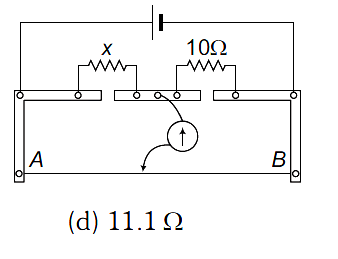
 - A meter bridge is set up as shown in figure, to determine an unknown resistance \(X\) using a standard \(10 \Omega\) resistor. The galvanometer shows null point when tapping key is at \(52 \mathrm{~cm}\) mark. The end-corrections are \(1 \mathrm{~cm}\) and \(2 \mathrm{~cm}\) respectively for the ends \(A\) and \(B\). The determined value of \(X\) is
 JEE Advanced 2011 Medium
 - The pair(s) of ions where BOTH the ions are precipitated upon passing gas in presence of dilute HCl, is (are)JEE Advanced 2015 Easy
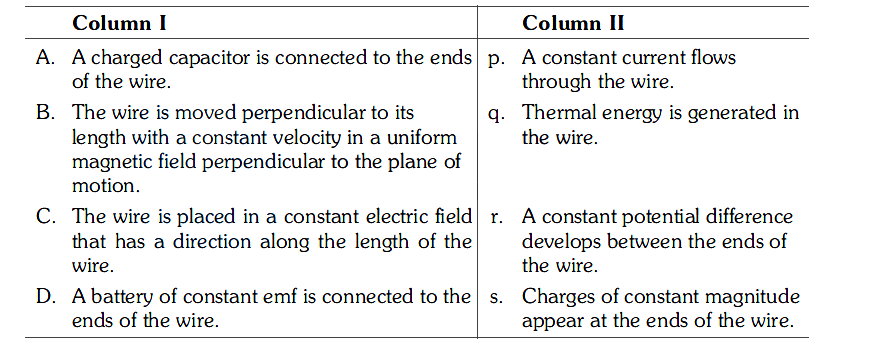
- Column I gives certain situations in which a straight metallic wire of resistance \(R\) is used and Column II gives some resulting effects. Match the statements in Column I with the statements in Column II and indicate your answer by darkening appropriate bubbles in the \(4 \times 4\) matrix given in the ORS.
 JEE Advanced 2007 Hard
 - Paragraph:
Scientists are working hard to develop nuclear fusion reactor. Nuclei of heavy hydrogen, \({ }_1^2 \mathrm{H}\) known as deuteron and denoted by \(D\) can be thought of as a candidate for fusion reactor. The \(D\) - \(D\) reaction is \({ }_1^2 \mathrm{H}+{ }_1^2 \mathrm{H} \rightarrow{ }_2^3 \mathrm{He}+n+\) energy. In the core of fusion reactor. A gas of heavy hydrogen is fully ionized into deuteron nuclei and electrons. This collection of \({ }_1^4 \mathrm{H}\) nuclei and electrons is known as plasma. The nuclei move randomly in the reactor core and occasionally come close enough for nuclear fusion to take place. Usually, the temperatures in the reactor core are too high and no material wall can be used to confine the plasma. Special techniques are used which confine the plasma for a time \(t_0\) before the particles fly away from the core. If n is the density (number/volume) of deutrons, the product t \(_0\) is called Lawson number. In one of the criteria, \(a\) reactor is termed successful if Lawson number is greater than \(5 \times 10^{14} \mathrm{scm}^{-3}\).
It may be helpful to use the following : Boltzmann constant \(k=8.6 \times 10^{-5} \mathrm{eV} / \mathrm{K}\); \(\frac{e^2}{4 \pi \varepsilon_0}=1.44 \times 10^{-9} \mathrm{eVm}\)
Question:
Results of calculations for four different designs of a fusion reactor using D-D reaction are given below. Which of these is most promising based on Lawson criterion?JEE Advanced 2009 Easy - A particle moves in the \(X-Y\) plane under the influence of a force such that its linear momentum is \(\mathbf{p}(t)=A[\hat{\mathbf{i}} \cos k t-\hat{\mathbf{j}} \sin k t]\), where \(A\) and \(k\) are constants. The angle between the force and the momentum isJEE Advanced 2007 Easy