


JEE Advanced · Mathematics · 25. AOD
Paragraph:
Consider the function \(f:(-\infty, \infty) \rightarrow(-\infty, \infty)\) defined by \(f(x)=\frac{x^2-a x+1}{x^2+a x+1} ; 0 < a < 2\)Question:
Let \(g(x)=\int_0^{e^x} \frac{f^{\prime}(t)}{1+t^2} d t\). Which of the following is true ?
- A
\(g^{\prime}(x)\) is positive on \((-\infty, 0)\) and negative on \((0, \infty)\)
- B
\(g^{\prime}(x)\) is negative on \((-\infty, 0)\) and positive on \((0, \infty)\)
- C
\(g^{\prime}(x)\) changes sign on both \((-\infty, 0)\) and \((0, \infty)\)
- D
\(g^{\prime}(x)\) does not change sign on \((-\infty, \infty)\)
Answer & Solution
Correct Answer
(B)
\(g^{\prime}(x)\) is negative on \((-\infty, 0)\) and positive on \((0, \infty)\)
Step-by-step Solution
Detailed explanation
\(\because g^{\prime}(x)=\frac{f^{\prime}\left(e^x\right)}{1+\left(e^x\right)^2} \cdot e^x=2 a\left[\frac{e^{2 x}-1}{\left(e^{2 x}+a e^x+1\right)^2}\right]\left(\frac{e^x}{1+e^{2 x}}\right)\) \(\begin{aligned} & g^{\prime}(x)=0 \text {, if } e^{2 x}-1 & =0, \\ \text { i.e., } & & x=0 \\ \text { If } & & x < 0, e^{2 x} < 1 \Rightarrow g^{\prime}(x) < 0 .\end{aligned}\)
See the Complete Solution
Get step-by-step explanations for this and 2.5 Lakh+ more JEE, NEET & CET questions.
- Unlock all solutions
- Practice the full chapter
- Track accuracy across PYQs
4.8 rated on Google Play · 14,000+ reviews
More questions from Mathematics
- Paragraph:
Let \(p\) be an odd prime number and \(T_p\) be the following set of \(2 \times 2\) matrices
\[
T_p=\left\{A=\left[\begin{array}{ll}
a & b \\
c & a
\end{array}\right] ; a, b, c \in\{0,1,2, \ldots, p-1\}\right\}
\]Question:
The number of \(A\) in \(T_p\) such that \(\operatorname{det}(A)\) is not divisible by \(p\), isJEE Advanced 2010 Easy - Consider the system of equations
where \(\quad a, b, c, d \in\{0,1\}\)
Statement 1 The probability that the system of equations has a unique solution, is \(3 / 8\).
Statement 2 The probability that the system of equations has a solution, is 1 .JEE Advanced 2008 Hard - Let \(\mathbb{R}\) denote the set of all real numbers. Let \(f: \mathbb{R} \rightarrow \mathbb{R}\) and \(g: \mathbb{R} \rightarrow(0,4)\) be functions defined by \(f(x)=\log _e\left(x^2+2 x+4\right)\), and \(g(x)=\frac{4}{1+e^{-2 x}}\)
Define the composite function \(f \circ g^{-1}\) by \(\left(f \circ g^{-1}\right)(x)=\left(g^{-1}(x)\right)\), where \(g^{-1}\) is the inverse of the function \(g\).
Then the value of the derivative of the composite function \(f \circ g^{-1}\) at \(x=2\) is ________ .JEE Advanced 2025 Hard - A straight line \(L\) through the point \((3,-2)\) is inclined at an angle \(60^{\circ}\) to the line \(\sqrt{3} x+y=1\). If \(L\) also intersects the \(X\)-axis, then the equation of \(L\) isJEE Advanced 2011 Easy
- Let RS be the diameter of the circle where, is the point. Let be a variable point (other than ) on the circle and tangents to the circle at meet at the point. The normal to the circle at P intersects a line drawn through parallel to at point . Then, the locus of passes through the point (s):JEE Advanced 2016 Medium
- Let be a differentiable function such that its derivative is continuous and . If is defined by and if , then the value of is_______JEE Advanced 2020 Medium
More PYQs from JEE Advanced
- The colour of the molecules of group 17 elements changes gradually from yellow to violet down the group. This is due to -JEE Advanced 2017 Medium
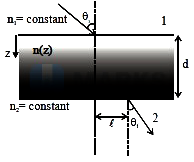
- A transparent slab of thickness d has a refractive index n (z) that increases with z. Here z is the vertical distance inside the slab, measured from the top. The slab is placed between two media with uniform refractive indices as shown in the figure. A ray of light is incident with angle from medium 1 and emerges in medium 2 with refraction angle with a lateral displacement . Which of the following statement(s) is (are) true?
 JEE Advanced 2016 Medium
 - Paragraph:
Let \(P Q\) be a focal chord of the parabola \(y^{2}=4 a x\). The tangents to the parabola at \(P\) and \(Q\) meet at a point lying on the line \(y=2 x+a, a>0\).
Question:
Length of chord \(P Q\) isJEE Advanced 2013 Medium - Paragraph :
A dense collection of equal number of electrons and positive ions is called neutral plasma. Certain solids containing fixed positive ions surrounded by free electrons can be treated as neutral plasma. Let \(N\) be the number density of free electrons, each of mass \(m\). When the electrons are subjected to an electric field, they are displaced relatively away from the heavy positive ions.If the electric field becomes zero, the electrons being to oscillate about the positive ions with a natural angular frequency \(\omega_p\), which is called the plasma frequency. To sustain the oscillations, a time varying electric field needs to be applied that has an angular frequency \(\omega\), where a part of the energy is absorbed and a part of it is reflected. As \(\omega\) approaches \(\omega_p\), all the free electrons are set to resonance together and all the energy is reflected. This is the explanation of high reflectivity of metals.
Question :
Taking the electronic charge as \(e\) and the permittivity as \(\varepsilon_0\), use dimensional analysis to determine the correct expression for \(\omega_p\).JEE Advanced 2011 Hard - Let \(p(x)\) be a real polynomial of least degree which has a local maximum at \(x=1\) and a local minimum at \(x=3\). If \(p(1)=6\) and \(p(3)=2\), then \(p^{\prime}(0)\) isJEE Advanced 2012 Medium
- The correct statement(s) pertaining to the adsorption of a gas on a solid surface is(are)JEE Advanced 2011 Hard