


JEE Advanced · Mathematics · 25. AOD
Let \(f(x)\) be a non-constant twice differentiable function defined on \((-\infty, \infty)\), such that \(f(x)=f(1-x)\) and \(f^{\prime}\left(\frac{1}{4}\right)=0\). Then,
- A
\(f^{\prime}(x)\) vanishes atleast twice on \([0,1]\)
- B
\(f^{\prime}\left(\frac{1}{2}\right)=0\)
- C
\(\int_{\frac{1}{2}}^{\frac{1}{2}} f\left(x+\frac{1}{2}\right) \sin x d x=0\)
- D
\(\int_0^{\frac{1}{2}} f(t) e^{\sin \pi t} d t=\int_{\frac{1}{2}}^1 f(1-t) e^{\sin \pi t} d t\)
Answer & Solution
Correct Answer
(A)
\(f^{\prime}(x)\) vanishes atleast twice on \([0,1]\)
Step-by-step Solution
Detailed explanation
Given that, \(f(x)=f(1-x)\)
On differentiating w.r.t. \(x\), we get
\[
f^{\prime}(x)=-f^{\prime}(1-x)
\]
Let us put \(\quad x=\frac{1}{2}\)
\[
\Rightarrow \quad 2 f^{\prime}\left(\frac{1}{2}\right)=0 \Rightarrow f^{\prime}\left(\frac{1}{2}\right)=0
\]
Since, \(f^{\prime}\left(\frac{1}{2}\right)=0\) and \(f^{\prime}\left(\frac{1}{4}\right)=0\)
\(\Rightarrow f^{\prime \prime}(x)=0\) at two points in \([0,1]\).
Now, \(\int_{-1 / 2}^{1 / 2} f\left(x+\frac{1}{2}\right) \sin x d x=0\)
As, \(f\left(x+\frac{1}{2}\right) \sin x\) is an odd function which is clear from the following explanation.
Let \(g(x)=f\left(x+\frac{1}{2}\right) \sin x\),
\[
g(-x)=f\left(\frac{1}{2}-x\right) \sin (-x)=-\sin x f\left(1-\left(\frac{1}{2}-x\right)\right)=-\sin x f\left(\frac{1}{2}+x\right)=-g(x)
\]
Moreover, \(\int_{1 / 2}^1 f(1-t) e^{\sin (\pi t)} d t=\int_0^{1 / 2} f(u) \cdot e^{\sin \pi u} d u\) where, \(1-t=u\).
On differentiating w.r.t. \(x\), we get
\[
f^{\prime}(x)=-f^{\prime}(1-x)
\]
Let us put \(\quad x=\frac{1}{2}\)
\[
\Rightarrow \quad 2 f^{\prime}\left(\frac{1}{2}\right)=0 \Rightarrow f^{\prime}\left(\frac{1}{2}\right)=0
\]
Since, \(f^{\prime}\left(\frac{1}{2}\right)=0\) and \(f^{\prime}\left(\frac{1}{4}\right)=0\)
\(\Rightarrow f^{\prime \prime}(x)=0\) at two points in \([0,1]\).
Now, \(\int_{-1 / 2}^{1 / 2} f\left(x+\frac{1}{2}\right) \sin x d x=0\)
As, \(f\left(x+\frac{1}{2}\right) \sin x\) is an odd function which is clear from the following explanation.
Let \(g(x)=f\left(x+\frac{1}{2}\right) \sin x\),
\[
g(-x)=f\left(\frac{1}{2}-x\right) \sin (-x)=-\sin x f\left(1-\left(\frac{1}{2}-x\right)\right)=-\sin x f\left(\frac{1}{2}+x\right)=-g(x)
\]
Moreover, \(\int_{1 / 2}^1 f(1-t) e^{\sin (\pi t)} d t=\int_0^{1 / 2} f(u) \cdot e^{\sin \pi u} d u\) where, \(1-t=u\).
See the Complete Solution
Get step-by-step explanations for this and 2.5 Lakh+ more JEE, NEET & CET questions.
- Unlock all solutions
- Practice the full chapter
- Track accuracy across PYQs
4.8 rated on Google Play · 14,000+ reviews
More questions from Mathematics
- Paragraph: Let be the circle in the – plane defined by the equation
Question : Let be a point on the circle with both coordinates being positive. Let the tangent to at intersect the coordinate axes at the points and Then, the mid-point of the line segment must lie on the curveJEE Advanced 2018 Medium - In , let L be a straight line passing through the origin. Suppose that all the points on L are at a constant distance from the two planes and Let M be the locus of the feet of the perpendiculars drawn from the points on L to the plane . Which of the following points lie (s) on M ?JEE Advanced 2015 Medium
- Paragraph:
Let \(A, B, C\) be three sets of complex numbers as defined below.
\(A=\{z ; \operatorname{lm} z \geq 1\} ; B=\{z:|z-2-i|=3\} ;\) \(C=\{z: \operatorname{Re}((1-i) z)=\sqrt{2}\}\).
Question:
The number of elements in the set \(A \cap B \cap C\) isJEE Advanced 2008 Hard - The slope of the tangent to the curve at the point (1, 3) is ________.JEE Advanced 2014 Medium
- Let the function be defined by . Then the value of is_________JEE Advanced 2020 Hard
- Let a, b, c be positive integers such that is an integer. If a, b, c are in geometric progression and the arithmetic mean of a, b, c is b + 2, then the value of is ________JEE Advanced 2014 Easy
More PYQs from JEE Advanced
- Let \(f: R \rightarrow R\) be a function such that \(f(x+y)=f(x)+f(y), \forall x, y \in R\). If \(f(x)\) is differentiable at \(x=0\), thenJEE Advanced 2011 Hard
- Paragraph :
A uniform thin cylindrical disk of mass \(M\) and radius \(R\) is attached to two identical massless springs of spring constant \(k\) which are fixed to the wall as shown in the figure. The springs are attached to the axle of the disk symmetrically on either side at a distance \(d\) from its centre. The axle is massless and both the springs and the axle are in a horizontal plane. The unstretched length of each spring is \(L\). The disk is initially at its equilibrium position with its centre of mass \((C M)\) at a distance Lfrom the wall. The disk rolls without slipping with velocity \(\mathbf{v}_0=v_0 \hat{\mathbf{i}}\) The coefficient of friction is \(\mu\).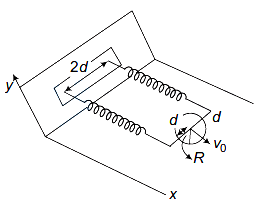
Question :
The net external force acting on the disk when its centre of mass is at displacement \(x\) with respect to its equilibrium position isJEE Advanced 2008 Medium - The value of \(\int \frac{\left(x^2-1\right) d x}{x^3 \sqrt{2 x^4-2 x^2+1}}\) isJEE Advanced 2006 Medium
- Suppose that are three non - coplanar vectors in . Let the components of a vector along \(p, q\) and \(r\) be 4,3 and 5 respectively. If the components of are x, y and z, respectively, then the value of isJEE Advanced 2015 Medium
- Columns 1, 2 and 3 contain conics, equations of tangents to the conics and points of contact, respectively.
For , if a tangent is drawn to a suitable conic (Column 1) at the point of contact , then which of the following options is the only Correct combination for obtaining its equation?Column 1 Column 2 Column 3 (I) (i) (P) (II) (ii) (Q) (III) (iii) (R) (IV) (iv) (S) JEE Advanced 2017 Hard - A solid sphere of mass and radius rolls without slipping on a fixed inclined plane with an angle of inclination from the horizontal. Two forces of magnitude each, parallel to the incline, act on the sphere, both at distance from the center of the sphere, as shown in the figure. The acceleration of the sphere down the plane is . (Take )
If the numerical value has more than two decimal places, truncate/round-off the value to TWO decimal places.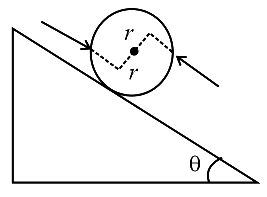 JEE Advanced 2022 Medium