


JEE Advanced · Mathematics · 23. C&D
Let \(f: R \rightarrow R\) be a function such that \(f(x+y)=f(x)+f(y), \forall x, y \in R\). If \(f(x)\) is differentiable at \(x=0\), then
- A
\(f(x)\) is differentiable only in a finite interval containing zero
- B
\(f(x)\) is continuous, \(\forall x \in R\)
- C
\(f^{\prime}(x)\) is constant, \(\forall x \in R\)
- D
\(f(x)\) is differentiable except at finitely many points
Answer & Solution
Correct Answer
(C)
\(f^{\prime}(x)\) is constant, \(\forall x \in R\)
Step-by-step Solution
Detailed explanation
\(f(x+y)=f(x)+f(y)\), as \(f(x)\) is differentiable at \(x=0\).
\[
\begin{aligned}
\Rightarrow & f^{\prime}(0)=k \\
\text { Now, } f^{\prime}(x) & =\lim _{h \rightarrow 0} \frac{f(x+h)-f(x)}{h} \\
& =\lim _{h \rightarrow 0} \frac{f(x)+f(h)-f(x)}{h} \\
& =\lim _{h \rightarrow 0} \frac{f(h)}{h} \quad\left[\frac{0}{0} \text { from }\right]
\end{aligned}
\]
Given, \(f(x+y)=f(x)+f(y), \forall x, y\)
\[
\begin{aligned}
& \therefore & f(0) & =f(0)+f(0), \\
& \text { when } & x & =y=0 \Rightarrow f(0)=0
\end{aligned}
\]
Using L'Hospital's rule,
\[
\lim _{h \rightarrow 0} \frac{f^{\prime}(h)}{1}=f^{\prime}(0)=k
\]
\(\Rightarrow f^{\prime}(x)=k\), on integrating both sides, \(f(x)=k x+C\), as \(f(0)=0 \Rightarrow C=0\)
So, \(f(x)=k x\)
\(\therefore f(x)\) is continuous for all \(x \in R\) and \(f^{\prime}(x)=k\), i.e. constant for all \(x \in R\).
Hence, both (b) and (c) are correct.
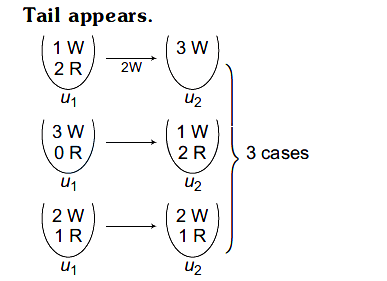
Solutions (Q. Nos. 12-13)
\[
\left.\left(\begin{array}{l}
3 \mathrm{~W} \\
2 \mathrm{R}
\end{array}\right)(\underbrace{1 \mathrm{~W}}_{u_1})\right\} \text { Initial }
\]
Head appears.
\(\left(\begin{array}{l}2 \mathrm{~W} \\ 2 \mathrm{R}\end{array}\right) \underset{u_1}{\mathrm{wW}}(\underbrace{2 \mathrm{~W}}_{u_2})\)
or \(\left.\left(\begin{array}{l}3 \mathrm{~W} \\ 1 \mathrm{R}\end{array}\right) \underset{u_1}{\stackrel{1 \mathrm{R}}{u_1}}\left(\begin{array}{c}1 \mathrm{~W} \\ 1 \mathrm{R}\end{array}\right)\right)_{u_2}^{u_2}\)
\[
\begin{aligned}
\Rightarrow & f^{\prime}(0)=k \\
\text { Now, } f^{\prime}(x) & =\lim _{h \rightarrow 0} \frac{f(x+h)-f(x)}{h} \\
& =\lim _{h \rightarrow 0} \frac{f(x)+f(h)-f(x)}{h} \\
& =\lim _{h \rightarrow 0} \frac{f(h)}{h} \quad\left[\frac{0}{0} \text { from }\right]
\end{aligned}
\]
Given, \(f(x+y)=f(x)+f(y), \forall x, y\)
\[
\begin{aligned}
& \therefore & f(0) & =f(0)+f(0), \\
& \text { when } & x & =y=0 \Rightarrow f(0)=0
\end{aligned}
\]
Using L'Hospital's rule,
\[
\lim _{h \rightarrow 0} \frac{f^{\prime}(h)}{1}=f^{\prime}(0)=k
\]
\(\Rightarrow f^{\prime}(x)=k\), on integrating both sides, \(f(x)=k x+C\), as \(f(0)=0 \Rightarrow C=0\)
So, \(f(x)=k x\)
\(\therefore f(x)\) is continuous for all \(x \in R\) and \(f^{\prime}(x)=k\), i.e. constant for all \(x \in R\).
Hence, both (b) and (c) are correct.
Solutions (Q. Nos. 12-13)
\[
\left.\left(\begin{array}{l}
3 \mathrm{~W} \\
2 \mathrm{R}
\end{array}\right)(\underbrace{1 \mathrm{~W}}_{u_1})\right\} \text { Initial }
\]
Head appears.
\(\left(\begin{array}{l}2 \mathrm{~W} \\ 2 \mathrm{R}\end{array}\right) \underset{u_1}{\mathrm{wW}}(\underbrace{2 \mathrm{~W}}_{u_2})\)
or \(\left.\left(\begin{array}{l}3 \mathrm{~W} \\ 1 \mathrm{R}\end{array}\right) \underset{u_1}{\stackrel{1 \mathrm{R}}{u_1}}\left(\begin{array}{c}1 \mathrm{~W} \\ 1 \mathrm{R}\end{array}\right)\right)_{u_2}^{u_2}\)
See the Complete Solution
Get step-by-step explanations for this and 2.5 Lakh+ more JEE, NEET & CET questions.
- Unlock all solutions
- Practice the full chapter
- Track accuracy across PYQs
4.8 rated on Google Play · 14,000+ reviews
More questions from Mathematics
- The number of seven digit integers, with sum of the digits equal to 10 and formed by using the digits 1,2 and 3 only, isJEE Advanced 2009 Easy
- If where takes only principal values, then the value of isJEE Advanced 2015 Easy
- Let denote the number of elements in set Let be a sample space, where each element is equally likely to occur. If and are independent events associated with then the number of ordered pairs such that equalsJEE Advanced 2019 Hard
- Let be a circle of radius . Let be circles of equal radius . Suppose each of the circles touches the circle externally. Also, for , the circle touches externally, and touches externally. Then, which of the following statements is/are TRUE?JEE Advanced 2022 Easy
- Let \(f:[1, \infty) \rightarrow[2, \infty)\) be a differentiable function such that \(f(1)=2\). If \(6 \int_1^x f(t) d t=3 x f(x)-x^3\) for all \(x \geq 1\), then the value of \(f(2)\) isJEE Advanced 2011 Easy
- The set of values of \(\theta\) satisfying the inequation \(2 \sin ^2 \theta-5 \sin \theta+2>0\), where \(0 < \theta < 2 \pi\), isJEE Advanced 2006 Easy
More PYQs from JEE Advanced
- Let . Consider the system of linear equations
Which of the following statement(s) is (are) correct ?JEE Advanced 2016 Easy - A pack contains n cards numbered from 1 to n. Two consecutive numbered cards are removed from the pack and the sum of the numbers on the remaining cards is 1224. If the smaller of the numbers on the removed cards is k, thenJEE Advanced 2013 Medium
- The ammonia is prepared by treating ammonium sulphate with calcium hydroxide is completely used by to form a stable coordination compound. Assume that, both the reactions are completed. If of ammonium sulphate and of are used in the preparation, the combined weight (in grams) of gypsum and the nickel ammonia coordination compound produced is ____. Atomic weights in :JEE Advanced 2018 Medium
- A positive point charge of \(10^{-8} \mathrm{C}\) is kept at a distance of 20 cm from the center of a neutral conducting sphere of radius 10 cm . The sphere is then grounded and the charge on the sphere is measured. The grounding is then removed and subsequently the point charge is moved by a distance of 10 cm further away from the center of the sphere along the radial direction. Taking \(\frac{1}{4 \pi \epsilon_0}=9 \times 10^9 \mathrm{Nm}^2 / \mathrm{C}^2\) (where \(\epsilon_0\) is the permittivity of free space), which of the following
statements is/are correct: :JEE Advanced 2025 Medium - Let \(\left(x_0, y_0\right)\) be the solution of the following equations \((2 x)^{\log 2}=(3 y)^{\log 3}\), \(3^{\log x}=2^{\log y}\), then \(x_0\) is equal toJEE Advanced 2011 Medium
- If is the wavelength of X-ray line of copper (atomic number 29) and is the wavelength of the X-ray line of molybdenum (atomic number 42), then the ratio is close toJEE Advanced 2014 Medium