


JEE Advanced · Mathematics · 25. AOD
Paragraph:
Read the following passage and answer the questions.
For every function \(f(x)\) which is twice differentiable, these will be good approximation of \(\int_a^b f(x) d x \cong\left(\frac{b-a}{2}\right)\{f(a)+f(b)\}\). Now, if we take \(c=\frac{a+b}{2}\), then using above again, we get \(\int_a^b f(x) d x=\int_a^c f(x) d x+\int_c^b f(x) d x \cong \frac{b-a}{4}\{f(a)+f(b)+2 f(c)\}\) and so on.
We get approximation for value of \(\int_a^b f(x) d x\).Question:
If \(f^{\prime \prime}(x) < 0, \forall x \in(a, b), c(c, f(c))\) is point of maxima where \(c \in(a, b)\), then \(f^{\prime}(c)\) is
- A
\(\frac{f(b)-f(a)}{b-a}\)
- B
\(3\left(\frac{f(b)-f(a)}{b-a}\right)\)
- C
\(2\left(\frac{f(b)-f(a)}{b-a}\right)\)
- D
0
Answer & Solution
Correct Answer
(D)
0
Step-by-step Solution
Detailed explanation
\(f^{\prime}(c)=0\).
See the Complete Solution
Get step-by-step explanations for this and 2.5 Lakh+ more JEE, NEET & CET questions.
- Unlock all solutions
- Practice the full chapter
- Track accuracy across PYQs
4.8 rated on Google Play · 14,000+ reviews
More questions from Mathematics
- Let \(\omega \neq 1\) be a cube root of unity and \(S\) be the set of all non-singular matrices of the form \(\left[\begin{array}{ccc}1 & a & b \\ \omega & 1 & c \\ \omega^2 & \omega & 1\end{array}\right]\), where each of \(a, b\) and \(c\) is either \(\omega\) or \(\omega^2\). Then, the number of distinct matrices in the set \(S\) isJEE Advanced 2011 Easy
- Six cards and six envelopes are numbered 1, 2, 3, 4, 5, 6 and cards are to be placed in envelopes so that each envelope contains exactly one card and no card is placed in the envelope bearing the same number and more over the card numbered 1 is always placed in envelope numbered 2. Then the number of ways it can be done isJEE Advanced 2014 Medium
- Paragraph:
The circle \(x^2+y^2-8 x=0\) and hyperbola \(\frac{x^2}{9}-\frac{y^2}{4}=1\) intersect at the points \(A\) and \(B\).Question:
Equation of a common tangent with positive slope to the circle as well as to the hyperbola isJEE Advanced 2010 Medium - Consider three sets and . Two elements are chosen at random, without replacement, from the set , and let denote the set of these chosen elements. Let and . Now two elements are chosen at random, without replacement, from the set and let denote the set of these chosen elements. Let . Finally, two elements are chosen at random, without replacement, from the set and let denote the set of these chosen elements.
Let . Given that , let be the conditional probability of the event . Then the value of isJEE Advanced 2021 Medium - In a \(\triangle A B C\) with fixed base \(B C\), the vertex \(A\) moves such that \(\cos B+\cos C=4 \sin ^2 \frac{A}{2}\). If \(a, b\) and \(c\) denote the lengths of the sides of the triangle opposite to the angles \(A, B\) and \(C\) respectively, thenJEE Advanced 2009 Medium
- Let be a nonzero real number. Suppose is a differentiable function such that . If the derivative of satisfies the equation for all then which of the following statements is/are TRUE?JEE Advanced 2020 Easy
More PYQs from JEE Advanced
- Consider a system of three connected strings, \(S_1, S_2\) and \(S_3\) with uniform linear mass densities \(\mu \mathrm{kg} / \mathrm{m}\), \(4 \mu \mathrm{~kg} / \mathrm{m}\) and \(16 \mu \mathrm{~kg} / \mathrm{m}\), respectively, as shown in the figure. \(S_1\) and \(S_2\) are connected at the point \(P\), whereas \(S_2\) and \(S_3\) are connected at the point \(Q\), and the other end of \(S_3\) is connected to a wall. A wave generator O is connected to the free end of \(S_1\). The wave from the generator is represented by \(y=y_0\) \(\cos (\omega t-k x) \mathrm{cm}\), where \(y_0, \omega\) and \(k\) are constants of appropriate dimensions. Which of the following statements is/are correct:
 JEE Advanced 2025 Hard
 - Consider an expanding sphere of instantaneous radius whose total mass remains constant. The expansion is such that the instantaneous density remains uniform throughout the volume. The rate of fractional change in density is constant. The velocity of any point on the surface of the expanding sphere is proportional toJEE Advanced 2017 Medium
- For the following reaction scheme, percentage yields are given along the arrow:
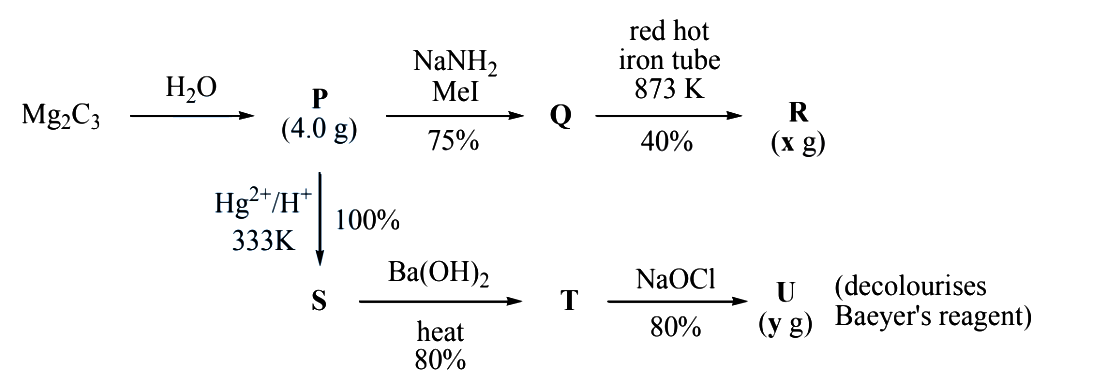
\(\mathbf{x} g\) and \(\mathbf{y} g\) are mass of \(\mathbf{R}\) and \(\mathbf{U}\), respectively.
(Use: Molar mass (in \(\mathrm{g} \mathrm{mol}^{-1}\) ) of \(\mathrm{H}, \mathrm{C}\) and \(\mathrm{O}\) as 1,12 and 16 , respectively)
The value of is ___.JEE Advanced 2021 Medium - Let be such that Then equalsJEE Advanced 2016 Easy
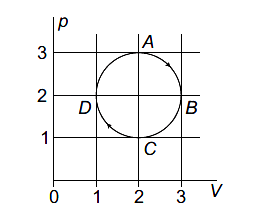
- The figure shows the \(p-V\) plot of an ideal gas taken through a cycle \(A B C D A\). The part \(A B C\) is a semi-circle and \(C D A\) is half of an ellipse. Then,
 JEE Advanced 2009 Medium
 - Let \(\theta \in\left(0, \frac{\pi}{4}\right)\) and \(t_1=(\tan \theta)^{\tan \theta},\) \(t_2=(\tan \theta)^{\cot \theta}\) and \(t_4=(\cot \theta)^{\tan \theta}\), thenJEE Advanced 2006 Easy