


JEE Advanced · Mathematics · 18. Matrices
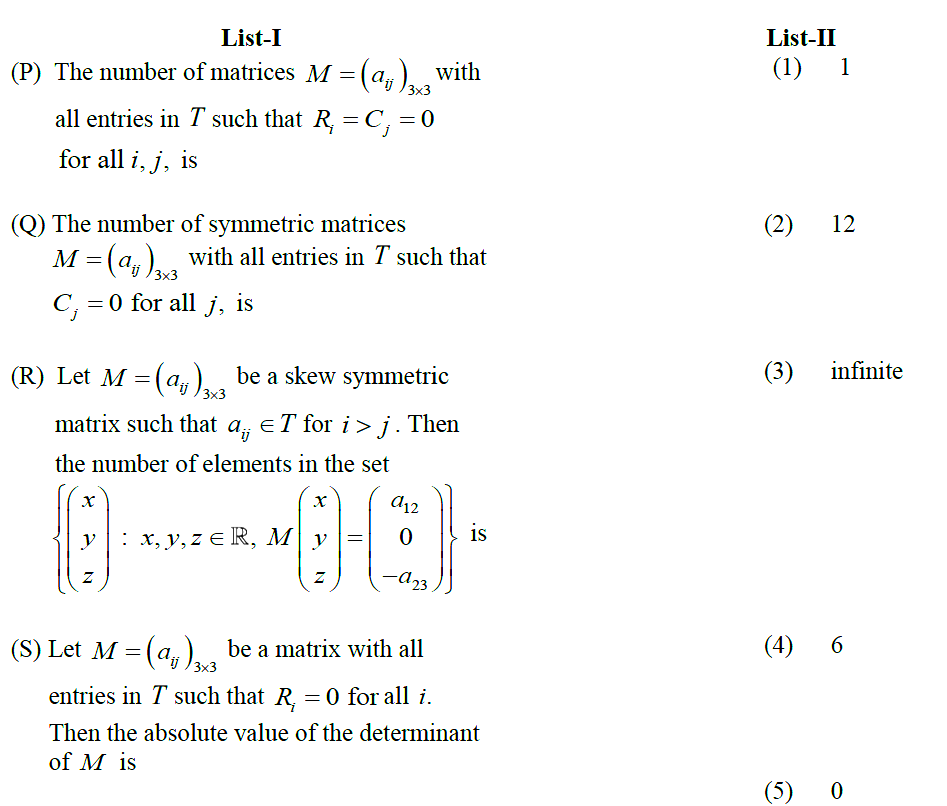
Let \(\alpha\) and \(\beta\) be the distinct roots of the equation \(x^2+x-1=0\). Consider the set \(T=\{1, \alpha, \beta\}\). For a \(3 \times 3\) matrix \(M=\left(a_{i j}\right)_{3 \times 3}\), define \(R_i=a_{i 1}+a_{i 2}+a_{i 3}\) and \(C_j=a_{1 j}+a_{2 j}+a_{3 j}\) for \(i=1,2,3\) and \(j=1,2,3\).
Match each entry in List-I to the correct entry in List-II.
The correct option is
- A \((\mathrm{P}) \rightarrow(4) \quad(\mathrm{Q}) \rightarrow(2) \quad(\mathrm{R}) \rightarrow(5) \quad(\mathrm{S}) \rightarrow(1)\)
- B \((\mathrm{P}) \rightarrow(2) \quad(\mathrm{Q}) \rightarrow(4) \quad(\mathrm{R}) \rightarrow(1) \quad(\mathrm{S}) \rightarrow(5)\)
- C \((\mathrm{P}) \rightarrow(2) \quad(\mathrm{Q}) \rightarrow(4) \quad(\mathrm{R}) \rightarrow(3) \quad(\mathrm{S}) \rightarrow(5)\)
- D \((\mathrm{P}) \rightarrow(1) \quad(\mathrm{Q}) \rightarrow(5) \quad(\mathrm{R}) \rightarrow(3) \quad(\mathrm{S}) \rightarrow(4)\)
Answer & Solution
Correct Answer
(C) \((\mathrm{P}) \rightarrow(2) \quad(\mathrm{Q}) \rightarrow(4) \quad(\mathrm{R}) \rightarrow(3) \quad(\mathrm{S}) \rightarrow(5)\)
Step-by-step Solution
Detailed explanation
\(\begin{aligned} & \alpha, \beta \text { are roots of } \mathrm{x}^2+\mathrm{x}-1=0 \\ & \therefore \alpha+\beta=-1 \Rightarrow 1+\alpha+\beta=0 \\ & M=\left[\begin{array}{lll}\mathrm{a}_{11} & \mathrm{a}_{12} & \mathrm{a}_{13} \\ \mathrm{a}_{21} & \mathrm{a}_{22} & \mathrm{a}_{23} \\ \mathrm{a}_{31} & \mathrm{a}_{32} & \mathrm{a}_{33}\end{array}\right]\end{aligned}\)
(P)
\(M=\left[\begin{array}{lll}1 & \alpha & \beta \\\alpha & \beta & 1 \\\beta & 1 & \alpha\end{array}\right] \Rightarrow 3!\times 2=12\)
For one arrangement of row 1 we can arrange other two rows exactly in two ways and row 1 can be arranged in 3 ! ways
\(\therefore 3!\times 2=12 \text { ways }\)
(Q)
\(M=\left[\begin{array}{lll}x & a & b \\ a & y & c \\ b & c & z\end{array}\right] \Rightarrow\) Consider one such arrangement with \(a=\alpha, b=\beta, c=1\)
\(M=\left[\begin{array}{lll}1 & \alpha & \beta \\ \alpha & \beta & 1 \\ \beta & 1 & \alpha\end{array}\right]\)
a, b, c can be arranged in \(3 !\) ways and corresponding entries can be arranged in 1 way.
(R)
\(\left[\begin{array}{ccc}0 & a & b \\ -a & 0 & c \\ -b & -c & 0\end{array}\right]\left[\begin{array}{l}x \\ y \\ z\end{array}\right]=\left[\begin{array}{c}a \\ 0 \\ -c\end{array}\right]\)
\(\begin{aligned}& a y+b z=a \\& -a x+c z=0 \\& -b x-c y=-c\end{aligned}\)
It is observed that \(\mathrm{D}=\mathrm{D}_{\mathrm{x}}=\mathrm{D}_{\mathrm{y}}=\mathrm{D}_{\mathrm{z}}=0\)
\(\therefore\) infinite solution
(S)
\(\left[\begin{array}{lll}1 & \alpha & \beta \\ \beta & \alpha & 1 \\ \alpha & 1 & \beta\end{array}\right]\)
\(\Rightarrow \alpha \beta-1-\alpha \beta^2+\alpha^2+\beta^2-\alpha^2 \beta=0 \quad(\) since \(\alpha \beta=\alpha+\beta=-1\) )
(P)
\(M=\left[\begin{array}{lll}1 & \alpha & \beta \\\alpha & \beta & 1 \\\beta & 1 & \alpha\end{array}\right] \Rightarrow 3!\times 2=12\)
For one arrangement of row 1 we can arrange other two rows exactly in two ways and row 1 can be arranged in 3 ! ways
\(\therefore 3!\times 2=12 \text { ways }\)
(Q)
\(M=\left[\begin{array}{lll}x & a & b \\ a & y & c \\ b & c & z\end{array}\right] \Rightarrow\) Consider one such arrangement with \(a=\alpha, b=\beta, c=1\)
\(M=\left[\begin{array}{lll}1 & \alpha & \beta \\ \alpha & \beta & 1 \\ \beta & 1 & \alpha\end{array}\right]\)
a, b, c can be arranged in \(3 !\) ways and corresponding entries can be arranged in 1 way.
(R)
\(\left[\begin{array}{ccc}0 & a & b \\ -a & 0 & c \\ -b & -c & 0\end{array}\right]\left[\begin{array}{l}x \\ y \\ z\end{array}\right]=\left[\begin{array}{c}a \\ 0 \\ -c\end{array}\right]\)
\(\begin{aligned}& a y+b z=a \\& -a x+c z=0 \\& -b x-c y=-c\end{aligned}\)
It is observed that \(\mathrm{D}=\mathrm{D}_{\mathrm{x}}=\mathrm{D}_{\mathrm{y}}=\mathrm{D}_{\mathrm{z}}=0\)
\(\therefore\) infinite solution
(S)
\(\left[\begin{array}{lll}1 & \alpha & \beta \\ \beta & \alpha & 1 \\ \alpha & 1 & \beta\end{array}\right]\)
\(\Rightarrow \alpha \beta-1-\alpha \beta^2+\alpha^2+\beta^2-\alpha^2 \beta=0 \quad(\) since \(\alpha \beta=\alpha+\beta=-1\) )
See the Complete Solution
Get step-by-step explanations for this and 2.5 Lakh+ more JEE, NEET & CET questions.
- Unlock all solutions
- Practice the full chapter
- Track accuracy across PYQs
4.8 rated on Google Play · 14,000+ reviews
More questions from Mathematics
- Paragraph:
The circle \(x^2+y^2-8 x=0\) and hyperbola \(\frac{x^2}{9}-\frac{y^2}{4}=1\) intersect at the points \(A\) and \(B\).Question:
Equation of the circle with \(A B\) as its diameter isJEE Advanced 2010 Easy - If \(P\) is a \(3 \times 3\) matrix such that \(P^{T}=2 P+I\), where \(P^{T}\) is the transpose of \(P\) and \(I\) is the \(3 \times 3\) identity matrix, then there exists a column matrix \(\quad X=\left[\begin{array}{l}x \\ y \\ z\end{array}\right] \neq\left[\begin{array}{l}0 \\ 0 \\ 0\end{array}\right]\) such thatJEE Advanced 2012 Medium
- Let denote the number of elements in set Let be a sample space, where each element is equally likely to occur. If and are independent events associated with then the number of ordered pairs such that equalsJEE Advanced 2019 Hard
- Consider a triangle \(A B C\) and let \(a, b\) and \(c\) denote the lengths of the sides opposite to vertices \(A, B\) and \(C\) respectively. Suppose \(a=6, b=10\) and the area of the triangle is \(15 \sqrt{3}\). If \(\angle A C B\) is obtuse and if \(r\) denotes the radius of the incircle of the triangle, then \(r^2\) is equal toJEE Advanced 2010 Easy
- Consider the equation . Which of the following statements is/are TRUE?JEE Advanced 2022 Medium
- The ellipse \(E_{1}: \frac{x^{2}}{9}+\frac{y^{2}}{4}=1\) is inscribed in a rectangle \(R\) whose sides are parallel to the coordinate axes. Another ellipse \(E_{2}\) passing through the point \((0,4)\) circumscribes the rectangle \(R\). The eccentricity of the ellipse \(E_{2}\) isJEE Advanced 2012 Easy
More PYQs from JEE Advanced
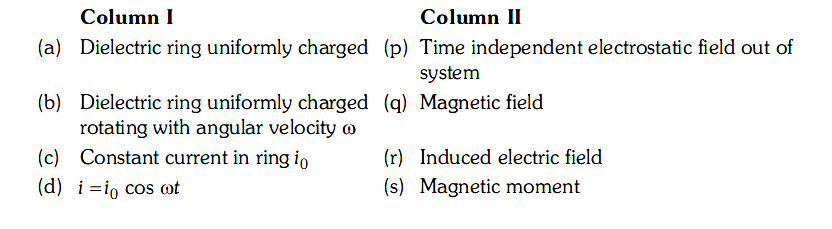
- Match the following columns
 JEE Advanced 2006 Hard
 - Let \(E^c\) denotes the complement of an event \(E\). Let \(E, F, G\) be pairwise independent events with \(P(G)>0\) and \(P(E \cap F \cap G)=0\). Then, \(P\left(E^c \cap F^c \mid G\right)\) equalsJEE Advanced 2007 Medium
- The hyperconjugative stabilities of tert-butyl cation and 2-butene, respectively, due toJEE Advanced 2013 Medium
- Paragraph:
Read the following passage and answer the questions.
Let \(A B C D\) be a square of side length 2 units. \(C_2\) is the circle through vertices \(A, B, C, D\) and \(C_1\) is the circle touching all the sides of square \(A B C D\). \(L\) is the line through \(A\).Question:
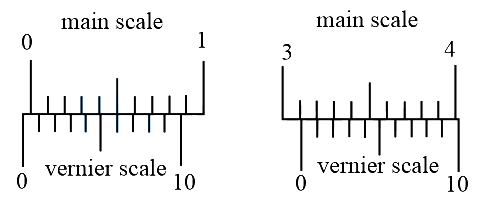
If \(P\) is a point on \(C_1\) and \(Q\) is a point on \(C_2\), then \(\frac{P A^2+P B^2+P C^2+P D^2}{Q A^2+Q B^2+Q C^2+Q D^2}\) is equal toJEE Advanced 2006 Hard - The smallest division on the main scale of a Vernier calipers is . Ten divisions of the Vernier scale correspond to nine divisions of the main scale. The figure below on the left shows the reading of this calipers with no gap between its two jaws. The figure on the right shows the reading with a solid sphere held between the jaws. The correct diameter of the sphere is
 JEE Advanced 2021 Medium
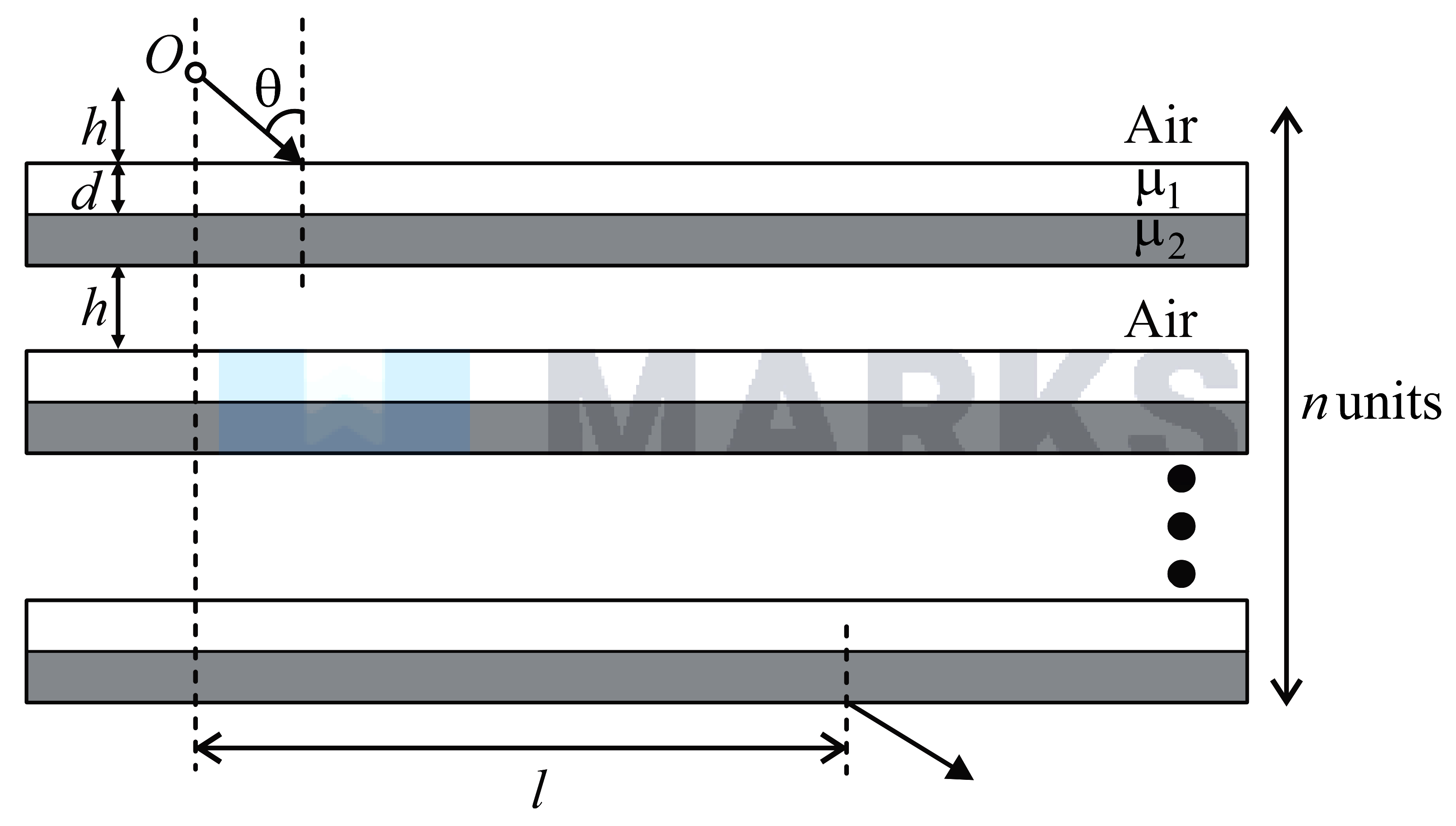
 - Consider a configuration of identical units, each consisting of three layers. The first layer is a column of air of height , and the second and third layers are of equal thickness , and refractive indices and , respectively. A light source is placed on the top of the first unit, as shown in the figure. A ray of light from is incident on the second layer of the first unit at an angle of to the normal. For a specific value of , the ray of light emerges from the bottom of the configuration at a distance , as shown in the figure. The value of is _______.
 JEE Advanced 2022 Hard