


JEE Advanced · Mathematics · 13. Parabola
Let \(A\) and \(B\) be two distinct points on the parabola \(y^2=4 x\). If the axis of the parabola touches a circle of radius \(r\) having \(A B\) as its diameter, then the slope of the line joining \(A\) and \(B\) can be
- A
\(-\frac{1}{r}\)
- B
\(\frac{1}{r}\)
- C
\(\frac{2}{r}\)
- D
\(-\frac{2}{r}\)
Answer & Solution
Correct Answer
(D)
\(-\frac{2}{r}\)
Step-by-step Solution
Detailed explanation
Here, coordinate \(M=\left(\frac{t_1^2+t_2^2}{2}, t_1+t_2\right) i e\), mid point of chord \(A B\).
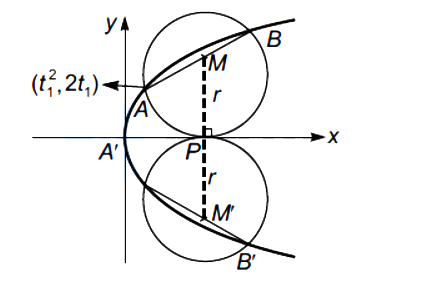
\(M P=t_1+t_2=r\) Also, \(\quad m_{A B}=\frac{2 t_2-2 t_1}{t_2^2-t_1^2}=\frac{2^{\ldots(i)}}{t_2+t_1}\) (when \(A B\) is chord)
\[
\Rightarrow \quad m_{A B}=\frac{2}{r}
\]
[from Eq. (i)]
Also, \(\quad m_{A^{\prime} B^{\prime}}=-\frac{2}{r}\) (when \(A^{\prime} B^{\prime}\) is chord)
Hence, (c, d) is the correct option.
\(M P=t_1+t_2=r\) Also, \(\quad m_{A B}=\frac{2 t_2-2 t_1}{t_2^2-t_1^2}=\frac{2^{\ldots(i)}}{t_2+t_1}\) (when \(A B\) is chord)
\[
\Rightarrow \quad m_{A B}=\frac{2}{r}
\]
[from Eq. (i)]
Also, \(\quad m_{A^{\prime} B^{\prime}}=-\frac{2}{r}\) (when \(A^{\prime} B^{\prime}\) is chord)
Hence, (c, d) is the correct option.
See the Complete Solution
Get step-by-step explanations for this and 2.5 Lakh+ more JEE, NEET & CET questions.
- Unlock all solutions
- Practice the full chapter
- Track accuracy across PYQs
4.8 rated on Google Play · 14,000+ reviews
More questions from Mathematics
- If \(x^2-10 a x-11 b=0\) have roots \(c\) and \(d\) and \(x^2-10 c x-11 d=0\) have roots \(a\) and \(b\), then, find \(a+b+c+d\).JEE Advanced 2006 Hard
- A rectangular sheet of fixed perimeter with sides having their lengths in the ratio is converted into an open rectangular box by folding after removing squares of equal area from all four corners. If the total area of removed squares is , the resulting box has maximum volume. Then the lengths of the sides of the rectangular sheet are:JEE Advanced 2013 Hard
- Let \(P Q R\) be a triangle of area \(\Delta\) with \(a=2, b=\frac{7}{2}\) and \(c=\frac{5}{2} ;\) where \(a, b\), and \(c\) are the lengths of the sides of the triangle opposite to the angles at \(P, Q\) and \(R\) respectively. Then \(\frac{2 \sin P-\sin 2 P}{2 \sin P+\sin 2 P}\) equals.JEE Advanced 2012 Medium
- Let \(\vec{w}=\hat{i}+\hat{j}-2 \hat{k}\), and \(\overrightarrow{\mathrm{u}}\) and \(\overrightarrow{\mathrm{v}}\) be two vectors such that \(\vec{u} \times \vec{v}=\vec{w}\) and \(\vec{v} \times \vec{w}=\vec{u}\). Let \(\alpha, \beta, \gamma\) and \(t\) be real numbers such that \(\vec{u}=\alpha \hat{i}+\beta \hat{j}+\gamma \hat{k},-t \alpha+\beta+\gamma=0, \alpha-t \beta+\gamma=0\), and \(\alpha+\beta-t \gamma=0\).
Match each entry in List-I to the correct entry in List-II and choose the correct option.
LIST - I LIST - II (P) \(|\vec{v}|^2\) is equal to (1) 0 (Q) If \(\alpha=\sqrt{3}\),then \(\gamma^2\) is equal to (2) 1 (R) If \(\alpha=\sqrt{3}\),then \((\beta+\gamma)^2\) is equal to (3) 2 (S) If \(\alpha=\sqrt{2}\),then \(t+3\) is equal to (4) 3 (5) 5 JEE Advanced 2025 Hard - Let determine diagonals of a parallelogram PQRS and be another vector. Then the volume of the parallelepiped determined by the vectors isJEE Advanced 2013 Medium
- If \(\mathbf{a}, \mathbf{b}, \mathbf{c}\) and \(\mathbf{d}\) are the unit vectors such that \((\mathbf{a} \times \mathbf{b}) \cdot(\mathbf{c} \times \mathbf{d})=1\) and \(\mathbf{a} \cdot \mathbf{c}=\frac{1}{2}\), thenJEE Advanced 2009 Hard
More PYQs from JEE Advanced
- The spin only magnetic moment value (in Bohr magneton units) of \(\mathrm{Cr}(\mathrm{CO})_6\) isJEE Advanced 2009 Easy
- Let \(f_{1}:(0, \infty) \rightarrow \mathbb{R}\) and \(f_{2}:(0, \infty) \rightarrow \mathbb{R}\) be defined by
\[
f_{1}(x)=\int_{0}^{x} \prod_{j=1}^{21}(t-j)^{j} d t, \quad x>0
\]
and
\(
f_{2}(x)=98(x-1)^{50}-600(x-1)^{49}+2450, \quad x>0
\)
where, for any positive integer \(n\) and real numbers \(a_{1}, a_{2}, \ldots, a_{n}, \prod_{i=1}^{n} a_{i}\) denotes the product of \(a_{1}, a_{2}, \ldots, a_{n} .\) Let \(m_{i}\) and \(n_{i}\), respectively, denote the number of points of local minima and the number of points of local maxima of function \(f_{i}, i=1,2\), in the interval \((0, \infty)\).
The value of is _____.JEE Advanced 2021 Medium - Paragraph:
Consider the polynomial \(f(x)=1+2 x+3 x^2+4 x^3\). Let \(s\) be the sum of all distinct real roots of \(f(x)\) and let \(t=|s|\).Question:
The real number \(s\) lies in the intervalJEE Advanced 2010 Medium - Paragraph:
In a thin rectangular metallic strip a constant current \(I\) flows along the positive \(x\)-direction, as shown in the figure. The length, width and thickness of the strip are \(l, w\) and \(d\), respectively.
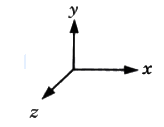
A uniform magnetic field \(\vec{B}\) is applied on the strip along the positive \(y\)-direction. Due to this, the charge carriers experience a net deflection along the \(z\)-direction. This results in accumulation of charge carriers on the surface \(P Q R S\) and appearance of equal and opposite charges on the face opposite to \(P Q R S\). A potential difference along the \(z\)-direction is thus developed. Charge accumulation continues until the magnetic force is balanced by the electric force. The current is assumed to be uniformly distributed on the cross section of the strip and carried by electrons.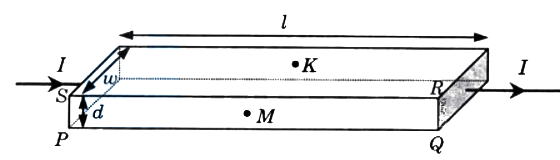
Question:
Consider two different metallic strips (\(1\) and \(2\)) of same dimensions (length \(l\), width \(w\) and thickness \(d\) ) with carrier densities \(n_{1}\) and \(n_{2}\), respectively. Strip \(1\) is placed in magnetic field \(B_{1}\) and strip \(2\) is placed in magnetic field \(B_{2}\), both along positive \(y\)-directions. Then \(V_{1}\) and \(V_{2}\) are the potential differences developed between \(K\) and \(M\) in strips \(1\) and \(2\), respectively. Assuming that the current \(I\) is the same for both the strips, the correct option(s) is(are)JEE Advanced 2015 Medium - The correct option(s) related to the extraction of iron from its ore in the blast furnace operating in the temperature range is(are)JEE Advanced 2022 Medium
- Consider an obtuse angled triangle in which the difference between the largest and the smallest angle is and whose sides are in arithmetic progression. Suppose that the vertices of this triangle lie on a circle of radius .
(There are two questions based on , the question given below is one of them)
Then the inradius of the triangle isJEE Advanced 2023 Medium