


JEE Advanced · Mathematics · 5. Sequences & Series
Let \(a_1, a_2, a_3, \ldots ., a_{100}\) be an arithmetic progression with \(a_1=3\) and \(S_p=\sum_{i=1}^p a_i\), \(1 \leq p \leq 100\). For any integer \(n\) with \(1 \leq n \leq 20\), let \(m=5 n\). If \(\frac{S_m}{S_n}\) does not depend on \(n\), then \(a_2\) is
- A 1
- B 2
- C 3
- D 4
Answer & Solution
Correct Answer
(C) 3
Step-by-step Solution
Detailed explanation
Given, \(a_1=3, m=5 n\) and \(a_1, a_2, \ldots\) are in AP. \(\therefore \frac{S_m}{S_n}=\frac{S_{5 n}}{S_n}\) is independent of \(n\). Now, \( \frac{\frac{5 n}{2}[2 \times 3+(5 n-1) d]}{\frac{n}{2}[2 \times 3+(n-1) d]}\) \(\Rightarrow \frac{f\{(6-d)+5 n\}}{(6-d)+n}\) independent of \(n\), if \(\begin{aligned} 6-d= & 0 \Rightarrow d=6 \\ \therefore a_2= & a_1+d=3+6=9 \\ & \text { Or }\end{aligned}\)
If \(d=0\) \(\frac{S_m}{S_n}\) is independent of \(n\).
\(\therefore a_2=3\)
If \(d=0\) \(\frac{S_m}{S_n}\) is independent of \(n\).
\(\therefore a_2=3\)
See the Complete Solution
Get step-by-step explanations for this and 2.5 Lakh+ more JEE, NEET & CET questions.
- Unlock all solutions
- Practice the full chapter
- Track accuracy across PYQs
4.8 rated on Google Play · 14,000+ reviews
More questions from Mathematics
- The common tangents to the circle and the parabola touch the circle at the points P, and Q the parabola at the points R, S. Then the area of the quadrilateral PQRS isJEE Advanced 2014 Easy
- Two lines and are coplanar. Then can take value(s)JEE Advanced 2013 Easy
- Let \(E\) and \(F\) be two independent events. The probability that exactly one of them occurs is \(11 / 25\) and the probability of none of them occurring is \(2 / 25\). If \(P(T)\) denotes the probability of occurrence of the event \(T\), thenJEE Advanced 2011 Hard
- Let the circles and intersect at the points and Suppose that another circle satisfies the following conditions:
centre of is collinear with the centres of and
and both lie inside and
touches at and at
Let the line through and intersect at and and let a common tangent of and be a tangent to the parabola
There are some expression given in the List- whose values are given in List- below:
List- List- II
Which of the following is the only INCORRECT combination?JEE Advanced 2019 Medium - The maximum value of the function \(f(x)=2 x^3-15 x^2+36 x-48\) on the set \(A=\left\{x \mid x^2+20 \leq 9 x\right\}\) isJEE Advanced 2009 Hard
- For a polynomial with real coefficients, let denote the number of distinct real roots of . Suppose is the set of polynomials with real coefficients defined by . For a polynomial , let and denote its first and second order derivatives respectively. Then the minimum possible value of , where , is ____JEE Advanced 2020 Medium
More PYQs from JEE Advanced
- Let \(y^{\prime}(x)+y(x) g^{\prime}(x)=g(x) g^{\prime}(x) y(0)=0, x \in R\), where \(f^{\prime}(x)\) denotes \(\frac{d f(x)}{d x}\) and \(g(x)\) is a given non-constant differentiable function on \(R\) with \(g(0)=g(2)=0\). Then, the value of \(y\) (2) is...JEE Advanced 2011 Easy
- Paragraph:
A fair die is tossed repeatedly until a six is obtained. Let \(X\) denotes the number of tosses required.Question:
The probability that \(X=3\) equalsJEE Advanced 2009 Easy - With reference to the scheme given below, which of the given statement(s) about \(\mathrm{T}, \mathrm{U}, \mathrm{V}\) and \(\mathrm{W}\) is (are) correct?
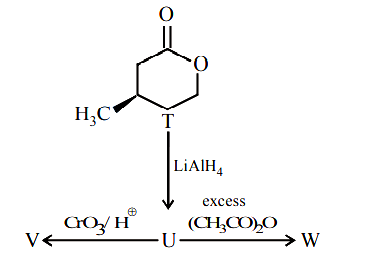 JEE Advanced 2012 Medium
 - Half-life of a radio active substance ' \(A\) ' is 4 days. The probability that a nucleus will decay in two half-lives isJEE Advanced 2006 Easy
- A bag contains \(N\) balls out of which 3 balls are white, 6 balls are green, and the remaining balls are blue. Assume that the balls are identical otherwise. Three balls are drawn randomly one after the other without replacement. For \(i=1,2,3\), let \(W_i, G_i\), and \(B_i\) denote the events that the ball drawn in the \(i^{\text {th }}\) draw is a white ball, green ball, and blue ball, respectively. If the probability \(P\left(W_1 \cap G_2 \cap B_3\right)=\frac{2}{5 N}\) and the conditional probability \(P\left(B_3 \mid W_1 \cap G_2\right)=\frac{2}{9}\), then \(N\) equals ________.JEE Advanced 2024 Medium
- If \(I_n=\int_{-\pi}^\pi \frac{\sin n x}{\left(1+\pi^x\right) \sin x} d x ; n=0,1,2\), \(\ldots\), thenJEE Advanced 2009 Medium