


JEE Advanced · Mathematics · 27. Definite Integration
If \(I_n=\int_{-\pi}^\pi \frac{\sin n x}{\left(1+\pi^x\right) \sin x} d x ; n=0,1,2\), \(\ldots\), then
- A
\(I_n=I_{n+2}\)
- B
\(\sum_{m=1}^{10} I_{2 m+1}=10 \pi\)
- C
\(\sum_{m=1}^{10} I_{2 m}=0\)
- D
\(I_n=I_{n+1}\)
Answer & Solution
Correct Answer
(A)
\(I_n=I_{n+2}\)
Step-by-step Solution
Detailed explanation
(a)
\[
\begin{aligned}
& I_n=\int_{-\pi}^\pi \frac{\sin n x}{\left(1+\pi^x\right) \sin x} d x \\
& I_n=\int_{-\pi}^\pi \frac{\pi^x \sin n x}{\left(1+\pi^x\right) \sin x} d x \\
& {\left[\because \int_a^b f(x) d x=\int_a^b f(a+b-x) d x\right]} \\
& 2 I_n=\int_{-\pi}^\pi \frac{\sin n x}{\sin x} d x
\end{aligned}
\]
\[
\begin{aligned}
& \Rightarrow \quad 2 I_n=2 \int_0^\pi \frac{\sin n x}{\sin x} d x \\
& \Rightarrow \quad I_n=\int_0^\pi \frac{\sin n x}{\sin x} d x \\
& \text { Now, } \quad I_{n+2}-I_n \\
& =\int_0^\pi \frac{\sin (n+2) x-\sin n x}{\sin x} d x \\
& =\int_0^\pi \frac{2 \cos (n+1) x \sin x}{\sin x} d x \\
& =2\left[\frac{\sin (n+1) x}{(n+1)}\right]_0^\pi=0 \\
& \Rightarrow \quad I_{n+2}=I_n \\
& \text { (b) As } I_3=I_5=\ldots=I_{21} \\
& \therefore \sum_{m=1}^{10} I_{2 m+1}=10 I_3=10 \int_0^\pi \frac{\sin 3 x}{\sin x} d x \\
& =10 \int_0^\pi\left(3-4 \sin ^2 x\right) d x \\
& =10[3 x-2 x+\sin 2 x]_0^\pi=10 \pi \\
& \text { (c) As } \quad I_2=I_4=\ldots=I_{20} \\
& \therefore \quad \sum_{m=1}^{10} I_{2 m}=10 \int_0^\pi \frac{\sin 2 x}{\sin x} d x \\
& =20[\sin x]_0^\pi=0 \\
&
\end{aligned}
\]
\[
\begin{aligned}
& I_n=\int_{-\pi}^\pi \frac{\sin n x}{\left(1+\pi^x\right) \sin x} d x \\
& I_n=\int_{-\pi}^\pi \frac{\pi^x \sin n x}{\left(1+\pi^x\right) \sin x} d x \\
& {\left[\because \int_a^b f(x) d x=\int_a^b f(a+b-x) d x\right]} \\
& 2 I_n=\int_{-\pi}^\pi \frac{\sin n x}{\sin x} d x
\end{aligned}
\]
\[
\begin{aligned}
& \Rightarrow \quad 2 I_n=2 \int_0^\pi \frac{\sin n x}{\sin x} d x \\
& \Rightarrow \quad I_n=\int_0^\pi \frac{\sin n x}{\sin x} d x \\
& \text { Now, } \quad I_{n+2}-I_n \\
& =\int_0^\pi \frac{\sin (n+2) x-\sin n x}{\sin x} d x \\
& =\int_0^\pi \frac{2 \cos (n+1) x \sin x}{\sin x} d x \\
& =2\left[\frac{\sin (n+1) x}{(n+1)}\right]_0^\pi=0 \\
& \Rightarrow \quad I_{n+2}=I_n \\
& \text { (b) As } I_3=I_5=\ldots=I_{21} \\
& \therefore \sum_{m=1}^{10} I_{2 m+1}=10 I_3=10 \int_0^\pi \frac{\sin 3 x}{\sin x} d x \\
& =10 \int_0^\pi\left(3-4 \sin ^2 x\right) d x \\
& =10[3 x-2 x+\sin 2 x]_0^\pi=10 \pi \\
& \text { (c) As } \quad I_2=I_4=\ldots=I_{20} \\
& \therefore \quad \sum_{m=1}^{10} I_{2 m}=10 \int_0^\pi \frac{\sin 2 x}{\sin x} d x \\
& =20[\sin x]_0^\pi=0 \\
&
\end{aligned}
\]
See the Complete Solution
Get step-by-step explanations for this and 2.5 Lakh+ more JEE, NEET & CET questions.
- Unlock all solutions
- Practice the full chapter
- Track accuracy across PYQs
4.8 rated on Google Play · 14,000+ reviews
More questions from Mathematics
- A plane passes through \((1,-2,1)\) and is perpendicular to two planes \(2 x-2 y+z=0\) and \(x-y+2 z=4\), then the distance of the plane from the point \((1,2,2)\) isJEE Advanced 2006 Medium
- A bag contains \(N\) balls out of which 3 balls are white, 6 balls are green, and the remaining balls are blue. Assume that the balls are identical otherwise. Three balls are drawn randomly one after the other without replacement. For \(i=1,2,3\), let \(W_i, G_i\), and \(B_i\) denote the events that the ball drawn in the \(i^{\text {th }}\) draw is a white ball, green ball, and blue ball, respectively. If the probability \(P\left(W_1 \cap G_2 \cap B_3\right)=\frac{2}{5 N}\) and the conditional probability \(P\left(B_3 \mid W_1 \cap G_2\right)=\frac{2}{9}\), then \(N\) equals ________.JEE Advanced 2024 Medium
- In the following \([x]\) denotes the greatest integer less than or equal to \(x\). Match the functions in Column I with the properties Column II.
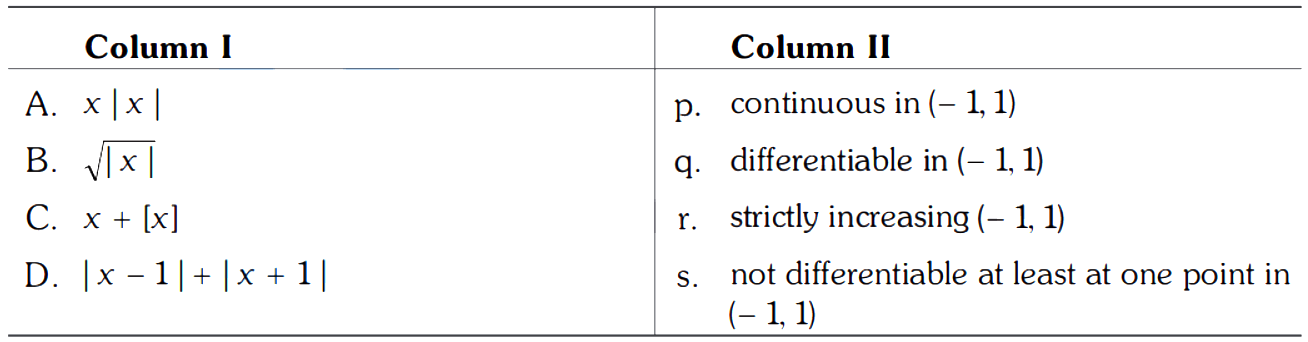 JEE Advanced 2007 Hard
 - Let . For let be the number of subsets of , each containing five elements out of which exactly are odd. ThenJEE Advanced 2017 Easy
- Let be the set of all complex numbers satisfying . Then which of the following statements is/are TRUE?JEE Advanced 2020 Hard
- Let \(I=\left(\begin{array}{ll}1 & 0 \\ 0 & 1\end{array}\right)\) and \(P=\left(\begin{array}{ll}2 & 0 \\ 0 & 3\end{array}\right)\). Let \(Q=\left(\begin{array}{ll}\mathrm{x} & \mathrm{y} \\ \mathrm{z} & 4\end{array}\right)\) for some non-zero real numbers \(x, y\), and \(z\), for which there is \(2 \times 2\) matrix \(R\) with all entries being non-zero real numbers, such that \(Q R=R P\). Then which of the following statements is (are) TRUE?JEE Advanced 2025 Medium
More PYQs from JEE Advanced
- Let \(f(x)=(1-x)^{2} \sin ^{2} x+x^{2}\) for all \(x \in I R\) and let \(g(x)=\int_{1}^{x}\left(\frac{2(t-1)}{t+1}-\ln t\right) f(t) d t\) for all \(x \in(1, \infty)\).
Question: Which of the following is true?JEE Advanced 2012 Hard - Paragraph:
Consider an evacuated cylindrical chamber of height \(h\) having rigid conducting plates at the ends and an insulating curved surface as shown in the figure. A number of spherical balls made of a light weight and soft material and coated with a conducting material are placed on the bottom plate. The balls have a radius \(r \ll h\). Now a high voltage source \((HV)\) is connected across the conducting plates such that the bottom plate is at \(+V_{0}\) and the top plate at \(-V_{0} .\) Due to their conducting surface, the balls will get charged, will become equipotential with the plate and are repelled by it. The balls will eventually collide with the top plate, where the coefficient of restitution can be taken to be zero due to the soft nature of the material of the balls. The electric field in the chamber can be considered to be that of a parallel plate capacitor. Assume that there are no collisions between the balls and the interaction between them is negligible. (Ignore gravity)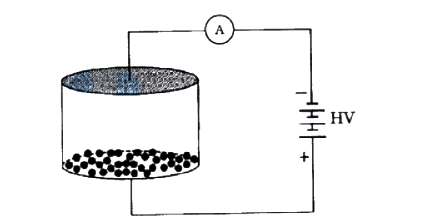
Question:
The average current in the steady state registered by the ammeter in the circuit will beJEE Advanced 2016 Medium - Let \(f\) be a real-valued function defined on the interval \((-1,1)\) such that \(e^{-x} f(x)=2+\int_0^x \sqrt{t^4+1} d t, \quad\) for all \(x \in(-1,1)\) and let \(f^{-1}\) be the inverse function of \(f\). Then \(\left(f^{-1}\right)^{\prime}(2)\) is equal toJEE Advanced 2010 Hard
- Let be a nonzero real number. Suppose is a differentiable function such that . If the derivative of satisfies the equation for all then which of the following statements is/are TRUE?JEE Advanced 2020 Easy
- Paragraph:
The mass of a nucleus \({ }_{Z}^{A} X\) is less than the sum of the masses of \((A-Z)\) number of neutrons and \(Z\) number of protons in the nucleus. The energy equivalent to the corresponding mass difference is known as the binding energy of the nucleus. A heavy nucleus of mass \(M\) can break into two light nuclei of masses \(m_{1}\) and \(m_{2}\) only if \(\left(m_{1}+m_{2}\right) \lt M\). Also two light nuclei of masses \(m_{3}\) and \(m_{4}\) can undergo complete fusion and form a heavy nucleus of mass \(M^{\prime}\) only if \(\left(m_{3}+m_{4}\right) \gt M^{\prime}\). The masses of some neutral atoms are given in the table below:
\(\left(1 u=932 M e V / c^{2}\right)\)
Question:
The kinetic energy (in \(k e V\) ) of the alpha particle, when the nucleus \({ }_{84}^{210} P o\) at rest undergoes alpha decay, isJEE Advanced 2013 Easy - The of is at . The solubility (in ) of in a solution isJEE Advanced 2013 Hard