


JEE Advanced · Mathematics · 8. Trigonometric Equations
Let \(\frac{\pi}{2} < x < \pi\) be such that \(\cot x=\frac{-5}{\sqrt{11}}\). Then \(\left(\sin \frac{11 x}{2}\right)(\sin 6 x-\cos 6 x)+\left(\cos \frac{11 x}{2}\right)(\sin 6 x+\cos 6 x)\) is equal to
- A \(\frac{\sqrt{11}-1}{2 \sqrt{3}}\)
- B \(\frac{\sqrt{11}+1}{2 \sqrt{3}}\)
- C \(\frac{\sqrt{11}+1}{3 \sqrt{2}}\)
- D \(\frac{\sqrt{11}-1}{3 \sqrt{2}}\)
Answer & Solution
Correct Answer
(B) \(\frac{\sqrt{11}+1}{2 \sqrt{3}}\)
Step-by-step Solution
Detailed explanation
Given,
\(\begin{aligned} & \cot x=-\frac{5}{\sqrt{11}} \\
& \frac{1-\tan ^2 \frac{x}{2}}{2 \tan \frac{x}{2}}=-\frac{5}{\sqrt{11}} \\
& \tan \frac{x}{2}=\sqrt{11},-\frac{1}{\sqrt{11}} \\
& \text{So, } \tan \frac{x}{2}=\sqrt{11}, \text { As } \frac{\pi}{4} < \frac{x}{2} < \frac{\pi}{2}\end{aligned}\)
\(\begin{aligned} & \text{As, } x \in\left(\frac{\pi}{2}, \pi\right) \\
& \text{Now, } \left(\sin \frac{11 x}{2}\right)(\sin 6 x-\cos 6 x)+\left(\cos \frac{11 x}{2}\right)(\sin 6 x+\cos 6 x) \\
& =\left\{\sin 6 x \sin \frac{11 x}{2}+\cos \frac{11 x}{2} \cos 6 x \right\} \\
& =\cos \left(6 x-\frac{11 x}{2}\right)+\sin \left(6 x-\frac{11 x}{2}\right) \\
& =\cos \frac{x}{2}+\sin \frac{x}{2} \\
& =\frac{1}{2 \sqrt{3}}+\frac{\sqrt{11}}{2 \sqrt{3}} \\
& =\frac{\sqrt{11}+1}{2 \sqrt{3}} \Rightarrow \text { Option (2) is correct. }\end{aligned}\)
\(\begin{aligned} & \cot x=-\frac{5}{\sqrt{11}} \\
& \frac{1-\tan ^2 \frac{x}{2}}{2 \tan \frac{x}{2}}=-\frac{5}{\sqrt{11}} \\
& \tan \frac{x}{2}=\sqrt{11},-\frac{1}{\sqrt{11}} \\
& \text{So, } \tan \frac{x}{2}=\sqrt{11}, \text { As } \frac{\pi}{4} < \frac{x}{2} < \frac{\pi}{2}\end{aligned}\)
\(\begin{aligned} & \text{As, } x \in\left(\frac{\pi}{2}, \pi\right) \\
& \text{Now, } \left(\sin \frac{11 x}{2}\right)(\sin 6 x-\cos 6 x)+\left(\cos \frac{11 x}{2}\right)(\sin 6 x+\cos 6 x) \\
& =\left\{\sin 6 x \sin \frac{11 x}{2}+\cos \frac{11 x}{2} \cos 6 x \right\} \\
& =\cos \left(6 x-\frac{11 x}{2}\right)+\sin \left(6 x-\frac{11 x}{2}\right) \\
& =\cos \frac{x}{2}+\sin \frac{x}{2} \\
& =\frac{1}{2 \sqrt{3}}+\frac{\sqrt{11}}{2 \sqrt{3}} \\
& =\frac{\sqrt{11}+1}{2 \sqrt{3}} \Rightarrow \text { Option (2) is correct. }\end{aligned}\)
See the Complete Solution
Get step-by-step explanations for this and 2.5 Lakh+ more JEE, NEET & CET questions.
- Unlock all solutions
- Practice the full chapter
- Track accuracy across PYQs
4.8 rated on Google Play · 14,000+ reviews
More questions from Mathematics
- Let and be defined by . Then is -JEE Advanced 2016 Easy
- Let be a thrice differentiable function. Suppose that and all Let for all .
If and then the correct expression(s) is(are)JEE Advanced 2015 Medium - Let be defined by Then which of the following statements is(are) TRUE?JEE Advanced 2021 Easy
- Let \(p(x)\) be a real polynomial of least degree which has a local maximum at \(x=1\) and a local minimum at \(x=3\). If \(p(1)=6\) and \(p(3)=2\), then \(p^{\prime}(0)\) isJEE Advanced 2012 Medium
- Let \(f:[1, \infty) \rightarrow[2, \infty)\) be a differentiable function such that \(f(1)=2\). If \(6 \int_1^x f(t) d t=3 x f(x)-x^3\) for all \(x \geq 1\), then the value of \(f(2)\) isJEE Advanced 2011 Easy
- Consider two straight lines, each of which is tangent to both the circle and the parabola . Let these lines intersect at the point . Consider the ellipse whose center is at the origin and whose semi-major axis is . If the length of the minor axis of this ellipse is , then the which of the following statement(s) is (are) TRUE?JEE Advanced 2018 Medium
More PYQs from JEE Advanced
- In the following reactions, and are the major products.
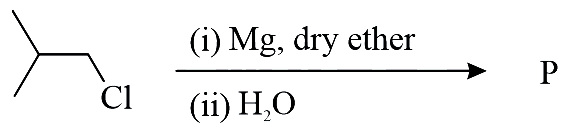
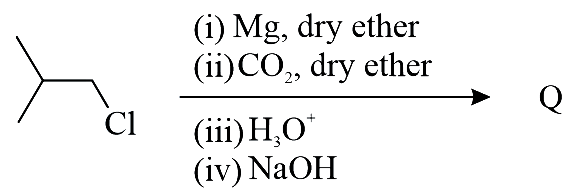
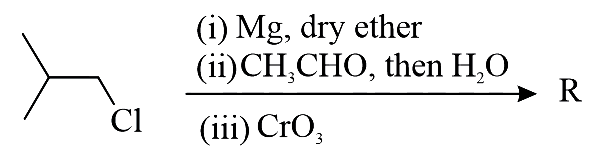
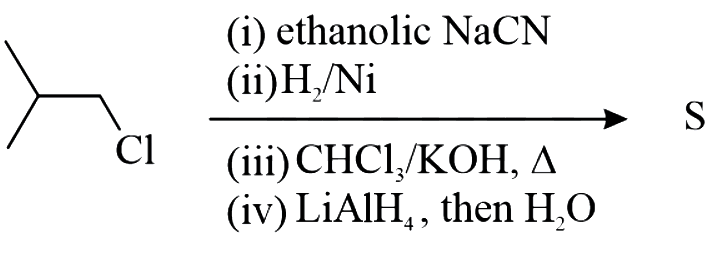
The correct statement about and isJEE Advanced 2023 Hard - A solution of colourless salt \(\mathrm{H}\) on boiling with excess \(\mathrm{NaOH}\) produces a non-flammable gas. The gas evolution ceases after sometime. Upon addition of \(\mathrm{Zn}\) dust to the same solution, the gas evolution restarts. The colourless salt (s) \(\mathrm{H}\) is (are)JEE Advanced 2008 Medium
- Let \(\left(x_0, y_0\right)\) be the solution of the following equations \((2 x)^{\log 2}=(3 y)^{\log 3}\), \(3^{\log x}=2^{\log y}\), then \(x_0\) is equal toJEE Advanced 2011 Medium
- Consider the region \(R=\left\{(x, y) \in \mathbb{R} \times \mathbb{R}: x \geq 0\right.\) and \(\left.y^{2} \leq 4-x\right\}\). Let \(\mathcal{F}\) be the family of all circles that are contained in \(R\) and have centers on the \(x\)-axis. Let \(C\) be the circle that has largest radius among the circles in \(\mathcal{F}\). Let \((\alpha, \beta)\) be a point where the circle \(C\) meets the curve \(y^{2}=4-x\).
The value of is _____.JEE Advanced 2021 Easy - Let be a differentiable function such that and . Let denote the base of the natural logarithm. Then the value of isJEE Advanced 2023 Easy
- Let \(k \in \mathbb{R}\). If \(\lim _{x \rightarrow 0^+}(\sin (\sin k x)+\cos x+x)^{\frac{2}{x}}=e^6\), then the value of \(k\) isJEE Advanced 2024 Easy