


JEE Advanced · Mathematics · 30. Vector Algebra
If \(\vec{a}, \vec{b}\) and \(\vec{c}\) are unit vectors satisfying \(|\vec{a}-\vec{b}|^{2}+|\vec{b}-\vec{c}|^{2}+|\vec{c}-\vec{a}|^{2}=9\), then \(|2 \vec{a}+5 \vec{b}+5 \vec{c}|\) is
- A 3
- B 8
- C 9
- D 1
Answer & Solution
Correct Answer
(A) 3
Step-by-step Solution
Detailed explanation
\(\begin{array}{l}
\because|\vec{a}|=|\vec{b}|=|\vec{c}|=1 \\
|\vec{a}-\vec{b}|^{2}+|\vec{b}-\vec{c}|^{2}+|\vec{c}-\vec{a}|^{2}=9 \\
\Rightarrow 2\left(|\vec{a}|^{2}+|\vec{b}|^{2}+|\vec{c}|^{2}\right)-2(\vec{a} \cdot \vec{b}+\vec{b} \cdot \vec{c}+\vec{c} \cdot \vec{a})=9 \\
\Rightarrow \vec{a} \cdot \vec{b}+\vec{b} \cdot \vec{c}+\vec{c} \cdot \vec{a}=\frac{-3}{2}
\end{array}\)
Also,
\(\begin{array}{l}
|\vec{a}+\vec{b}+\vec{c}|^{2}=|\vec{a}|^{2}+|\vec{b}|^{2}+|\vec{c}|^{2}+2(\vec{a} \cdot \vec{b}+\vec{b} \cdot \vec{c}+\vec{c} \cdot \vec{a}) \\
=1+1+1+2 \times\left(-\frac{3}{2}\right)=0 \\
\Rightarrow \vec{a}+\vec{b}+\vec{c}=0 \Rightarrow(\vec{b}+\vec{c})=-\vec{a} \\
\therefore|2 \vec{a}+5(\vec{b}+\vec{c})|=|2 \vec{a}-5 \vec{a}|=|-3 \vec{a}|=3
\end{array}\)
\because|\vec{a}|=|\vec{b}|=|\vec{c}|=1 \\
|\vec{a}-\vec{b}|^{2}+|\vec{b}-\vec{c}|^{2}+|\vec{c}-\vec{a}|^{2}=9 \\
\Rightarrow 2\left(|\vec{a}|^{2}+|\vec{b}|^{2}+|\vec{c}|^{2}\right)-2(\vec{a} \cdot \vec{b}+\vec{b} \cdot \vec{c}+\vec{c} \cdot \vec{a})=9 \\
\Rightarrow \vec{a} \cdot \vec{b}+\vec{b} \cdot \vec{c}+\vec{c} \cdot \vec{a}=\frac{-3}{2}
\end{array}\)
Also,
\(\begin{array}{l}
|\vec{a}+\vec{b}+\vec{c}|^{2}=|\vec{a}|^{2}+|\vec{b}|^{2}+|\vec{c}|^{2}+2(\vec{a} \cdot \vec{b}+\vec{b} \cdot \vec{c}+\vec{c} \cdot \vec{a}) \\
=1+1+1+2 \times\left(-\frac{3}{2}\right)=0 \\
\Rightarrow \vec{a}+\vec{b}+\vec{c}=0 \Rightarrow(\vec{b}+\vec{c})=-\vec{a} \\
\therefore|2 \vec{a}+5(\vec{b}+\vec{c})|=|2 \vec{a}-5 \vec{a}|=|-3 \vec{a}|=3
\end{array}\)
See the Complete Solution
Get step-by-step explanations for this and 2.5 Lakh+ more JEE, NEET & CET questions.
- Unlock all solutions
- Practice the full chapter
- Track accuracy across PYQs
4.8 rated on Google Play · 14,000+ reviews
More questions from Mathematics
- Let \(p(x)\) be a real polynomial of least degree which has a local maximum at \(x=1\) and a local minimum at \(x=3\). If \(p(1)=6\) and \(p(3)=2\), then \(p^{\prime}(0)\) isJEE Advanced 2012 Medium
- Let \(a\) and \(b\) be non-zero and real numbers. Then, the equation \(\left(a x^2+b y^2+c\right)\left(x^2-5 x y+6 y^2\right)=0\) representsJEE Advanced 2008 Medium
- The number of -digit integers in the closed interval formed by using the digits is ______.JEE Advanced 2022 Hard
- Let \(\omega \neq 1\) be a cube root of unity and \(S\) be the set of all non-singular matrices of the form \(\left[\begin{array}{ccc}1 & a & b \\ \omega & 1 & c \\ \omega^2 & \omega & 1\end{array}\right]\), where each of \(a, b\) and \(c\) is either \(\omega\) or \(\omega^2\). Then, the number of distinct matrices in the set \(S\) isJEE Advanced 2011 Easy
- For the equation hasJEE Advanced 2014 Medium
- The value of is ____________JEE Advanced 2014 Easy
More PYQs from JEE Advanced
- For an ideal gas, consider only P-V work in going from an initial state \(\mathrm{X}\) to the final state \(\mathrm{Z}\). The final state \(\mathrm{Z}\) can be reached by either of the two paths shown in the figure. Which of the following choice(s) is (are) correct?
[Take \(\Delta \mathrm{S}\) as change in entropy and w as work done].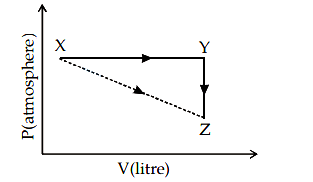 JEE Advanced 2012 Medium
 - A wooden block performs SHM on a frictionless surface with frequency \(v_0\). The block carries a charge \(+Q\) on its surface. If now a uniform electric field \(\mathbf{E}\) is switched on as shown, then the SHM of the block will be
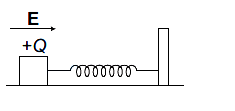 JEE Advanced 2011 Easy
 - An ideal gas is in thermodynamic equilibrium. The number of degrees of freedom of a molecule of the gas is . The internal energy of one mole of the gas is and the speed of sound in the gas is . At a fixed temperature and pressure, which of the following is the correct option?JEE Advanced 2023 Easy
- Paragraph:
Properties such as boiling point, freezing point and vapour pressure of a pure solvent change when solute molecules are added to get homogeneous solution. These are called colligative properties. Applications of colligative properties are very useful in day-to-day life. One of its examples is the use of ethylene glycol and water mixture as anti-freezing liquid in the radiator automobiles.
A solution \(M\) is prepared by mixing ethanol and water. The mole fraction of ethanol in the mixtrue is \(0.9\)
Given Freezing point depression constant of water \(\left(k^{\text {water }}\right)=1.86 \mathrm{~K} \mathrm{~kg} \mathrm{~mol}^{-1}\)
Freezing point depression constant of ethanol \(\left(k_f^{\text {ethanol }}\right)=2.0 \mathrm{Kkg} \mathrm{mol}^{-1}\)
Boiling point elevation constant of water \(\left(k_b^{\text {water }}\right)=0.52 \mathrm{Kkg} \mathrm{mol}^{-1}\)
Boiling point elevation constant of ethanol \(\left(k_b^{\text {ethanol }}\right)=1.2 \mathrm{Kkg} \mathrm{mol}^{-1}\)
Standard freezing point of water \(=273 \mathrm{~K}\)
Standard freezing point of ethanol \(=155.7 \mathrm{~K}\)
Standard boiling point of water \(=373 \mathrm{~K}\)
Standard boiling point of ethanol \(=351.5 \mathrm{~K}\)
Vapour pressure of pure water \(=328 \mathrm{~mm}\) of \(\mathrm{Hg}\)
Vapour pressure of pure ethanol \(=40 \mathrm{~mm}\) of \(\mathrm{Hg}\)
Molecular weight of water \(=18 \mathrm{~g} \mathrm{~mol}^{-1}\)
Molecular weight of ethanol \(=46 \mathrm{~g} \mathrm{~mol}^{-1}\)
In answering the following questions, consider the solutions to be ideal dilute solutions and solutes to be non-volatile and non-dissociative.
Question:
The vapour pressure of the solution \(M\) isJEE Advanced 2008 Medium - The number of values of \(\theta\) in the interval \(\left(-\frac{\pi}{2}, \frac{\pi}{2}\right)\) such that \(\theta \neq \frac{n \pi}{5}\) for \(n=0, \pm 1, \pm 2\) and \(\tan \theta=\cot 5 \theta\) as well as \(\sin 2 \theta=\cos 4 \theta\) isJEE Advanced 2010 Easy
- Consider a uniform spherical charge distribution of radius centred at the origin O. In this distribution, a spherical cavity of radius , centred at with distance (see figure) is made. If the electric field inside the cavity at position is , then the correct statement(s) is (are)
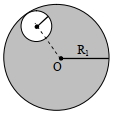 JEE Advanced 2015 Medium