


JEE Advanced · Mathematics · 22. Functions
Paragraph:
If a continuous \(f\) defined on the real line \(R\), assume positive and negative values in \(R\), then the equation \(f(x)=0\) has a root in \(R\). For example, if it is known that a continuous function \(f\) on \(R\) is positive at some point and its minimum values is negative, then the equation \(f(x)=0\) has a root in \(R\).
Consider \(f(x)=k e^x-x\) for all real \(x\), where \(k\) is real constant.Question:
The positive value of \(k\) for which \(k e^x-x=0\) has only one root is
- A
\(\frac{1}{e}\)
- B
1
- C
\(e\)
- D
\(\log _e 2\)
Answer & Solution
Correct Answer
(A)
\(\frac{1}{e}\)
Step-by-step Solution
Detailed explanation
Let \(f(x)=k e^x-x\)
\(\begin{aligned} & & f^{\prime}(x) & =k e^x-1=0 \\ & & x & =-\ln k \\ & \therefore & f^{\prime \prime}(x) & =k e^x \\ & \text { Hence, } & {\left[f^{\prime \prime}(x)\right]_{x=-\ln k} } & =1>0 \\ & & f(-\ln k) & =1+\ln k\end{aligned}\)
For one root of given equation
\[
\begin{aligned}
1+\ln k & =0 \\
Hence,
k & =\frac{1}{e} .
\end{aligned}
\]
\(\begin{aligned} & & f^{\prime}(x) & =k e^x-1=0 \\ & & x & =-\ln k \\ & \therefore & f^{\prime \prime}(x) & =k e^x \\ & \text { Hence, } & {\left[f^{\prime \prime}(x)\right]_{x=-\ln k} } & =1>0 \\ & & f(-\ln k) & =1+\ln k\end{aligned}\)
For one root of given equation
\[
\begin{aligned}
1+\ln k & =0 \\
Hence,
k & =\frac{1}{e} .
\end{aligned}
\]
See the Complete Solution
Get step-by-step explanations for this and 2.5 Lakh+ more JEE, NEET & CET questions.
- Unlock all solutions
- Practice the full chapter
- Track accuracy across PYQs
4.8 rated on Google Play · 14,000+ reviews
More questions from Mathematics
- Let be three non-zero real numbers such that the equation has two distinct real roots and with . Then, the value of isJEE Advanced 2018 Medium
- Let \(P(3,2,6)\) be a point in space and \(Q\) be a point on the line \(\mathbf{r}=(\hat{\mathbf{i}}-\hat{\mathbf{j}}+2 \hat{\mathbf{k}})+\mu(-3 \hat{\mathbf{i}}+\hat{\mathbf{j}}+5 \hat{\mathbf{k}})\).
Then, the value of \(\mu\) for which the vector \(\mathbf{P Q}\) is parallel to the plane \(x-4 y+3 z=1\) isJEE Advanced 2009 Medium - \[
\text { Match the statements given in Column I with the values given in Column II. }
\]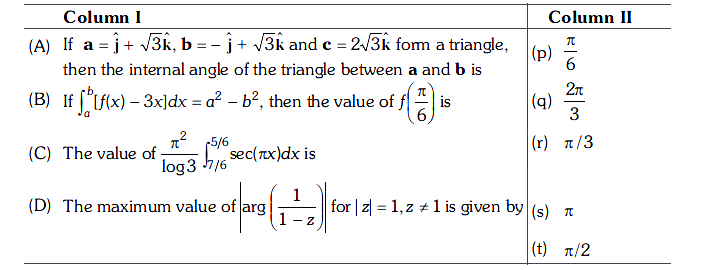 JEE Advanced 2011 Medium
 - For a > b > c > 0, the distance between (1, 1) and the point of intersection of the lines ax + by + c = 0 and bx + ay + c = 0 is less than .ThenJEE Advanced 2013 Medium
- For \(x>0, \lim _{x \rightarrow 0}\left((\sin x)^{1 / x}+\left(\frac{1}{x}\right)^{\sin x}\right)\) isJEE Advanced 2006 Medium
- \(\frac{d^2 x}{d y^2}\) equalsJEE Advanced 2007 Medium
More PYQs from JEE Advanced
- Statement 1 The geometrical isomer of the complex \(\left.\left[\mathrm{M}_{\left(\mathrm{NH}_3\right.}\right)_4 \mathrm{Cl}_2\right]\) are optically inactive.
Statement 2 Both geometrical isomers of the complex \(\left[\mathrm{M}\left(\mathrm{NH}_3\right)_4 \mathrm{Cl}_2\right]\) possess axis of symmetry.JEE Advanced 2008 Medium - Consider a branch of the hyperbola \(x^2-2 y^2-2 \sqrt{2} x-4 \sqrt{2} y-6=0\) with vertex at the point \(A\). Let \(B\) be one of the end points of its latus rectum. If \(C\) is the focus of the hyperbola nearest to the point \(A\), then the area of the \(\triangle A B C\) isJEE Advanced 2008 Medium
- For the reaction sequence given below, the correct statement(s) is(are)
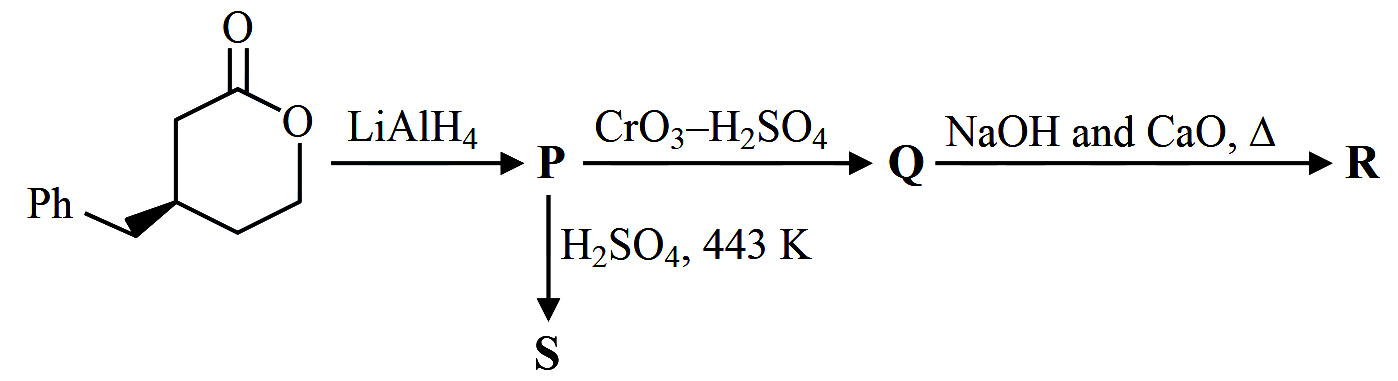 JEE Advanced 2025 Hard
 - Two beams of red and violet colours are made to pass separately through a prism (angle of the prism is \(60^{\circ}\) ). In the position of minimum deviation, the angle of refraction will beJEE Advanced 2008 Easy
- A straight line through the vertex \(P\) of a \(\triangle P Q R\) intersects the side \(Q R\) at the point \(S\) and the circumcircle of the \(\triangle P Q R\) at the point \(T\). If \(S\) is not the centre of the circumcircle, thenJEE Advanced 2008 Hard
- Let \(a=3 \sqrt{2}\) and \(b=\frac{1}{5^{1 / 6} \sqrt{6}}\). If \(x, y \in \mathbb{R}\) are such that
\(\begin{gathered}3 x+2 y=\log _a(18)^{\frac{5}{4}} \\2 x-y=\log _b(\sqrt{1080})\end{gathered}\)
and then \(4 x+5 y\) is equal to . ________.JEE Advanced 2024 Easy