


JEE Advanced · Chemistry · 23. Coordination Compounds
Among the following complexes, the total number of diamagnetic species is_____
\(\left[\mathrm{Mn}\left(\mathrm{NH}_3\right)_6\right]^{3+},\left[\mathrm{MnCl}_6\right]^{3-},\left[\mathrm{FeF}_6\right]^{3-},\left[\mathrm{CoF}_6\right]^{3-},\)\(\left[\mathrm{Fe}\left(\mathrm{NH}_3\right)_6\right]^{3+}\), and \(\left[\mathrm{Co}(\mathrm{en})_3\right]^{3+}\)
[Given, atomic number: \(\mathrm{Mn}=25, \mathrm{Fe}=26, \mathrm{Co}=27\);
\(\text { en } \left.=\mathrm{H}_2 \mathrm{NCH}_2 \mathrm{CH}_2 \mathrm{NH}_2\right]\)
- A 5
- B 6
- C 1
- D 9
Answer & Solution
Correct Answer
(C) 1
Step-by-step Solution
Detailed explanation
\(\mathrm{Mn}^{3+} \Rightarrow[\mathrm{Ar}] 3 \mathrm{~d}^4\)
\(\mathrm{d}^4\) configuration in \(\mathrm{t}_{2 \mathrm{~g}}\) and \(\mathrm{eg}_{\mathrm{g}}\) orbitals will always have unpaired electrons irrespective of SFL and WFL.
\(\mathrm{Fe}^{3+} \Rightarrow[\mathrm{Ar}] 3 \mathrm{~d}^5\)
\(\mathrm{d}^5\) configuration will also have unpaired electron irrespective of SFL and WFL.
\(\mathrm{Co}^{3+} \Rightarrow[\mathrm{Ar}] 3 \mathrm{~d}^6\)
\(\mathrm{d}^6 \Rightarrow\) it can be both paramagnetic or diamagnetic based on field of ligands.
In case of \(\mathrm{F}^{-} \Rightarrow\) weak field ligand, configuration will be \(\mathrm{t}_{2 \mathrm{~g}}^4 \mathrm{e}_{\mathrm{g}}^2\) hence it is paramagnetic but in case of
en \(\Rightarrow\) strong filed ligand, configuration will be \(\mathrm{t}_{2 \mathrm{~g}}^6 \mathrm{e}_{\mathrm{g}}^0\) hence it will be diamagnetic.
So,
\(\left[\mathrm{Mn}\left(\mathrm{NH}_3\right) 6\right]^{3+}\) : Paramagnetic
\(\left[\mathrm{MnCl}_6\right]^{3-}\) : Paramagnetic
\(\left[\mathrm{FeF}_6\right]^{3-}\) : Paramagnetic
\(\left[\mathrm{CoF}_6\right]^{3-}\) : Paramagnetic
\(\left[\mathrm{Fe}\left(\mathrm{NH}_3\right)_6\right]^{3+}\) : Paramagnetic
\(\left[\mathrm{Co}(\mathrm{en})_3\right]^{3+}\) : Diamagnetic
Only 1 complex is diamagnetic.
\(\mathrm{d}^4\) configuration in \(\mathrm{t}_{2 \mathrm{~g}}\) and \(\mathrm{eg}_{\mathrm{g}}\) orbitals will always have unpaired electrons irrespective of SFL and WFL.
\(\mathrm{Fe}^{3+} \Rightarrow[\mathrm{Ar}] 3 \mathrm{~d}^5\)
\(\mathrm{d}^5\) configuration will also have unpaired electron irrespective of SFL and WFL.
\(\mathrm{Co}^{3+} \Rightarrow[\mathrm{Ar}] 3 \mathrm{~d}^6\)
\(\mathrm{d}^6 \Rightarrow\) it can be both paramagnetic or diamagnetic based on field of ligands.
In case of \(\mathrm{F}^{-} \Rightarrow\) weak field ligand, configuration will be \(\mathrm{t}_{2 \mathrm{~g}}^4 \mathrm{e}_{\mathrm{g}}^2\) hence it is paramagnetic but in case of
en \(\Rightarrow\) strong filed ligand, configuration will be \(\mathrm{t}_{2 \mathrm{~g}}^6 \mathrm{e}_{\mathrm{g}}^0\) hence it will be diamagnetic.
So,
\(\left[\mathrm{Mn}\left(\mathrm{NH}_3\right) 6\right]^{3+}\) : Paramagnetic
\(\left[\mathrm{MnCl}_6\right]^{3-}\) : Paramagnetic
\(\left[\mathrm{FeF}_6\right]^{3-}\) : Paramagnetic
\(\left[\mathrm{CoF}_6\right]^{3-}\) : Paramagnetic
\(\left[\mathrm{Fe}\left(\mathrm{NH}_3\right)_6\right]^{3+}\) : Paramagnetic
\(\left[\mathrm{Co}(\mathrm{en})_3\right]^{3+}\) : Diamagnetic
Only 1 complex is diamagnetic.
See the Complete Solution
Get step-by-step explanations for this and 2.5 Lakh+ more JEE, NEET & CET questions.
- Unlock all solutions
- Practice the full chapter
- Track accuracy across PYQs
4.8 rated on Google Play · 14,000+ reviews
More questions from Chemistry
- The correct option(s) related to the extraction of iron from its ore in the blast furnace operating in the temperature range is(are)JEE Advanced 2022 Medium
- The geometries of the ammonia complexes of respectively, are :JEE Advanced 2016 Medium
- Paragraph:
The concentration of potassium ions inside a biological cell is at least twenty times higher than the outside. The resulting potential difference across the cell is important in several processes such as transmission of nerve impulses and maintaining the ion balance. A simple model for such a concentration cell involving a metal \(\mathrm{M}\) is :
\(
M(s) \mid M^{+}(\alpha q ; 0.05 \text { molar }) \| M^{+}(a q ; 1 \text { molar })\) \(\mid M(s)
\)
For the above electrolytic cell the magnitude of the cell potential \(\left|E_{\text {cell }}\right|=70 \mathrm{mV}\).
Question:
If the \(0.05\) molar solution of \(M^{+}\)is replaced by a \(0.0025\) molar \(M^{+}\) solution, then the magnitude of the cell potential would beJEE Advanced 2010 Medium - Tin is obtained from cassiterite by reduction with coke. Use the data given below to determine the minimum temperature (in K ) at which the reduction of cassiterite by coke would take place.
\(298 K: \Delta_{ f } H ^0\left( SnO _2(s)\right)=-581.0 kJ mol ^{-1}\), \(\Delta_{ f } H ^0\left( CO _2(g)\right)=-394.0 kJ mol ^{-1}\)
\(S ^0\left( SnO _2(s)\right)=56.0 JK ^{-1} mol^{-1}, S^0( Sn ( s ))\) \(=52.0 JK ^{-1} mol^{-1}\)
\(S ^0( C ( s ))=6.0 JK ^{-1} mol^{-1}, S^0\left( CO _2(g)\right)\) \(=210.0 JK ^{-1} mol^{-1}\)
Assume that the enthalpies and the entropies are temperature independent.JEE Advanced 2020 Medium - In the reaction scheme shown below, and are the major products.
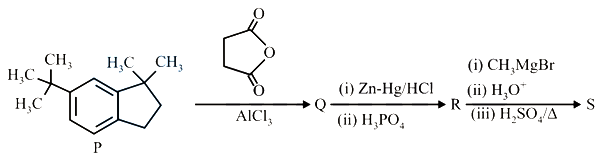
The correct structure ofJEE Advanced 2020 Hard - KI in acetone, undergoes SN2 reaction with each of P, Q, R and S. The rates of the reaction vary as
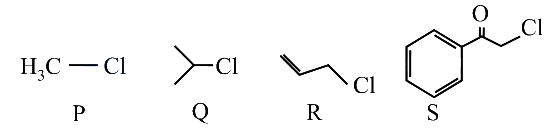 JEE Advanced 2013 Medium
More PYQs from JEE Advanced
- The Fischer projection of -erythrose is shown below.
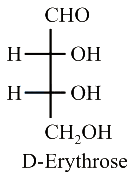
-Erythrose and its isomers are listed as and in Column I. Choose the correct relationship of and with -erythrose from Column II.Column - I Column -II P. 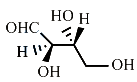
1. Diastereomer Q. 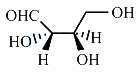
2. Identical R. 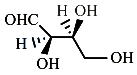
3. Enantiomer S. 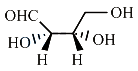 JEE Advanced 2020 Medium
 - Paragraph :
When a particle of mass \(m\) moves on the \(x\)-axis in a potential of the form \(V(x)=k x^2\), it performs simple harmonic motion.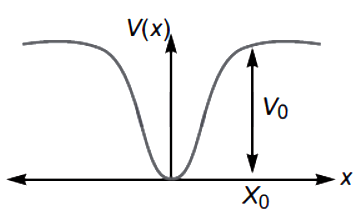
The corresponding time period is proportional to \(\sqrt{\frac{m}{k}}\), as can be seen easily using dimensional analysis. However, the motion of a particle can be periodic even when its potential energy increases on both sides of \(x=0\) in a way different from \(k x^2\) and its total energy is such that the particle does not escape to infinity. Consider a particle of mass \(\mathrm{m}\) moving on the \(x\)-axis. Its potential energy is \(V(x)=\alpha x^4(\alpha>0)\) for \(|x|\) near the origin and becomes a constant equal to \(V_0\) for \(|x| \geq X_0\) (see figure).
Question :
If the total energy of the particle is \(E\), it will perform periodic motion only ifJEE Advanced 2010 Medium - Match the statements of Column I with these in Column II.
[Note : Here \(z\) takes values in the complex plane and \(\operatorname{Im}(z)\) and \(\operatorname{Re}(z)\) denote respectively, the imaginary part and the real part of \(z\) ]Column I Column II (A)The set of points \(z\) satisfying \(|z-i| z||=|z+i| z||\) is contained in or equal to (p)an ellipse with eccentricity \(4 / 5\) (B) The set of points \(z\) satisfying \(|z+4|+|z-4|=0\) is contained in or equal to (q) the set of points \(z\) satisfying \(\operatorname{Im}(z)=0\) (C) If \(|w|=2\), then the set of points \(z=w-\frac{1}{w}\) is contained in or equal to (r) the set of points \(z\) satisfying \(|\operatorname{Im} z| \leq 1\) (D) If \(|w|=1\), then the set of points \(z=w+\frac{1}{w}\) is contained in or equal to (s) the set of points satisfying \(|\operatorname{Re} z| \leq 2\) (t) the set of points \(z\) satisfying \(|z| \leq 3\) JEE Advanced 2010 Hard - For the reaction, \(2 \mathrm{CO}+\mathrm{O}_2 \rightarrow 2 \mathrm{CO}_2 ; \Delta H=-560 \mathrm{~kJ}\). Two moles of \(\mathrm{CO}\) and one mole of \(\mathrm{O}_2\) are taken in a container of volume \(1 \mathrm{~L}\). They completely form two moles of \(\mathrm{CO}_2\), the gases deviate appreciably from ideal behaviour. If the pressure in the vessel changes from 70 to \(40 \mathrm{~atm}\), find the magnitude (absolute value) of \(\Delta U\) at \(500 \mathrm{~K} .(1 \mathrm{~L}-\mathrm{atm}=0.1 \mathrm{~kJ})\)JEE Advanced 2006 Easy
- The unbalanced chemical reactions given in List I show missing reagent or condition (?) which are provided in list II. match List I with List II and select the correct answer using the code given below the lists :
List - I List - II A. \(PbO _2+ H _2 SO _4 \xrightarrow{?}\) \(PbSO _4 + O _2+\) other product P. \(\text{NO}\) B. \(Na _2 S_2 O _3+ H _2 O \xrightarrow{?}\) \(NaHSO _4~+\) other product Q. \(\text{I}_2\) C. \(N _2 H _4 \xrightarrow{?} N_2 +\) other product R. Warm D. \(XeF _2 \xrightarrow{?} Xe ~+\) other product S. \(\text{Cl}_2\) JEE Advanced 2013 Easy - Paragraph:
When a metal rod \(M\) is dipped into an aqueous colourless concentrated solution of compound \(\mathrm{N}\), the solution turns light blue. Addition of aqueous \(\mathrm{NaCl}\) to the blue solution gives a white precipitate \(\mathrm{O}\). Addition of aqueous \(\mathrm{NH}_3\) dissolves \(\mathrm{O}\) and gives an intense blue solution.
Question:
The final solution containsJEE Advanced 2011 Hard