


JEE Advanced · Chemistry · 2. Atomic Structure
The wave function, is a mathematical function whose value depends upon spherical polar coordinates of the electron and characterized by the quantum numbers and . Here is the distance from the nucleus, is colatitude and is azimuth. In the mathematical functions given in the Table, is the atomic number and is Bohr radius
| Column 1 | Column 2 | Column 3 |
| (I) 1s orbital | \(\begin{array}{l}\text { (i) } \psi_{ n , 1, m_1} \\ \propto\left(\frac{ Z }{ a _{ o }}\right)^{\frac{3}{2}} e ^{-\left(\frac{ Zr }{ e _{ o }}\right)}\end{array}\) | (P)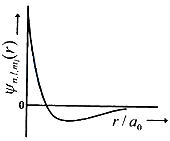 |
| (II) 2s orbital | (ii) One radial node | (Q) Probability density at the nucleus \(\propto \frac{1}{ a _{ o }^3}\). |
| (III) \(2 p _{ z }\) orbital | \(\begin{array}{l}\text { (iii) } \psi_{ n }, 1, m_{ l } \\ \propto\left(\frac{ Z }{ a _{ o }}\right)^{\frac{5}{2}} re ^{-\left(\frac{ Zr }{2 a _{ o }}\right)} \cos \theta\end{array}\) | (R) Probability density is maximum at the nucleus. |
| (IV) \(3 d_{ z }^2\) orbital | (iv) \(x y\)-plane is a nodal plane | (S) Energy needed to excite an electron from \(n =2\) state to \(n =4\) state is \(\frac{27}{32}\) times the energy needed to excite are electron from \(n =2\) state to \(n =6\) state. |
- A
- B
- C
- D
Answer & Solution
Correct Answer
(D)
Step-by-step Solution
Detailed explanation
incorrect, because, has no nodal plane. correct, because orbital has radial node.
See the Complete Solution
Get step-by-step explanations for this and 2.5 Lakh+ more JEE, NEET & CET questions.
- Unlock all solutions
- Practice the full chapter
- Track accuracy across PYQs
4.8 rated on Google Play · 14,000+ reviews
More questions from Chemistry
- A colorless aqueous solution contains nitrates of two metals, and . When it was added to an aqueous solution of , a white precipitate was formed. This precipitate was found to be partly soluble in hot water to give a residue and a solution . The residue was soluble in aq. and also in excess sodium thiosulfate. The hot solution gave a yellow precipitate with . The metals and , respectively, areJEE Advanced 2020 Medium
- If the unit cell of a mineral has cubic close packed (ccp) array of oxygen atoms with m fraction of octahedral holes occupied by aluminium ions and n fraction of tetrahedral holes occupied by magnesium ions, m and n, respectively, areJEE Advanced 2015 Medium
- In the following reaction sequence in aqueous solution, the species and respectively, are
\(S _2 O _3^{2-} \xrightarrow{ Ag ^{+}} \underset{\substack{\text { Clear } \\ \text { Solution }}}{ X } \xrightarrow{ Ag ^{+}} \underset{\substack{\text { White } \\ \text { Precipitate }}}{ Y }\) \(\xrightarrow{\text { With time }} \underset{\substack{\text { Black } \\ \text { Precipitate }}}{ Z }\)JEE Advanced 2016 Easy - Among \(\left[ I _3\right]^{+},\left[ SiO _4\right]^{4-}, SO _2 Cl _2, XeF _2, SF _4, ClF _3,\) \(Ni ( CO )_4, XeO _2 F_2,\left[ PtCl _4\right]^{2-}, XeF _4\), and \(SOCl _2\), the total number of species having \(sp ^3\) hybridised central atom isJEE Advanced 2023 Hard
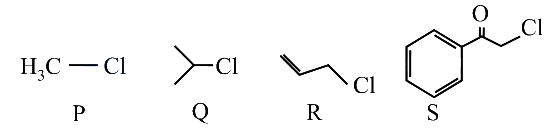
- KI in acetone, undergoes SN2 reaction with each of P, Q, R and S. The rates of the reaction vary as
 JEE Advanced 2013 Medium
 - With respect to hypochlorite, chlorate and perchlorate ions, choose the correct statement(s).JEE Advanced 2020 Easy
More PYQs from JEE Advanced
- Let \((x, y)\) be any point on the parabola \(y^2=4 x\). Let \(P\) be the point that divides the line segment from \((0,0)\) to \((x, y)\) in the ratio \(1: 3\). Then, the locus of \(P\) isJEE Advanced 2011 Medium
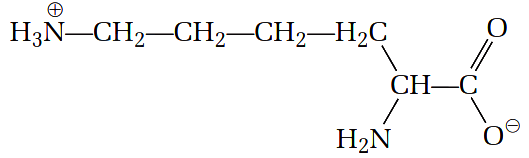
- The total number of basic groups in the following form of lysine is
 JEE Advanced 2010 Easy
 - Let \(\alpha=\frac{1}{\sin 60^{\circ} \sin 61^{\circ}}+\frac{1}{\sin 62^{\circ} \sin 63^{\circ}}+\ldots+\) \(\frac{1}{\sin 118^{\circ} \sin 119^{\circ}}\)
Then the value of \(\left(\frac{\operatorname{cosec} 1^{\circ}}{\alpha}\right)^2\) is __________JEE Advanced 2025 Hard - Paragraph:
There are some deposits of nitrates and phosphates in earth's crust. Nitrates are more soluble in water. Nitrates are difficult to reduce under the laboratory conditions but microbes do it easily. Ammonia forms large number of complexes with transition metal ions. Hybridisation easily explains the ease of sigma donation capability of \(\mathrm{NH}_3\) and \(\mathrm{PH}_3\). Phosphine is a flammable gas and is prepared from white phosphorus.
Question:
Among the following, the correct statement isJEE Advanced 2008 Easy - A solution is prepared by mixing each of , and in \(100 \mathrm{~mL}\) of water. of the resulting solution is
[Given: and of are and , respectively. ]JEE Advanced 2022 Medium - At \(298 \mathrm{~K}\), the limiting molar conductivity of a weak monobasic acid is \(4 \times 10^{2} \mathrm{~S} \mathrm{~cm}^{2} \mathrm{~mol}^{-1}\). At \(298 \mathrm{~K}\), for an aqueous solution of the acid the degree of dissociation is \(\boldsymbol{\alpha}\) and the molar conductivity is \(\mathbf{y} \times 10^{2} \mathrm{~S} \mathrm{~cm}^{2} \mathrm{~mol}^{-1}\). At \(298 \mathrm{~K}\), upon 20 times dilution with water, the molar conductivity of the solution becomes \(3 \mathbf{y} \times 10^{2} \mathrm{~S} \mathrm{~cm}^{2} \mathrm{~mol}^{-1}\)
The value of is _________ .JEE Advanced 2021 Hard