


JEE Advanced · Chemistry · 23. Coordination Compounds
The volume (in \(\mathrm{mL}\) ) of \(0.1 \mathrm{M} \mathrm{AgNO}_3\) required for complete precipitation of chloride ions present in \(30 \mathrm{~mL}\) of \(0.01 \mathrm{M}\) solution of \(\left[\mathrm{Cr}\left(\mathrm{H}_2 \mathrm{O}_{)_5} \mathrm{Cl}\right] \mathrm{Cl}_2\right.\), as silver chloride is close to
- A 2
- B 4
- C 6
- D 8
Answer & Solution
Correct Answer
(C) 6
Step-by-step Solution
Detailed explanation
\(\mathrm{mmol}\) of complex \(=30 \times 0.01=0.3\) Also, 1 mole of complex \(\left[\mathrm{Cr}\left(\mathrm{H}_2 \mathrm{O}\right)_5 \mathrm{Cl}\right] \mathrm{Cl}_2\) gives only two moles of chloride ion when dissolved in solution
\(
\left[\mathrm{Cr}\left(\mathrm{H}_2 \mathrm{O}\right)_5 \mathrm{Cl}\right] \mathrm{Cl}_2 \longrightarrow\left[\mathrm{Cr}\left(\mathrm{H}_2 \mathrm{O}\right)_5 \mathrm{Cl}^{2+}+2 \mathrm{Cl}^{-}\right.
\)
\(\Rightarrow \mathrm{mmol}\) of \(\mathrm{Cl}^{-}\)ion produced from its \(0.3 \mathrm{mmol}=0.6\)
Hence, \(0.6 \mathrm{mmol}\) of \(\mathrm{Ag}^{+}\)would be required for precipitation.
\(
\begin{aligned}
& \Rightarrow 0.60 \mathrm{mmol} \text { of } \mathrm{Ag}^{+}=0.1 \mathrm{M} \times \mathrm{V}(\text { in } \mathrm{mL}) \\
& \Rightarrow \quad V=6 \mathrm{~mL} .
\end{aligned}
\)
\(
\left[\mathrm{Cr}\left(\mathrm{H}_2 \mathrm{O}\right)_5 \mathrm{Cl}\right] \mathrm{Cl}_2 \longrightarrow\left[\mathrm{Cr}\left(\mathrm{H}_2 \mathrm{O}\right)_5 \mathrm{Cl}^{2+}+2 \mathrm{Cl}^{-}\right.
\)
\(\Rightarrow \mathrm{mmol}\) of \(\mathrm{Cl}^{-}\)ion produced from its \(0.3 \mathrm{mmol}=0.6\)
Hence, \(0.6 \mathrm{mmol}\) of \(\mathrm{Ag}^{+}\)would be required for precipitation.
\(
\begin{aligned}
& \Rightarrow 0.60 \mathrm{mmol} \text { of } \mathrm{Ag}^{+}=0.1 \mathrm{M} \times \mathrm{V}(\text { in } \mathrm{mL}) \\
& \Rightarrow \quad V=6 \mathrm{~mL} .
\end{aligned}
\)
See the Complete Solution
Get step-by-step explanations for this and 2.5 Lakh+ more JEE, NEET & CET questions.
- Unlock all solutions
- Practice the full chapter
- Track accuracy across PYQs
4.8 rated on Google Play · 14,000+ reviews
More questions from Chemistry
- is known to undergo radioactive decay to form by emitting alpha and bet a particles. A rock initially contained of . If the number of alpha particles that it would emit during its radioactive decay of to in three half-lives is , then what is the value of ?JEE Advanced 2020 Medium
- With reference to aqua regia, choose the correct option(s).JEE Advanced 2019 Hard
- The plot of versus for a reversible reaction is shown.
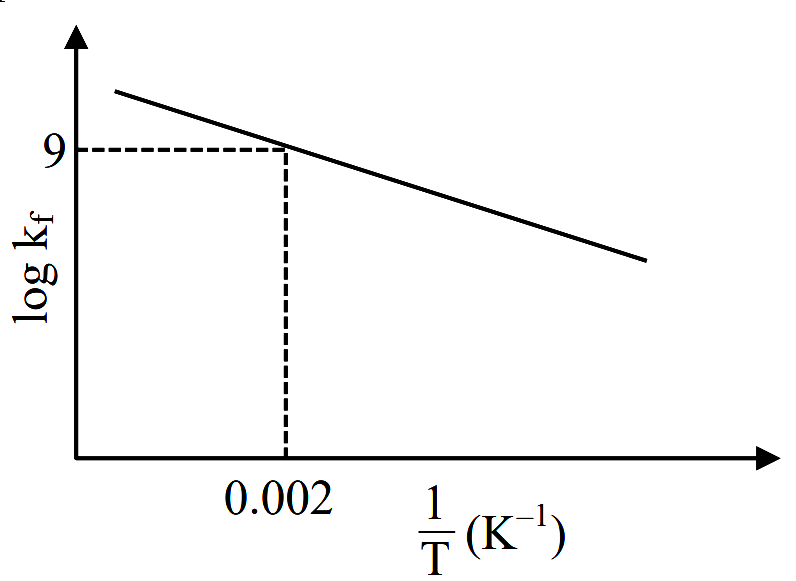
Pre-exponential factors for the forward and backward reactions are and , respectively. If the value of for the reaction at is , the value of at is
equilibrium constant of the reaction, rate constant of forward reaction, rate constant of backward reaction]JEE Advanced 2023 Easy - Among \(\left[ I _3\right]^{+},\left[ SiO _4\right]^{4-}, SO _2 Cl _2, XeF _2, SF _4, ClF _3,\) \(Ni ( CO )_4, XeO _2 F_2,\left[ PtCl _4\right]^{2-}, XeF _4\), and \(SOCl _2\), the total number of species having \(sp ^3\) hybridised central atom isJEE Advanced 2023 Hard
- In a constant volume calorimeter, \(3.5 \mathrm{~g}\) of a gas with molecular weight \(=28\) was burnt in excess oxygen at \(298.0 \mathrm{~K}\). The temperature of the calorimeter was found to increases from \(298.0 \mathrm{~K}\) to \(298.45 \mathrm{~K}\) due to the combustion process. Given, that the heat capacity of the calorimeter is \(2.5\) \(\mathrm{kJ} \mathrm{K}^{-1}\), the numerical value for the enthalpy of combustion of the gas in \(\mathrm{kJ} \mathrm{mol}^{-1}\) isJEE Advanced 2009 Easy
- Hydrogen peroxide in its reaction with KIO4 and NH2OH respectively, is acting as aJEE Advanced 2014 Medium
More PYQs from JEE Advanced
- Let \(f(x)=x^2\) and \(g(x)=\sin x\) for all \(x \in R\). Then, the set of all \(x\) satisfying \((\) fogogof \()(x)=(\operatorname{gogof})(x)\), where \((f \circ g)(x)=f(g(x))\) isJEE Advanced 2011 Hard
- If \(f(x)=\left\{\begin{array}{cc}-x-\frac{\pi}{2}, & x \leq-\frac{\pi}{2} \\ -\cos x, & -\frac{\pi}{2} < x \leq 0 \\ x-1, & 0 < x \leq 1 \\ \log x, & x>1\end{array}\right.\), thenJEE Advanced 2011 Medium
- Paragraph :
Phase space diagrams are useful tools in analyzing all kinds of dynamical problems. They are especially useful in studying the changes in motion as initial position and momentum are changed. Here we consider some simple dynamical systems in one-dimension. For such systems, phase space is a plane in which position is plotted along horizontal axis and momentum is plotted along vertical axis. The phase space diagram is \(x(t) v s p(t)\) curve in this plane. The arrow on the
curve indicates the time flow. For example, the phase space diagram for a particle moving with constant velocity is a straight line as shown in the figure. We use the sign convention in which position or momentum upwards (or to right) is positive and downwards (or to left) is negative.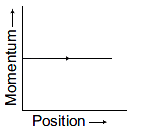
Question :
The phase space diagram for simple harmonic motion is a circle centered at the origin. In the figure, the two circles represent the same oscillator but for different initial conditions, and \(E_1\) and \(E_2\) are the total mechanical energies respectively. Then,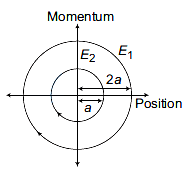 JEE Advanced 2011 Easy
 - A person in a lift is holding a water jar, which has a small hole at the lower end of its side. When the lift is at rest, the water jet coming out of the hole hits the floor of the lift at a distance d of 1.2 m from the person. In the following, state of the lift's motion is given in List I and the distance where the water jet hits the floor of the lift is given in List II. Match the statements from List I with those in List II and select the correct answer using the code given below the lists.
List I List II A. Lift is accelerating vertically up. B. Lift is accelerating vertically down with an acceleration less than the gravitational acceleration. C. Lift is moving vertically up with constant speed. D. Lift is falling freely. No water leaks out of the jar JEE Advanced 2014 Hard - A conducting square loop of side \(L\), mass \(M\) and resistance \(R\) is moving in the \(X Y\) plane with its edges parallel to the \(X\) and \(Y\) axes. The region \(y \geq 0\) has a uniform magnetic field, \(\vec{B}=B_0 k\). The magnetic field is zero everywhere else. At time \(t=0\), the loop starts to enter the magnetic field with an initial velocity \(v_0 \hat{\jmath} \mathrm{~m} / \mathrm{s}\), as shown in the figure. Considering the quantity \(K=\frac{B_0^2 L^2}{R M}\) in appropriate units, ignoring self-inductance of the loop and gravity, which of the following statements is/are correct:
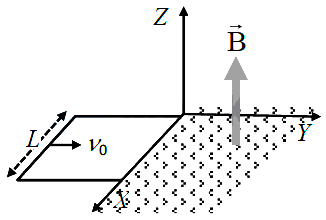 JEE Advanced 2025 Hard
 - Let \(\left(x_0, y_0\right)\) be the solution of the following equations \((2 x)^{\log 2}=(3 y)^{\log 3}\), \(3^{\log x}=2^{\log y}\), then \(x_0\) is equal toJEE Advanced 2011 Medium