


JEE Advanced · Chemistry · 29. Biomolecules
The substituents \(R_{1}\) and \(R_{2}\) for nine peptides are listed in the table given below. How many of these peptides are positively charged at \(\mathrm{pH}=7.0\) ?
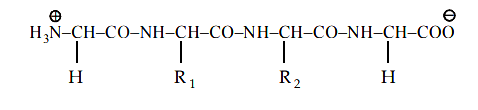
\(\begin{array}{|c|c|c|}\hline Peptide & \mathbf{R}_{\mathbf{1}} & \mathbf{R}_{\mathbf{2}} \\\hline I & \mathrm{H} & \mathrm{H} \\\hline II & \mathrm{H} & \mathrm{CH}_{3} \\\hline III & \mathrm{CH}_{2} \mathrm{COOH} & \mathrm{H} \\\hline IV & \mathrm{CH}_{2} \mathrm{CONH}_{2} & \left(\mathrm{CH}_{2}\right)_{4} \mathrm{NH}_{2} \\\hline V & \mathrm{CH}_{2} \mathrm{CONH}_{2} & \mathrm{CH}_{2} \mathrm{CONH}_{2} \\\hline VI & \left(\mathrm{CH}_{2}\right)_{4} \mathrm{NH}_{2} & \left(\mathrm{CH}_{2}\right)_{4} \mathrm{NH}_{2} \\\hline VII & \mathrm{CH}_{2} \mathrm{COOH} & \mathrm{CH}_{2} \mathrm{CONH}_{2} \\\hline VIII & \mathrm{CH}_{2} \mathrm{OH} & \left(\mathrm{CH}_{2}\right)_{4} \mathrm{NH}_{2} \\\hline IX & \left(\mathrm{CH}_{2}\right)_{4} \mathrm{NH}_{2} & \mathrm{CH}_{3} \\\hline\end{array}\)
- A 4
- B 6
- C 8
- D 10
Answer & Solution
Correct Answer
(A) 4
Step-by-step Solution
Detailed explanation
Peptides with isoelectric point (pI) more than 7 would exist as cation in neutral solution \((\mathrm{pH}=7)\) which means the given polypeptide is of basic nature, so it must contain two or more amino groups. Hence IV, VI, VIII and IX are correct options.
See the Complete Solution
Get step-by-step explanations for this and 2.5 Lakh+ more JEE, NEET & CET questions.
- Unlock all solutions
- Practice the full chapter
- Track accuracy across PYQs
4.8 rated on Google Play · 14,000+ reviews
More questions from Chemistry
- For the reaction:
The correct statement(s) in the balanced equation is/are:JEE Advanced 2014 Medium - In the reaction,
\(
2 \mathrm{X}+\mathrm{B}_2 \mathrm{H}_6 \longrightarrow\left[\mathrm{BH}_2(\mathrm{X})_2\right]^{+}\left[\mathrm{BH}_4\right]^{-}
\)
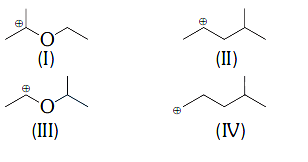
The amine (s) \(X\), is (are)JEE Advanced 2009 Medium - The correct stability order for the following species is
 JEE Advanced 2008 Medium
 - The freezing point (in \({ }^{\circ} \mathrm{C}\) ) of solution containing \(0.1 \mathrm{~g}\) of \(\mathrm{K}_3\left[\mathrm{Fe}(\mathrm{CN})_6\right]\) (molecular weight 329\()\) in \(100 \mathrm{~g}\) of water \(\left(K_f=1.86 \mathrm{~K} \mathrm{~kg} \mathrm{~mol}^{-1}\right)\) isJEE Advanced 2011 Easy
- The major products obtained from the reactions in List-II are the reactants for the named reactions mentioned in List-I. Match List-I with List-II and choose the correct option.
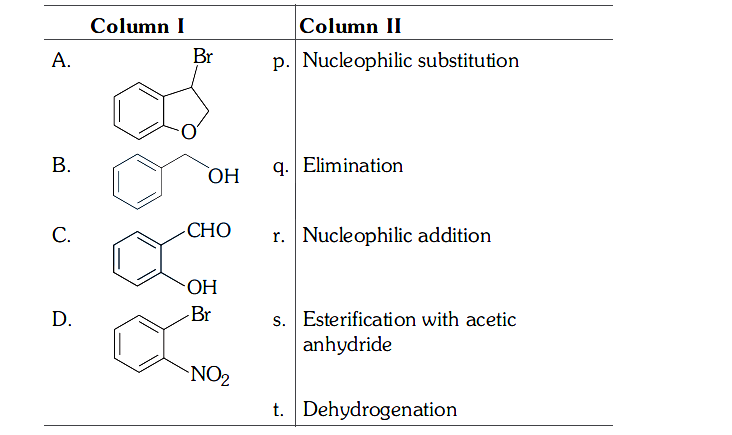
List I List II Etard reaction Gattermann reaction Gattermann-Koch reaction Rosenmund reduction JEE Advanced 2023 Easy - Match each of the compounds given in Column I with the reaction (s) that they can undergo, given in Column II.
 JEE Advanced 2009 Hard
More PYQs from JEE Advanced
- Which of the following statement(s) is/are correct?JEE Advanced 2011 Medium
- Calamine, malachite, magnetite and cryolite, respectively are:JEE Advanced 2019 Easy
- Paragraph :
Phase space diagrams are useful tools in analyzing all kinds of dynamical problems. They are especially useful in studying the changes in motion as initial position and momentum are changed. Here we consider some simple dynamical systems in one-dimension. For such systems, phase space is a plane in which position is plotted along horizontal axis and momentum is plotted along vertical axis. The phase space diagram is \(x(t) v s p(t)\) curve in this plane. The arrow on the
curve indicates the time flow. For example, the phase space diagram for a particle moving with constant velocity is a straight line as shown in the figure. We use the sign convention in which position or momentum upwards (or to right) is positive and downwards (or to left) is negative.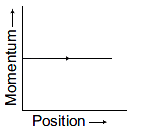
Question :
The phase space diagram for simple harmonic motion is a circle centered at the origin. In the figure, the two circles represent the same oscillator but for different initial conditions, and \(E_1\) and \(E_2\) are the total mechanical energies respectively. Then,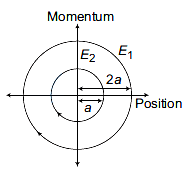 JEE Advanced 2011 Easy
 - A soft plastic bottle, filled with water of density \(1 \mathrm{gm} / \mathrm{cc}\), carries an inverted glass test-tube with some air (ideal gas) trapped as shown in the figure. The test-tube has a mass of \(5 \mathrm{gm}\), and it is made of a thick glass of density \(2.5 \mathrm{gm} / \mathrm{cc}\). Initially the bottle is sealed at atmospheric pressure \(p_{0}=10^{5} \mathrm{~Pa}\) so that the volume of the trapped air is \(v_{0}=3.3 \mathrm{cc}\). When the bottle is squeezed from outside at constant temperature, the pressure inside rises and the volume of the trapped air reduces. It is found that the test tube begins to sink at pressure \(p_{0}+\Delta p\) without changing its orientation. At this pressure, the volume of the trapped air is \(v_{0}-\Delta v\).
Let \(\Delta v=X\) cc and \(\Delta p=Y \times 10^{3} \mathrm{~Pa}\).
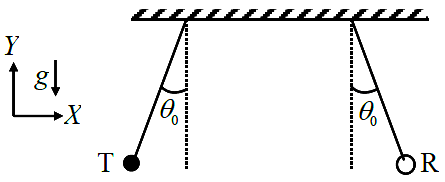
The value of is ____.JEE Advanced 2021 Hard - An audio transmitter \((T)\) and a receiver \((R)\) are hung vertically from two identical massless strings of length 8 m with their pivots well separated along the \(X\) axis. They are pulled from the equilibrium position in opposite directions along the \(X\) axis by a small angular amplitude \(\theta_0=\cos ^{-1}(0.9)\) and released simultaneously. If the natural frequency of the transmitter is 660 Hz and the speed of sound in air is \(330 \mathrm{~m} / \mathrm{s}\), the maximum variation in the frequency (in Hz ) as measured by the receiver (Take the acceleration due to gravity \(g=10 \mathrm{~m} / \mathrm{s}^2\) ) is \(\qquad\)
 JEE Advanced 2025 Hard
 - Let \(f:(-1,1) \rightarrow I R\) be such that \(f(\cos 4 \theta)=\frac{2}{2-\sec ^{2} \theta}\) for \(\theta \in\left(0, \frac{\pi}{4}\right) \cup\left(\frac{\pi}{4}, \frac{\pi}{2}\right)\). Then the value (s) of \(f\left(\frac{1}{3}\right)\) is (are)JEE Advanced 2012 Medium