


JEE Advanced · Chemistry · 13. GOC
Paragraph:
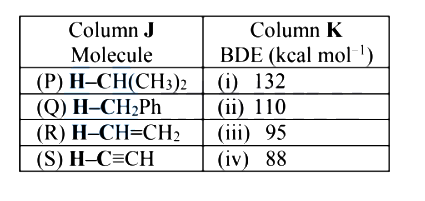
The amount of energy required to break a bond is same as the amount of energy released when the same bond is formed. In gaseous state, the energy required for homolytic cleavage of a bond is called Bond Dissociation Energy (BDE) or Bond Strength. BDE is affected by \(s\)-character of the bond and the stability of the radicals formed. Shorter bonds are typically stronger bonds. BDEs for some bonds are given below:




Question:
Correct match of the \(\mathbf{C}-\mathbf{H}\) bonds (shown in bold) in Column \(\mathbf{J}\) with their BDE in Column \(\mathbf{K}\) is
- A
- B
- C
- D
Answer & Solution
Correct Answer
(A)
Step-by-step Solution
Detailed explanation
Relative stability of radicals : \(\underset{( sp )}{\dot{ C }} \equiv CH >\underset{\left( sp ^2\right)}{\dot{ C }} H = CH _2>\)\(\underset{\left( sp ^3\right)(\text { Resonance stabilized })}{\dot{ C } H _2- Ph }>\underset{\left( sp ^3\right)}{\dot{ C } H }\left( CH _3\right)_2\) So,
See the Complete Solution
Get step-by-step explanations for this and 2.5 Lakh+ more JEE, NEET & CET questions.
- Unlock all solutions
- Practice the full chapter
- Track accuracy across PYQs
4.8 rated on Google Play · 14,000+ reviews
More questions from Chemistry
- The coordination number of \(\mathrm{Al}\) in the crystalline state of \(\mathrm{AlCl}_3\) isJEE Advanced 2009 Easy
- Reaction of \(\mathbf{x}\) g of \(\mathrm{Sn}\) with \(\mathrm{HCl}\) quantitatively produced a salt. Entire amount of the salt reacted with \(\mathbf{y} g\) of nitrobenzene in the presence of required amount of \(\mathrm{HCl}\) to produce \(1.29 \mathrm{~g}\) of an organic salt (quantitatively).
(Use Molar masses (in \(\mathrm{g} \mathrm{mol}^{-1}\) ) of \(\mathrm{H}, \mathrm{C}, \mathrm{N}, \mathrm{O}, \mathrm{Cl}\) and \(\mathrm{Sn}\) as \(1,12,14,16,35\) and 119 , respectively).
The value of is_________ .JEE Advanced 2021 Easy - Extraction for zinc from zinc blende is achieved byJEE Advanced 2007 Medium
-

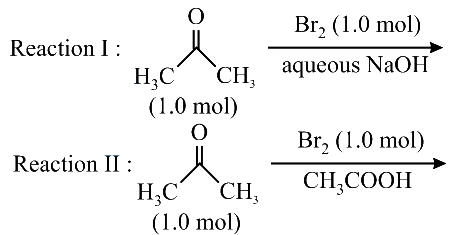
Which is correct statement if \(\mathrm{N}_2\) is added at equilibrium condition?JEE Advanced 2006 Easy - After completion of the reactions (I and II), the organic compound(s) in the reaction mixtures is(are):
 JEE Advanced 2013 Hard
 - The mole fraction of a solute in a solution is . At , the molarity of this solution is the same as its molality. The density of this solution at is . The ratio of the molecular weights of the solute and solvent, , is:JEE Advanced 2016 Medium
More PYQs from JEE Advanced
- Paragraph :
When liquid medicine of density \(\rho\) is to be put in the eye, it is done with the help of a dropper. As the bulb on the top of the dropper is pressed, a drop forms at the opening of the dropper. We wish to estimate the size of the drop.
We first assume that the drop formed at the opening is spherical because that requires a minimum increase in its surface energy. To determine the size, we calculate the net vertical force due to the surface tension \(T\) when the radius of the drop is \(R\). When this force becomes smaller than the weight of the drop, the drop gets detached from the dropper.Question :
After the drop detaches, its surface energy isJEE Advanced 2010 Easy - For every pair of continuous functions such that then the correct statement (s) is (are)JEE Advanced 2014 Hard
- Let two non-collinear unit vectors \(\mathbf{a}\) and \(\hat{\mathbf{b}}\) form an acute angle.
A point \(P\) moves so that at any time \(t\) the position vector \(\mathbf{O P}\) (where, \(O\) is the origin) is given by \(\mathbf{a} \cos t+\hat{\mathbf{b}} \sin t\). When \(P\) is farthest from origin \(O\), let \(M\) be the length of \(\mathbf{O P}\) and \(\hat{\mathbf{u}}\) be the unit vector along \(\mathbf{O P}\). Then,JEE Advanced 2008 Medium - Tangents are drawn from the point \((17,7)\) to the circle \(x^2+y^2=169\).
Statement I The tangents are mutually perpendicular.
Statement II The locus of the points from which mutually perpendicular tangents can be drawn to the given circle is \(x^2+y^2=338\)JEE Advanced 2007 Medium - Let for all Then the correct expression(S) is(are)JEE Advanced 2015 Medium
- Paragraph:
Consider the function \(f:(-\infty, \infty) \rightarrow(-\infty, \infty)\) defined by \(f(x)=\frac{x^2-a x+1}{x^2+a x+1} ; 0 < a < 2\)Question:
Which of the following is true ?JEE Advanced 2008 Medium