


JEE Advanced · Chemistry · 21. p Block (G15-18)
The complete hydrolysis of \(\mathrm{ICl}_2 \mathrm{ClF}_3\) and \(\mathrm{BrF}_5\), respectively, gives
- A \(\mathrm{IO}^{-}, \mathrm{ClO}_2^{-}\)and \(\mathrm{BrO}_3^{-}\)
- B \(\mathrm{IO}_3^{-}, \mathrm{ClO}_2^{-}\)and \(\mathrm{BrO}_3^{-}\)
- C \(\mathrm{IO}^{-}, \mathrm{ClO}^{-}\)and \(\mathrm{BrO}_2^{-}\)
- D \(\mathrm{IO}_3^{-}, \mathrm{ClO}_4^{-}\)and \(\mathrm{BrO}_2^{-}\)
Answer & Solution
Correct Answer
(A) \(\mathrm{IO}^{-}, \mathrm{ClO}_2^{-}\)and \(\mathrm{BrO}_3^{-}\)
Step-by-step Solution
Detailed explanation
See the Complete Solution
Get step-by-step explanations for this and 2.5 Lakh+ more JEE, NEET & CET questions.
- Unlock all solutions
- Practice the full chapter
- Track accuracy across PYQs
4.8 rated on Google Play · 14,000+ reviews
More questions from Chemistry
- Hydrogen peroxide in its reaction with KIO4 and NH2OH respectively, is acting as aJEE Advanced 2014 Medium
- Consider the following volume-temperature \((\mathrm{V}-\mathrm{T})\) diagram for the expansion of 5 moles of an ideal monoatomic gas.
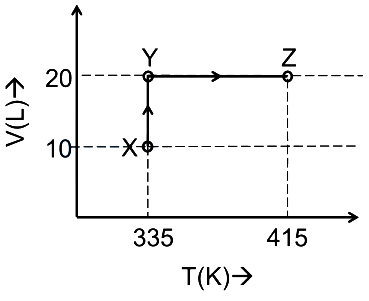
Considering only P-V work is involved, the total change in enthalpy (in Joule) for the transformation of state in the sequence \(\mathbf{X} \rightarrow \mathbf{Y} \rightarrow \mathbf{Z}\) is ________.
[Use the given data: Molar heat capacity of the gas for the given temperature range, \(\mathrm{C}_{\mathrm{V}, \mathrm{m}}=12 \mathrm{~J} \mathrm{~K}^{-1}\) \(\mathrm{mol}^{-1}\) and gas constant, \(\left.\mathrm{R}=8.3 \mathrm{~J} \mathrm{~K}^{-1} \mathrm{~mol}^{-1}\right]\)JEE Advanced 2024 Medium - Paragraph:
The reaction of \(\mathrm{K}_{3}\left[\mathrm{Fe}(\mathrm{CN})_{6}\right]\) with freshly prepared \(\mathrm{FeSO}_{4}\) solution produces a dark blue precipitate called Turnbull's blue. Reaction of \(\mathrm{K}_{4}\left[\mathrm{Fe}(\mathrm{CN})_{6}\right]\) with the \(\mathrm{FeSO}_{4}\) solution in complete absence of air produces a white precipitate \(\mathbf{X}\), which turns blue in air. Mixing the \(\mathrm{FeSO}_{4}\) solution with \(\mathrm{NaNO}_{3}\), followed by a slow addition of concentrated \(\mathrm{H}_{2} \mathrm{SO}_{4}\) through the side of the test tube produces a brown ring.
Question:
Among the following, the brown ring is due to the formation ofJEE Advanced 2021 Easy - Statement I Molecules that are not superimposable on their mirror images are chiral.
Statement II All chiral molecules have chiral centres.JEE Advanced 2007 Easy - An ideal gas is expanded from under different conditions. The correct statement(s) among the following is(are)JEE Advanced 2017 Medium
- The wave function, is a mathematical function whose value depends upon spherical polar coordinates of the electron and characterized by the quantum numbers and . Here is the distance from the nucleus, is colatitude and is azimuth. In the mathematical functions given in the Table, is the atomic number and is Bohr radius
For hydrogen atom, what is the only CORRECT combination?Column 1 Column 2 Column 3 (I) 1s orbital \(\text {(i) } \psi_{ n , 1, m_1}\)
\(\propto\left(\frac{ Z }{ a _{ o }}\right)^{\frac{3}{2}} e ^{-\left(\frac{ Zr }{ e _{ o }}\right)}\)(P) 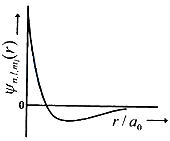
(II) 2s orbital (ii) One radial node (Q) Probability density at the nucleus \(\propto \frac{1}{ a _{ o }^3}\). (III) \(2 p _{ z }\) orbital \(\text {(iii) } \psi_{ n }, 1, m_{ l }\)
\(\propto\left(\frac{ Z }{ a _{ o }}\right)^{\frac{5}{2}} re ^{-\left(\frac{ Zr }{2 a _{ o }}\right)} \cos \theta\)(R) Probability density is maximum at the nucleus. (IV) \(3 d_{ z }^2\) orbital (iv) \(x y\)-plane is a nodal plane (S) Energy needed to excite an electron from \(n =2\) state to \(n =4\) state is \(\frac{27}{32}\) times the energy needed to excite are electron from \(n =2\) state to \(n =6\) state. JEE Advanced 2017 Hard
More PYQs from JEE Advanced
- Tangents drawn from the point \(P(1,8)\) to the circle \(x^2+y^2-6 x-4 y-11=0\) touch the circle at the points \(A\) and \(B\). The equation of the circumcircle of \(\triangle P A B\) isJEE Advanced 2009 Medium
- The total number of possible isomers for is___.JEE Advanced 2021 Medium
- Let \(f:[-1,2] \rightarrow[0, \infty)\) be a continuous function such that \(f(x)=f(1-x)\) for all \(x \in[-1,2]\). Let \(R_1=\int_{-1}^2 x f(x) d x\) and \(R_2\) be the area of the region bounded by \(y=f(x), x=-1, x=2\) and the \(X\)-axis. Then,JEE Advanced 2011 Medium
- For a dilute solution containing \(2.5 \mathrm{~g}\) of a non-volatile non-electrolyte solute in \(100 \mathrm{~g}\) of water, the elevation in boiling point at 1 atm pressure is \(2^{\circ} \mathrm{C}\). Assuming concentration of solute is much lower than the concentration of solvent, the vapour pressure ( \(\mathrm{mm}\) of \(\mathrm{Hg}\) ) of the solution is (take \(K_{b}=0.76 \mathrm{~K} \mathrm{~kg} \mathrm{~mol}^{-1}\) )JEE Advanced 2012 Medium
- A series \(R\) - \(C\) circuit is connected to \(A C\) voltage source. Consider two cases; \((A)\) when \(C\) is without a dielectric medium and \((B)\) when \(C\) is filled with dielectric of constant 4. The current \(I_R\) through the resistor and voltage \(V_C\) across the capacitor are compared in the two cases. Which of the following is/are true?JEE Advanced 2011 Easy
- In the following reaction, compound is obtained from compound via an ionic intermediate.
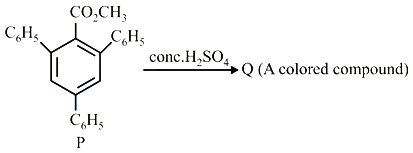
What is the degree of unsaturation of ?JEE Advanced 2020 Medium