


JEE Advanced · Chemistry · 1. Mole Concept
To form a complete monolayer of acetic acid on \(1 \mathrm{~g}\) of charcoal, \(100 \mathrm{~mL}\) of \(0.5 \mathrm{M}\) acetic acid was used. Some of the acetic acid remained unadsorbed. To neutralize the unadsorbed acetic acid, 40 \(\mathrm{mL}\) of \(1 \mathrm{M} \mathrm{NaOH}\) solution was required. If each molecule of acetic acid occupies \(\mathbf{P} \times 10^{-23} \mathrm{~m}^2\) surface area on charcoal, the value of \(\mathbf{P}\) is _______ [Use given data: Surface area of charcoal \(=1.5 \times 10^2 \mathrm{~m}^2 \mathrm{~g}^{-1} ;\) Avogadro's number \(\left(\mathrm{N}_{\mathrm{A}}\right)=6.0 \times 10^{23}\) \(\left.\mathrm{mol}^{-1}\right]\)
- A 2000
- B 250
- C 3241
- D 2500
Answer & Solution
Correct Answer
(D) 2500
Step-by-step Solution
Detailed explanation
\(\text {Millimole of acid taken }=100 \times 0.5=50 \)
\( \text {Millimole of } \mathrm{NaOH} \text { used }=40 \times 1=40 \)
\( \text {Millimole of acid adsorbed }=50-40=10 \)
\( \text {Molecules of acid adsorbed }=10 \times 10^{-3} \times 6\) \(\times~10^{23}=6 \times 10^{21} \)
\( \text {Surface area occupied per molecule }\) \(=\frac{1.5 \times 10^2}{6 \times 10^{21}}=0.25 \times 10^{-19}=2500 \times 10^{-23}\)
\( \text {Millimole of } \mathrm{NaOH} \text { used }=40 \times 1=40 \)
\( \text {Millimole of acid adsorbed }=50-40=10 \)
\( \text {Molecules of acid adsorbed }=10 \times 10^{-3} \times 6\) \(\times~10^{23}=6 \times 10^{21} \)
\( \text {Surface area occupied per molecule }\) \(=\frac{1.5 \times 10^2}{6 \times 10^{21}}=0.25 \times 10^{-19}=2500 \times 10^{-23}\)
See the Complete Solution
Get step-by-step explanations for this and 2.5 Lakh+ more JEE, NEET & CET questions.
- Unlock all solutions
- Practice the full chapter
- Track accuracy across PYQs
4.8 rated on Google Play · 14,000+ reviews
More questions from Chemistry
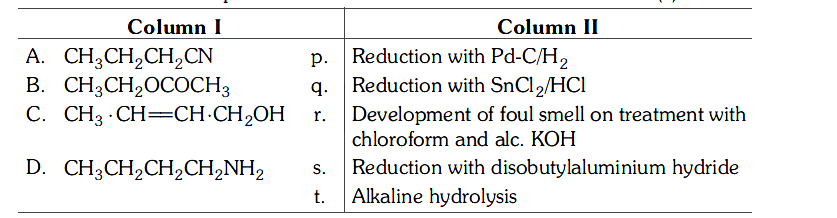
- Match each of the compounds is Column I with its characteristic reaction(s) is Column II.
 JEE Advanced 2009 Hard
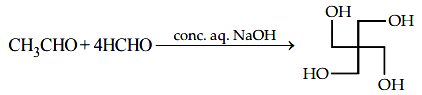
 - The number of aldol reaction(s) that occurs in the given transformation is :
 JEE Advanced 2012 Medium
 - Extraction of copper from copper pyrite involvesJEE Advanced 2016 Medium
- The equilibrium \(2 \mathrm{Cu}^{\mathrm{I}} \rightleftharpoons \mathrm{Cu}^0+\mathrm{Cu}^{\text {II }}\) in aqueous medium at \(25^{\circ} \mathrm{C}\) shifts towards the left in the presence ofJEE Advanced 2011 Hard
- For 'invert sugar', the correct statement(s) is (are)
(Given: specific rotations of sucrose, maltose, glucose and fructose in aqueous solution are and , respectively)JEE Advanced 2016 Easy - An ideal gas is expanded from under different conditions. The correct statement(s) among the following is(are)JEE Advanced 2017 Medium
More PYQs from JEE Advanced
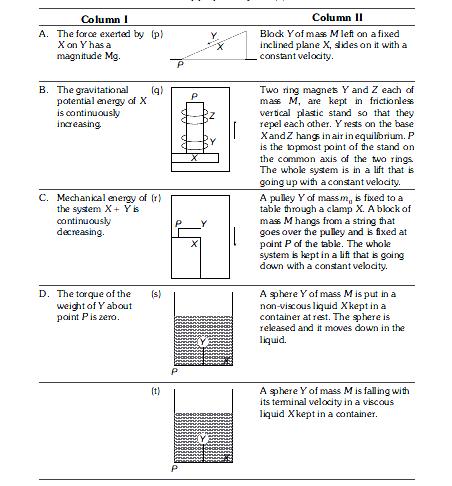
- Column II shows five systems in which two objects are labelled as \(X\) and \(Y\). Also in each case a point \(P\) is shown. Column-I gives some statements about \(X\) and/or \(Y\). Match these statements to the appropriate system(s) from Column-II.
 JEE Advanced 2009 Medium
 - Statement I A block of mass \(m\) starts moving on a rough horizontal surface with a velocity \(v\). It stops due to friction between the block and the surface after moving through a certain distance. The surface is now tilted to an angle of \(30^{\circ}\) with the horizontal and the same block is made to go up on the surface with the same initial velocity \(v\). The decrease in the mechanical energy in the second situation is smaller than that in the first situation.
Statement II The coefficient of friction between the block and the surface decreases with the increase in the angle of inclination.JEE Advanced 2007 Medium - Extraction for zinc from zinc blende is achieved byJEE Advanced 2007 Medium
- Statement 1 The stream of water flowing at high speed from a garden hose pipe tends to spread like a fountain when held vertically up, but tends to narrow down when held vertically down.
and Statement 2 In any steady flow of an incompressible fluid, the volume flow rate of the fluid remains constant.JEE Advanced 2008 Easy - Put a uniform meter scale horizontally on your extended index fingers with the left one at and the right one at . When you attempt to move both the fingers slowly towards the center, initially only the left finger slips with respect to the scale and the right finger does not. After some distance, the left finger stops and the right one starts slipping. Then the right finger stops at a distance from the center of the scale and the left one starts slipping again. This happens because of the difference in the frictional forces on the two fingers. If the coefficients of static and dynamic friction between the fingers and the scale are and , respectively, the value of (in cm) is___________.JEE Advanced 2020 Medium
- Let and let and
Then which of the following options is/are correct?JEE Advanced 2019 Hard