


JEE Advanced · Chemistry · 5. States of Matter
A gas described by van der Waals' equation
- A behaves similar to an ideal gas in the limit of large molar volumes
- B behaves similar to an ideal gas in the limit of large pressures
- C is characterised by van der Waals' coefficients that are dependent on the identity of the gas but are independent of the temperature
- D has the pressure that is lower than the pressure exerted by the same gas behaving ideally
Answer & Solution
Correct Answer
(B) behaves similar to an ideal gas in the limit of large pressures
Step-by-step Solution
Detailed explanation
The gas described by van der Waals' equation in the limit of large molar volume, in the intermediate range of pressure experience balancing by two factors.
\(
\left(p+\frac{a}{V^2}\right)(V-b)=R T \Rightarrow p V=\frac{a}{V}\) \(-~p b+\frac{a b}{V^2}=R T
\)
(We can neglect the product of two very small constants, \(\frac{a b}{V^2}\) )
So,
\(
p V+\frac{a}{V}-p b=R T
\)
As
\(
\frac{a}{V}=p b
\)
The gas behaves ideally, \(p V=R T\)
- The van der Waals' constants ' \(a\) ' and ' \(b\) ' are characteristics of the gas. The value of these constants are determined by the critical constants of the gas
\(
a=3 p_C V_C^2=3 p_C\left(\frac{3 R T_C}{8 p_C}\right)^2=\frac{27\left(R T_C\right)^2}{64 p_C} ;\) \(b=\frac{1}{3}\left(\frac{3 R T_C}{8 p_C}\right)=\frac{R T_C}{8 p_C}
\)
Question is based on description by van der Waals' equation, that's why we have to ignore the effect of temperature on \(a\) and \(b\). Actually, the so-called constant varies to some extent with temperature and this shows that the van der Waals' equation is not a complete solution of the behaviour of real gas
\(
\left(p+\frac{a}{V^2}\right)(V-b)=R T \Rightarrow p V=\frac{a}{V}\) \(-~p b+\frac{a b}{V^2}=R T
\)
(We can neglect the product of two very small constants, \(\frac{a b}{V^2}\) )
So,
\(
p V+\frac{a}{V}-p b=R T
\)
As
\(
\frac{a}{V}=p b
\)
The gas behaves ideally, \(p V=R T\)
- The van der Waals' constants ' \(a\) ' and ' \(b\) ' are characteristics of the gas. The value of these constants are determined by the critical constants of the gas
\(
a=3 p_C V_C^2=3 p_C\left(\frac{3 R T_C}{8 p_C}\right)^2=\frac{27\left(R T_C\right)^2}{64 p_C} ;\) \(b=\frac{1}{3}\left(\frac{3 R T_C}{8 p_C}\right)=\frac{R T_C}{8 p_C}
\)
Question is based on description by van der Waals' equation, that's why we have to ignore the effect of temperature on \(a\) and \(b\). Actually, the so-called constant varies to some extent with temperature and this shows that the van der Waals' equation is not a complete solution of the behaviour of real gas
See the Complete Solution
Get step-by-step explanations for this and 2.5 Lakh+ more JEE, NEET & CET questions.
- Unlock all solutions
- Practice the full chapter
- Track accuracy across PYQs
4.8 rated on Google Play · 14,000+ reviews
More questions from Chemistry
- Paragraph:
There are some deposits of nitrates and phosphates in earth's crust. Nitrates are more soluble in water. Nitrates are difficult to reduce under the laboratory conditions but microbes do it easily. Ammonia forms large number of complexes with transition metal ions. Hybridisation easily explains the ease of sigma donation capability of \(\mathrm{NH}_3\) and \(\mathrm{PH}_3\). Phosphine is a flammable gas and is prepared from white phosphorus.
Question:
White phosphorus on reaction with \(\mathrm{NaOH}\) gives \(\mathrm{PH}_3\) as one of the products. This is aJEE Advanced 2008 Easy - Consider the Bohr's model of a one-electron atom where the electron moves around the nucleus. In the following List-I contains some quantities for the orbit of the atom and List-II contains options showing how they depend on .
List - I List - II (I) Radius of the orbit (II) Angular momentum of the electron in the orbit (III) Kinetic energy of the electron in the orbit (IV) Potential energy of the electron in the orbit
Which of the following options has the correct combination considering List-I and List-II?JEE Advanced 2019 Medium - The reaction of white phosphorus with aqueous \(\mathrm{NaOH}\) gives phosphine along with another phosphorus containing compound. The reaction type; the oxidation states of phosphorus in phosphine and the other product are respectivelyJEE Advanced 2012 Easy
- The surface of copper gets tarnished by the formation of copper oxide. gas was passed to prevent the oxide formation during heating of copper at 1250 K. However, the gas contains 1 mole % of water vapour as impurity. The water vapour oxidises copper as per the reaction given below:
Is the minimum partial pressure of (in bar) needed to prevent the oxidation at 1250 K. The value of is ____.
(Given: total pressure \(=1\) bar, R (universal gas constant) \(=8 J K ^{-1} mol^{-1}, \ln (10) =2.3 \cdot Cu (s)\) and \(Cu _2 O (s)\) are mutually immiscible.
At \(1250 K: 2 Cu ( s )+\frac{1}{2} O _2(g) \rightarrow Cu _2 O ( s ) ;\) \(\Delta G^{\ominus}=-78,000 J mol ^{-1}\)
\(H _2(g)+\frac{1}{2} O _2(g) \rightarrow H _2 O ( g ) ; \quad \Delta^{\ominus}=\)\(-1,78,000 J mol ^{-1} ; G\) is the Gibbs energy)/mi> \(\Theta=\) \(-78,000 J mol -1\)
\(H _2(g)+\frac{1}{2} O _2(g) \rightarrow H _2 O ( g ) ; \quad\)\(\Delta^{\ominus}=-1,78,000 J mol ^{-1} ; G\) is the Gibbs energy)JEE Advanced 2018 Hard - Hyperconjugation involves overlap of the following orbitalsJEE Advanced 2008 Easy
- Match the reactions (in the given stoichiometry of the reactants) in List-I with one of their products given in List-II and choose the correct option.
List - I List - II (P) \(P _2 O _3\) \(+~3 H _2 O \rightarrow\) (1) \(P ( O )\left( OCH _3\right)\) \(Cl _2\) (Q) \(P _4+3 NaOH\) \(+~3 H _2 O \rightarrow\) (2) \(H _3 PO _3\) (R) \(PCl _5+ CH _3\) \(COOH \rightarrow\) (3) \(PH _3\) (S) \(H _3 PO _2\) \(+~2 H _2 O ~+\) \(4 AgNO _3 \rightarrow\) (4) \(POCL _3\) (5) \(H _3 PO _4\) JEE Advanced 2023 Medium
More PYQs from JEE Advanced
- Let \(g_{i}:\left[\frac{\pi}{8}, \frac{3 \pi}{8}\right] \rightarrow \mathbb{R}, i=1,2\), and \(f:\left[\frac{\pi}{8}, \frac{3 \pi}{8}\right] \rightarrow \mathbb{R}\) be functions such that \(g_{1}(x)=1, g_{2}(x)=|4 x-\pi|\) and \(f(x)=\sin ^{2} x\), for all \(x \in\left[\frac{\pi}{8}, \frac{3 \pi}{8}\right]\)
Define
\[
S_{i}=\int_{\frac{\pi}{8}}^{\frac{3 \pi}{8}} f(x) \cdot g_{i}(x) d x, \quad i=1,2
\]
The value of is ___.JEE Advanced 2021 Medium - A free hydrogen atom after absorbing a photon of wavelength gets excited from the state to the state Immediately after that the electron jumps to state by emitting a photon of wavelength Let the change in momentum of atom due to the absorption and the emission are and respectively. If Which of the option(s) is/are correct?
[Use and are Planck's constant and speed of light, respectively]JEE Advanced 2019 Medium - Column I showns four systems, each of the same length \(L\), for producing standing waves. The lowest possible natural frequency of a system is called its fundamental frequency, whose wavelength is denoted as \(\lambda_f\). Match each system with statements given in Column II describing the nature and wave length of the standing waves.
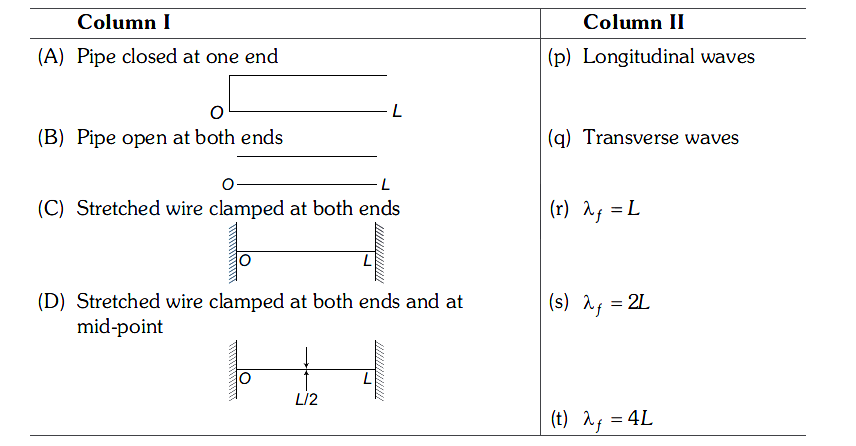 JEE Advanced 2011 Hard
 - Let thenJEE Advanced 2017 Easy
-
Column I Column II In a triangle let and be the lengths of the angles and , respectively. If and then possible values of for which is are In a triangle let and be the lengths of the sides opposite to the angles and , respectively. If , then possible value(s) of is (are) In let and be the position vectors of and with respect to the origin , respectively. If the distance of from the bisector of the acute angle of with is , then possible value (s) of is (are) Suppose that denotes the area of the region bounded by and where Then the value (s) of when and , is (are) JEE Advanced 2015 Hard - Paragraph:
Carbon-14 is used to determine the age of organic material. The procedure is based on the formation of \({ }^{14} \mathrm{C}\) by neutron capture in the upper atmosphere.
\(
{ }_7^{14} \mathrm{~N}+{ }_0^1 n \longrightarrow{ }_6^{14} \mathrm{C}+{ }_1 n^1
\)
\({ }^{14} \mathrm{C}\) is absorbed by living organisms during photosynthesis. The \({ }^{14} \mathrm{C}\) content is constant in living organism once the plant or animal dies, the uptake of carbon dioxide by it ceases and the level of \({ }^{14} \mathrm{C}\) in the dead being, falls to the decay which \({ }^{14} \mathrm{C}\) undergoes.
\(
{ }_6^{14} \mathrm{C} \longrightarrow{ }_7^{14} \mathrm{~N}+\beta^{-}
\)
The half life period of \({ }^{14} \mathrm{C}\) is 5770 years. The decay constant \((\lambda)\) can be calculated by using the following formula \(\lambda=\frac{0.693}{t_{1 / 2}}\).
The comparison of the \(\beta^{-}\)activity of the dead matter with that of the carbon still in circulation enables measurement of the period of the isolation of the material from the living cycle. The method however, ceases to be accurate over periods longer than 30,000 years. The proportion of \({ }^{14} \mathrm{C}\) to \({ }^{12} \mathrm{C}\) in living matter is \(1: 10^{12}\).
Question:
A nuclear explosion has taken place leading to increase in concentration of \(C^{14}\) in nearby areas. \(\mathrm{C}^{14}\) concentration is \(C_1\) in nearby areas and \(C_2\) in areas far away. If the age of the fossil is determined to be \(T_1\) and \(T_2\) at the places respectively thenJEE Advanced 2006 Hard