


AP EAMCET · PHYSICS · Center of Mass Momentum and Collision
Which of the following statements regarding centre of mass is NOT true?
- A For two particles of equal mass, the centre of mass lies exactly midway between them
- B For three non-linear particles of equal mass, the centre of mass coincides with the centroid of the triangle formed by the particles
- C When the total external force on a system is zero, the velocity of the centre of mass of the system remains constant.
- D For two particles of different masses, the centre of mass of the particles is nearer to the particle of lesser mass.
Answer & Solution
Correct Answer
(D) For two particles of different masses, the centre of mass of the particles is nearer to the particle of lesser mass.
Step-by-step Solution
Detailed explanation
Option (d) is incorrect because the centre of mass o two particles is nearer to the particle of higher mas not lesser mass.
See the Complete Solution
Get step-by-step explanations for this and 2.5 Lakh+ more JEE, NEET & CET questions.
- Unlock all solutions
- Practice the full chapter
- Track accuracy across PYQs
4.8 rated on Google Play · 14,000+ reviews
More questions from PHYSICS
- Three circular discs of same material and same thickness of radii \(r, 2 r\) and \(3 r\) are placed on a horizontal plane such that their centres lie along a straight line. The radius of the middle disc is \(2 \mathrm{r}\) and it touches the other two discs. The distance of the centre of mass of the system from the centre of the smaller disc is ________ .AP EAMCET 2017 Medium
- 125 identical charged small spheres coalesce to form a big charged sphere, If the electric potential on each small sphere is 60 mV then the electric potential on the bigger sphere formed isAP EAMCET 2024 Medium
- If the given figure shows the relation between magnetic field (B-along \(y\)-axis) and magnetic intensity ( H -along x -axis) of a ferromagnetic material, then the point that represents coercivity of the material is
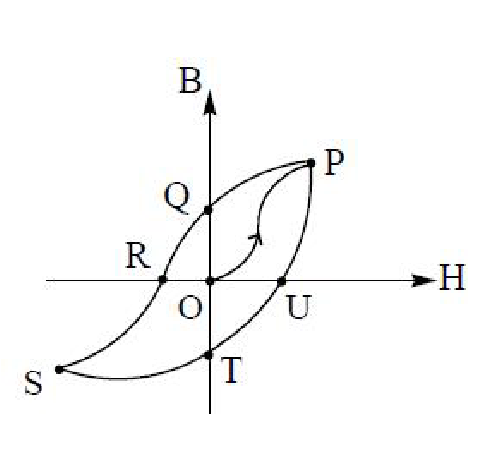 AP EAMCET 2025 Easy
 - A stationary hydrogen atom undergoes a transition from \(n=5\) to \(n=4\). Recoil speed of the atom is \((R=\) Rydberg constant, \(h=\) Planck's constant and \(m=\) mass of the proton).AP EAMCET 2018 Easy
- Six point charges each of the magnitude \(Q\) are placed at the vertices of a regular hexagon of side \(a\) as shown in the figure. Electric field intensity on the line passing through the centre \(O\) and perpendicular to the plane of the figure at a large distance \(x(\gg > a)\) from \(O\) is
\(\left(\text {Let, } \frac{1}{4 \pi \in_0}=k\right)\)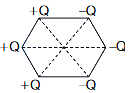 AP EAMCET 2019 Hard
 - A TV tower has a height \(160 \mathrm{~m}\). Its coverage range is nearly (Earth's radius, \(R_e=6400 \mathrm{~km}\))AP EAMCET 2019 Easy
More PYQs from AP EAMCET
- From a point \(P(0, b)\) two tangents are drawn to the circle \(x^2+y^2=16\) and these two tangents intersect \(X\)-axis is two points \(A\) and \(B\). If the area of \(\triangle P A B\) is minimum, then the equation of its circumcircle isAP EAMCET 2018 Medium
- Suppose \(t_n\) is the number of triangles formed using the vertices of a regular polygon of \(n\) sides. If \(t_{n+1}=t_n+28\), then \(n=\)AP EAMCET 2017 Medium
- As shown in the figure, a block of mass \(9 \mathrm{~kg}\) is hung by a wire of area of cross-section of 1 \(\mathrm{mm}^2\) in a lift going up with an acceleration of \(2 \mathrm{~ms}^{-2}\). If the speed of the transverse wave on the wire is \(120 \mathrm{~ms}^{-1}\), the density of the material of the wire is
(Acceleration due to gravity \(=10 \mathrm{~ms}^{-2}\))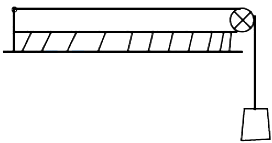 AP EAMCET 2017 Medium
 - In a \(\triangle A B C\), if \(a \cos A=b \cos B\), where \(a \neq b\), then \(\triangle A B C\) isAP EAMCET 2022 Medium
- The molarity of the solution when \(4.9 \mathrm{~g}\) of \(\mathrm{H}_2 \mathrm{SO}_4\) dissolved in \(250 \mathrm{~mL}\) of solution isAP EAMCET 2023 Medium
- The rate constant, k of a zero order reaction \(2 \mathrm{NH}_3(\mathrm{~g})\) \(\underset{1130 \mathrm{~K}}{\stackrel{\mathrm{Pt}}{\longrightarrow}} \mathrm{N}_2(\mathrm{~g})+3 \mathrm{H}_2(\mathrm{~g})\) is \(\mathrm{y} \times 10^{-4} \mathrm{~mol} \mathrm{~L}^{-1} \mathrm{~s}^{-1}\). The rate of formation of hydrogen (in \(\mathrm{mol} \mathrm{L}^{-1} \mathrm{~s}^{-1}\) ) isAP EAMCET 2017 Easy