


AP EAMCET · PHYSICS · Electrostatics
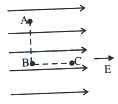
The figure shows three points \(A, B\) and \(C\) in a uniform electric field \((\overrightarrow{\mathrm{E}})\). The line \(\mathrm{AB}\) is perpendicular to \(\mathrm{BC}\) and \(B C\) is parallel to \(\overrightarrow{\mathrm{E}}\). If \(V_A, V_B\) and \(V_C\) are the potentials at \(\mathrm{A}, \mathrm{B}\) and \(\mathrm{C}\) respectively, then the correct option is
- A \(\mathrm{V}_{\mathrm{A}}=\mathrm{V}_{\mathrm{B}}=\mathrm{V}_{\mathrm{C}}\)
- B \(V_A=V_B>V_C\)
- C \(\mathrm{V}_{\mathrm{A}}=\mathrm{V}_{\mathrm{B}} < \mathrm{V}_{\mathrm{C}}\)
- D \(V_A>V_B=V_C\)
Answer & Solution
Correct Answer
(B) \(V_A=V_B>V_C\)
Step-by-step Solution
Detailed explanation
On moving in direction of electric field, electric potential decreases. So, \(\mathrm{V}_{\mathrm{B}}>\mathrm{V}_{\mathrm{C}}\) Also in direction moving perpendicular to the direction of electric field. There is no change in potential.…
See the Complete Solution
Get step-by-step explanations for this and 2.5 Lakh+ more JEE, NEET & CET questions.
- Unlock all solutions
- Practice the full chapter
- Track accuracy across PYQs
4.8 rated on Google Play · 14,000+ reviews
More questions from PHYSICS
- A mass \(m\) is in rest on an inclined plane of mass \(M\) which is further resting on a smooth horizontal plane. Now, if the mass \(m\) starts moving under gravity, the position of centre of mass of system willAP EAMCET 2020 Medium
- 125 identical charged small spheres coalesce to form a big charged sphere, If the electric potential on each small sphere is 60 mV then the electric potential on the bigger sphere formed isAP EAMCET 2024 Medium
- Two blocks A and B of masses 2 kg and 4 kg respectively are kept on a rough horizontal surface. If same force of 20 N is applied on each block, then the ratio of the accelerations of the blocks \(A\) and \(B\) is (Coefficient of kinetic friction between the surface and the blocks is 0.3 and acceleration due to gravity \(=10 \mathrm{~m} \mathrm{~s}^{-2}\) )AP EAMCET 2025 Medium
- A body starts from rest and moves with uniform acceleration. If the distance travelled by it in the first \(2 \mathrm{~s}\) is \(x_1\) and in the next \(2 \mathrm{~s}\) is \(x_2\), then \(x_1\) and \(x_2\) are related asAP EAMCET 2020 Hard
- Assertion (A) Electromagnetic waves exert pressure, called radiation pressure.
Reason (R) This is because they carry energy.AP EAMCET 2021 Easy - Two spherical soap bubbles of radii \(r_1\) and \(r_2\) in vacuum combine under isothermal conditions. The resulting bubble has a radius equal to:AP EAMCET 2003 Easy
More PYQs from AP EAMCET
- Which of the following alkenes does not undergo anti Markovnikov addition of HBr ?AP EAMCET 2024 Easy
- If \(\frac{{ }^{n+1} C_{r+1}}{{ }^{n+1} C_r}=\frac{n-r+1}{m}\), then \(m=\)AP EAMCET 2020 Easy
- If thenAP EAMCET 2022 Medium
- Two short bar magnets have their magnetic moments \(1.2 \mathrm{Am}^2\) and \(1.0 \mathrm{Am}^2\). They are placed on a horizontal table parallel to each other at a distance of \(20 \mathrm{~cm}\) between their centres, such that their north poles pointing towards geographic south. They have common magnetic equatorial line. Horizontal component of earth's field is \(3.6 \times 10^{-5} \mathrm{~T}\). Then, the resultant horizontal magnetic induction at mid point of the line joining their centers is \(\left(\frac{\mu_0}{4 \pi}=10^{-7} \mathrm{~N} / \mathrm{m}\right)\)AP EAMCET 2013 Hard
- If the degrees of freedom of a gas molecule is 6, then the total internal energy of the gas molecule at a temperature of \(47^{\circ} \mathrm{C~}(\mathrm{in~} \mathrm{eV})\) is
\(\left(\right.\) Boltzmann constant \(\left.=1.38 \times 10^{-23} \mathrm{~J} \mathrm{~K}^{-1}\right)\)AP EAMCET 2025 Medium - If \(A+B+C=\frac{\pi}{4}\), then \(\sin 4 A+\sin 4 B+\sin 4 C=\)AP EAMCET 2025 Medium