


AP EAMCET · PHYSICS · Laws of Motion
Passengers standing in a bus are thrown outwards when the bus takes a sudden turn. This happens because of
- A Outward pull on them
- B Inertia
- C Change in momentum
- D Change in acceleration
Answer & Solution
Correct Answer
(B) Inertia
Step-by-step Solution
Detailed explanation
No solution. Refer to answer key.
See the Complete Solution
Get step-by-step explanations for this and 2.5 Lakh+ more JEE, NEET & CET questions.
- Unlock all solutions
- Practice the full chapter
- Track accuracy across PYQs
4.8 rated on Google Play · 14,000+ reviews
More questions from PHYSICS
- Particles of masses \(m, 2 m, 3 m, \ldots n m\) grams are placed on the same line at distance \(l, 2 l, 3 l \ldots n l\) \(\mathrm{cm}\) from a fixed point. The distance of centre of mass of the particles from the fixed point in centimetre isAP EAMCET 2002 Easy
- Two satellites of masses m and 1.5 m are revolving around the earth with different speeds in two circular orbits of heights \(\mathrm{R}_E\) and \(2 \mathrm{R}_E\) respectively, where \(\mathrm{R}_E\) is the radius of the earth. The ratio of the minimum and maximum gravitational forces on the earth due to the two satellites isAP EAMCET 2024 Medium
- A Van de Graff generator has a spherical metal shell as an electrode which is at a potential . If the dielectric strength of the surrounding medium is then the diameter of the shell isAP EAMCET 2018 Medium
- Assertion (A) : The displacement of a vertically projected body during last second of its upward motion is \(\frac{g}{2}\).
Reason \((\mathrm{R})\) : For a vertically projected body the acceleration decreases gradually and becomes \(\frac{g}{2}\) during the last second of upward motion.AP EAMCET 2018 Easy - The charge \(q\) (in coulomb) passing through a \(10 \mathrm{~ohm}\) resistor as a function of time \(t\) (in second) is given by \(q\) \(=3 t^2-2 t+6\). The potential difference across the ends of the resistor at time \(t=5 \mathrm{~s}\) isAP EAMCET 2024 Medium
- A rectangular loop circuit has a sliding wire \(P Q\) as shown in the figure. The loop is placed in a magnetic field \(B\), perpendicular to its plane. The resistance of the wire \(P Q\) is \(R\). If the wire moves with constant velocity \(v\), then find the current flowing in the wire \(P Q\) ?
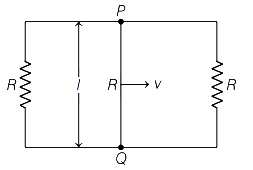 AP EAMCET 2021 Hard
More PYQs from AP EAMCET
- Match of the following.
\(\begin{array}{ll}
\hline \text{ Column I } & \text{ Column II } \\
\hline \begin{array}{ll}
\text{A. Ratio of } \frac{\Delta Q}{\Delta U} \text{ in an isobaric} \\
\text{process}
\end{array} & 1. \frac{T_1}{\left(T_1-T_2\right)} \\
\hline \begin{array}{ll}
\text{B. Ratio of } \frac{\Delta Q}{\Delta W} \text{ in an isobaric} \\
\text{process}
\end{array} & 2. \frac{T_2}{\left(T_1-T_2\right)} \\
\hline \begin{array}{l}
\text{C. Coefficient of performance} \\
\text{of a refrigerator}
\end{array} & 3. \frac{\gamma}{\gamma-1} \\
\hline \begin{array}{l}
\text{D. Coefficient of performance} \\
\text{of a heat pump}
\end{array} & 4. \gamma \\
\hline
\end{array}\)
Codes
\(\begin{array}{llll}A & B & C & D\end{array}\)AP EAMCET 2021 Medium - The kinetic energy (in J) of a particle of mass \(4.5 \times 10^{-31} \mathrm{~kg}\) having a wavelength of \(1000 \mathrm{~nm}\) is : \(\left(\mathrm{h}=6.62 \times 10^{-34} \mathrm{~J} \mathrm{~s}\right)\)AP EAMCET 2017 Hard
- Two conducting spheres of radii \(9 \mathrm{~cm}\) and \(1 \mathrm{~cm}\) are separated by a distance of \(20 \mathrm{~cm}\) in free space. If the spheres are charged to same potential of \(10 \mathrm{~V}\) each, the force of repulsion between them isAP EAMCET 2017 Medium
- If \(f(x)=\left\{\begin{array}{lll}x-5, & \text { for } x \leq 1 \\ 4 x^2-9, & \text { for } 1 < x < 2 \\ 3 x+4, & \text { for } x \geq 2,\end{array}\right.\) then \(f^{\prime}\left(2^{+}\right)\)is equal toAP EAMCET 2007 Medium
- The equation of the base of an equilateral triangle is \(x+y=2\) and its opposite vertex is \((2,1)\). If \(m_1, m_2\) are the slopes of the other two sides and the length of its side is a, then \(\left|m_1-m_2\right|+a \sqrt{2}=\)AP EAMCET 2025 Hard
- A \(500 \mathrm{~g}\) ball is attached to one end of an aluminum wire of area of cross-section \(0.5 \mathrm{~mm}^2\) and an unstretched length of \(1.4 \mathrm{~m}\). The other end of the wire is fixed to the top of a vertical pole. The ball rotates about the pole in a horizontal plane such that the angle between the wire and the horizontal is \(30^{\circ}\). The increase in the length of the wire is ____ \(\mathrm{mm}\). (Young's modulus of aluminum \(=0.7 \times 10^{11} \mathrm{Nm}^{-2}\) and acceleration due to gravity \(=10 \mathrm{~ms}^{-2}\))AP EAMCET 2017 Medium