


AP EAMCET · PHYSICS · Oscillations
If the displacement ' \(x\) ' of a body in motion in terms of time ' \(t\) ' is given by \(x=A \sin (\omega t+\theta)\), then the minimum time at which the displacement becomes maximum is
- A \(\left[\frac{\pi}{2 \omega}-\frac{\theta}{\omega}\right]\)
- B \(\left[\frac{2 \omega}{\pi}-\frac{\omega}{\theta}\right]\)
- C \(\left[\frac{\pi}{\omega}-\frac{1}{\omega}\right]\)
- D \(\left[\frac{\omega}{\pi}-\frac{\omega}{\pi^2}\right]\)
Answer & Solution
Correct Answer
(A) \(\left[\frac{\pi}{2 \omega}-\frac{\theta}{\omega}\right]\)
Step-by-step Solution
Detailed explanation
\(\sin (\omega t+\theta) = 1\) \(\omega t+\theta = \frac{\pi}{2}\) \(t = \frac{1}{\omega} \left( \frac{\pi}{2} - \theta \right)\) \(t = \left[\frac{\pi}{2 \omega}-\frac{\theta}{\omega}\right]\)
See the Complete Solution
Get step-by-step explanations for this and 2.5 Lakh+ more JEE, NEET & CET questions.
- Unlock all solutions
- Practice the full chapter
- Track accuracy across PYQs
4.8 rated on Google Play · 14,000+ reviews
More questions from PHYSICS
- A body of mass \(M\) is dropped from a height \(h\) on a sand floor. If the body penetrates \(x \mathrm{~cm}\) into the sand, then the average resistance offered by the sand to the body isAP EAMCET 2021 Medium
- The displacement of a damped harmonic oscillator is given by \(x(\mathrm{t})=\mathrm{e}^{-0.1 \mathrm{t}} \cos (10 \pi \mathrm{t}+\varphi)\). Here \(\mathrm{t}\) is in seconds. The time taken for its amplitude of vibration to drop to half of its initial value is close to:AP EAMCET 2023 Medium
- The length and area of cross-section of a copper wire are respectively 30 m and \(6 \times 10^{-7} \mathrm{~m}^2\). If the resistivity of copper is \(1.7 \times 10^{-8} \Omega \mathrm{~m}\), then the resistance of the wire isAP EAMCET 2025 Easy
- A steel ball of mass \(200 \mathrm{~g}\) falls freely from a height of 20 \(\mathrm{m}\) and bounces to a height of \(10.8 \mathrm{~m}\) from the ground. If the energy lost in this process is absorbed by the ball, the rise in its temperature is ( \(\mathrm{g}=10 \mathrm{~ms}^{-2}\), specific heat capacity of steel is \(460 \mathrm{Jkg}^{-1} \mathrm{~K}^{-1}\) )AP EAMCET 2023 Medium
- When a liquid is heated in copper vessel its coefficient of apparent expansion is \(6 \times 10^{-6} /{ }^{\circ} \mathrm{C}\). When the same liquid is heated in a steel vessel its coefficient of apparent expansion is \(24 \times 10^{-6} /{ }^{\circ} \mathrm{C}\). If coefficient of linear expansion for copper is \(18 \times 10^{-6} /{ }^{\circ} \mathrm{C}\), the coefficient of linear expansion for steel isAP EAMCET 2012 Easy
- Two satellites \(A\) and \(B\) are revolving around the earth in orbits of heights \(1.25 R_E\) and \(19.25 R_E\) from the surface of earth respectively, where \(R_E\) is the radius of the earth. The ratio of the orbital speeds of the satellites \(A\) and \(B\) isAP EAMCET 2025 Medium
More PYQs from AP EAMCET
- The velocity of a particle which starts from rest is given by the following table.

The total distance travelled (in metre) by the particles in \(10 \mathrm{~s}\), using Trapezoidal rule is given byAP EAMCET 2009 Medium - Four capacitors are connected as shown in the figure. If \(\mathrm{C}_1, \mathrm{C}_2, \mathrm{C}_3\) and \(\mathrm{C}_4\) are in the ratio of \(1: 2: 3: 4\), then the ratio of the charges on the capacitors \(C_2\) and \(C_4\) is
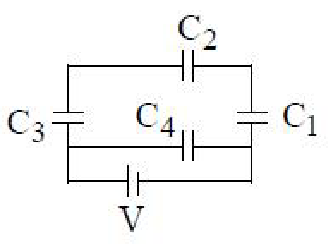 AP EAMCET 2025 Medium
 - Water from a tap emerges vertically downwards with initial velocity \(4 \mathrm{~ms}^{-1}\). The cross-sectional area of the tap is \(A\). The flow is steady and pressure is constant throughout the stream of water. The distance \(h\) vertically below the tap, where the cross-sectional area of the stream becomes \(\left(\frac{2}{3}\right) A\), is \(\left(g=10 \mathrm{~m} / \mathrm{s}^2\right)\)AP EAMCET 2010 Medium
- The values of \(t\) such that the matrix \(\left(\begin{array}{ccc}1 & 3 & 2 \\ 2 & 5 & t \\ 4 & 7-t & -6\end{array}\right)\) has no inverse, areAP EAMCET 2018 Easy
- Statement I The eccentricity of the hyperbola \(9 x^2-16 y^2-72 x+96 y-144=0\) is \(5 / 4\).
Statement II The eccentricity of the hyperbola \(\frac{x^2}{a^2}-\frac{y^2}{b^2}=1\) is \(\sqrt{1+\frac{b^2}{a^2}}\)AP EAMCET 2022 Medium - If \(\Delta\) is the area of the triangle formed by the positive \(x\)-axis and the normal and tangent to the circle \(x^2+y^2=4\) at \((1, \sqrt{3})\), then \(\Delta\) is equal toAP EAMCET 2012 Hard