


AP EAMCET · PHYSICS · Magnetic Properties of Matter
A vibration magnetometer is used at two different places \(\mathrm{A}\) and \(\mathrm{B}\) on the earth. The time period of a magnet suspended freely in the magnetometer at \(\mathrm{A}\) is twice that at \(\mathrm{B}\). If the horizontal component of the earth's magnetic field at \(\mathrm{B}\) is \(32 \times 10^{-6} \mathrm{~T}\), then its value at \(\mathrm{A}\) is
- A \(\mathrm{H}_{\mathrm{A}}=8 \times 10^{-6} \mathrm{~T}\)
- B \(\mathrm{H}_{\mathrm{A}}=32 \times 10^{-6} \mathrm{~T}\)
- C \(\mathrm{H}_{\mathrm{A}}^{\mathrm{A}}=4 \times 10^{-6} \mathrm{~T}\)
- D \(\mathrm{H}_{\mathrm{A}}=16 \times 10^{-6} \mathrm{~T}\)
Answer & Solution
Correct Answer
(A) \(\mathrm{H}_{\mathrm{A}}=8 \times 10^{-6} \mathrm{~T}\)
Step-by-step Solution
Detailed explanation
\(\begin{aligned} & \mathrm{T}=2 \pi \sqrt{\frac{\mathrm{I}}{\mathrm{MB}_{\mathrm{H}}}} \\ & \mathrm{T} \propto \frac{1}{\sqrt{\mathrm{B}_{\mathrm{H}}}}\end{aligned}\)…
See the Complete Solution
Get step-by-step explanations for this and 2.5 Lakh+ more JEE, NEET & CET questions.
- Unlock all solutions
- Practice the full chapter
- Track accuracy across PYQs
4.8 rated on Google Play · 14,000+ reviews
More questions from PHYSICS
- Light enters from air into a given medium at an angle of \(45^{\circ}\) with interface of the air-medium surface. After refraction, the light ray is deviated through an angle of \(15^{\circ}\) from its original direction. The refractive index of the medium isAP EAMCET 2023 Easy
- If the speed of sound in a mixture of 2 moles of Helium and 2 moles of Hydrogen at temperature \(\frac{972}{5} \mathrm{~K}\) is \(n \times 100 \mathrm{~ms}^{-1}\), then the value of \(n\) is (Take, \(\left.R=\frac{25}{3} \mathrm{~J} \mathrm{~mol}^{-1} \mathrm{~K}^{-1}\right)\)AP EAMCET 2019 Easy
- A body of mass \(\mathrm{I} \mathrm{kg}\) is suspended from a spring of negligible mass. Another body of mass \(500 \mathrm{~g}\) moving vertically upwards hits the suspended body with a velocity of \(3 \mathrm{~ms}^{-1}\) and gets embedded in it. If the frequency of oscillation of the system of the two bodies after collision is \(\frac{10}{\pi} \mathrm{Hz}\), the amplitude of the motion and the spring constant are respectively,AP EAMCET 2019 Hard
- The work done by 6 moles of helium gas when its temperature increases by \(20^{\circ} \mathrm{C}\) at constant pressure is
(Universal gas constant \(=8.31 \mathrm{~J} \mathrm{~mol}^{-1} \mathrm{~K}^{-1}\) )AP EAMCET 2025 Medium - Aball is projected from a point with a speed \(V_0\) at certain angle with the horizontal. From the same point and at the same instant, a person starts running with a constant speed \(0.5 \mathrm{~V}_0\) to catch the ball. If the person catches the ball after some time, then the angle of projection of the ball isAP EAMCET 2025 Medium
- If the tension in the horizontal wire shown in the figure is 30 N, then the weight W and tension in the wire OA are respectively
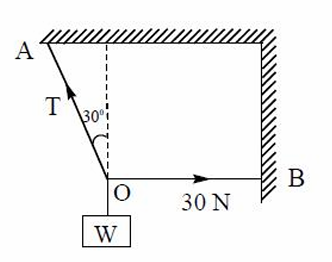 AP EAMCET 2025 Medium
More PYQs from AP EAMCET
- A point in the domain that cannot be filled in so that the resulting function is continuous is calledAP EAMCET 2020 Medium
- In a common emitter transistor amplifier the resistance of collector is \(3 \mathrm{k} \Omega\). If the current amplification factor is 100 and the base resistance is \(2 \mathrm{k} \Omega\), then the power gain of the transistor isAP EAMCET 2025 Medium
- What is the kinetic energy (in \(\mathrm{J} \mathrm{mol}^{-1}\) ) of one mole of an ideal gas (molar mass \(=0.1 \mathrm{~kg} \mathrm{~mol}^{-1}\) ) if its rms velocity is \(4 \times 10^2 \mathrm{~ms}^{-1}\) at \(\mathrm{T}(\mathrm{K}) ?\)AP EAMCET 2024 Easy
- A galvanometer, having a resistance of \(50 \Omega\), gives a full scale deflection for a current of 0.05 A. The length in metre of a resistance wire of area of cross-section \(2.97 \times 10^{-2} \mathrm{~cm}^2\) that can be used to convert the galvanometer into an ammeter which can read a maximum of 5 A current is :
(Specific resistance of the wire\(\left.=5 \times 10^{-7} \Omega-\mathrm{m}\right)\)AP EAMCET 2003 Hard - If \(\mathrm{P}\) is the set of all real numbers \(\alpha\) such that the product of the lengths of perpendiculars from \((\alpha, 1)\) to the pair of straight lines \(3 x^2+7 x y+2 y^2=0\) is \(\frac{\sqrt{2}}{5}\) then the sum of the elements in \(\mathrm{P}\) isAP EAMCET 2017 Easy
- The image of the point \((3,8)\) in the line \(x+3 y=7\) isAP EAMCET 2011 Medium