


AP EAMCET · PHYSICS · Motion In One Dimension
A particle starts from rest and moves in a straight line. It travels a distance 2 L with uniform acceleration and then moves with a constant velocity a further distance of L. Finally, it comes to rest after moving a distance of 3L under uniform retardation. Then the ratio of average speed to the maximum speed \(\left(\frac{\bar{V}}{V_m}\right)\) of the particle is
- A \(\frac{6}{11}\)
- B \(\frac{7}{11}\)
- C \(\frac{5}{11}\)
- D \(\frac{2}{11}\)
Answer & Solution
Correct Answer
(A) \(\frac{6}{11}\)
Step-by-step Solution
Detailed explanation
The \(v\)-t graph of the particle is \(\begin{aligned} & 2 L=\frac{1}{2} v_{\max } \times t_1 \Rightarrow t_1=\frac{4 L}{v_{\max }} \\ & L=v_{\max } \times t_2 \Rightarrow t_2=\frac{L}{v_{\max }}\end{aligned}\)…
See the Complete Solution
Get step-by-step explanations for this and 2.5 Lakh+ more JEE, NEET & CET questions.
- Unlock all solutions
- Practice the full chapter
- Track accuracy across PYQs
4.8 rated on Google Play · 14,000+ reviews
More questions from PHYSICS
- A block of mass \(m=25 \mathrm{~kg}\) sliding on a smooth horizontal surface with a velocity \(v=3 \mathrm{~ms}^{-1}\) meets the spring of spring constant \(k=100 \mathrm{~N} / \mathrm{m}\) fixed at one end as shown in figure. The maximum compression of the spring and velocity of block as it returns to the original position respectively are
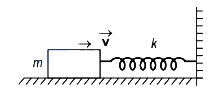 AP EAMCET 2007 Medium
 - At what temperature does the velocity of sound in air increased by 10% comparison with velocity at \(0^{\circ} \mathrm{C}\) ?AP EAMCET 2021 Medium
- Two moving coil galvanometer, \(X\) and \(Y\) have coils with resistance \(10 \Omega\) and \(14 \Omega\) cross-sectional areas \(4.8 \times 10^{-3} \mathrm{~m}^2\) and \(2.4 \times 10^{-3} \mathrm{~m}^2\), number of turns 30 and 45 respectively. They are placed in magnetic field of \(0.25 \mathrm{~T}\) and \(0.50 \mathrm{~T}\) respectively. Then, the ratio of their current sensitivities and the ratio of their voltage sensitivities are respectivelyAP EAMCET 2018 Hard
- Steam at \(100^{\circ} \mathrm{C}\) is passed into \(1 \mathrm{~kg}\) of water contained in a calorimeter at \(9^{\circ} \mathrm{C}\) till the temperature of water and calorimeter is increased to \(90^{\circ} \mathrm{C}\). The mass of the steam condensed is nearly
(water equivalent of calorimeter \(=0.1 \mathrm{~kg}\), specific heat of water \(=1 \mathrm{calg}^{-1}{ }^{\circ} \mathrm{C}^{-1}\)
and latent heat of vaporisation \(=540 \mathrm{calg}^{-1}\) )AP EAMCET 2018 Medium - A charged particle when enters a uniform magnetic field moves in a helical path. If its angular velócity is \(4 \pi \times 10^6\) rads \(^{-1}\) and its velocity in the direction of magnetic field is \(3 \times 10^5 \mathrm{~ms}^{-1}\) then the pitch of the helix isAP EAMCET 2023 Easy
- Adiabatic bulk modulus of a gas at a pressure ' \(\mathrm{P}^{\prime}\) is ( \(\gamma\)-ratio of specific heat capacities of the gas)AP EAMCET 2023 Hard
More PYQs from AP EAMCET
- A light ray is incident from a medium of refractive index 2 into a medium of refractive index \(\sqrt{3}\). The critical angle isAP EAMCET 2022 Easy
- For the matrix \(A=\left[\begin{array}{lll}3 & -3 & 4 \\ 2 & -3 & 4 \\ 0 & -1 & 1\end{array}\right] \cdot A^{-1}=\)AP EAMCET 2018 Easy
- The number of all possible solutions of the equation \(\mathrm{z}^3+\overline{\mathrm{z}}=0\) isAP EAMCET 2023 Hard
- The sum of all the coefficients in the binomial expansion of \((1+2 x)^n\) is 6561. Let \(R=(I+2 x)^n=I+F\), where \(I \in N\) and \(0 < F < \mathrm{l}\).
If \(x=\frac{1}{\sqrt{2}}\), then \(1-\frac{F}{1+(\sqrt{2}-1)^4}=\)AP EAMCET 2019 Medium - Suppose the tangents drawn to the circle \(x^2+y^2-6 x-4 y-11=0\) from \(P(1,8)\) touch the circle at \(A\) and \(B\). Then the centre of the circle passing through \(P\), \(\mathrm{A}\) and \(\mathrm{B}\) isAP EAMCET 2022 Easy
- A bar of mass \(m\) resting on a smooth horizontal plane starts moving due to a constant force \(F\). In the process of its rectilinear motion the angle \(\theta\) between the direction of this force and the horizontal varies as \(\theta=k x\), where \(k\) is a constant and \(x\) is the distance traversed by the bar from its initial position. The velocity \((v)\) of the bar as a function of the angle \(\theta\) isAP EAMCET 2022 Medium