


AP EAMCET · Maths · Straight Lines
The diagonals \(\mathrm{AC}\) and \(\mathrm{BD}\) of a rhombus \(\mathrm{ABCD}\) intersect at the point \((3,4)\). If \(\mathrm{BD}=2 \sqrt{2}, \mathrm{~A}=(1,2), \mathrm{B}=(\alpha, \beta)\),\(D=(\gamma, \delta)\) and \(\alpha < \delta < \gamma < \beta\), then \(\beta+\gamma-\delta=\)
- A \(0\)
- B \(\alpha + 4\)
- C \(-2\alpha +6\)
- D \(-3\alpha + 12\)
Answer & Solution
Correct Answer
(D) \(-3\alpha + 12\)
Step-by-step Solution
Detailed explanation
\(\because B D=2 \sqrt{2}\) \(\therefore O B=O D=\sqrt{2}\) \(\because \quad(3,4)\) is mid point of \(A C\) \(\therefore C=(5,6)\) So, \(O A=O C=\sqrt{4+4}=2 \sqrt{2}\) In \(\triangle A O B, O A^2+O B^2=A B^2\) \(\Rightarrow A B^2=10 \Rightarrow A B=\sqrt{10}\)…
See the Complete Solution
Get step-by-step explanations for this and 2.5 Lakh+ more JEE, NEET & CET questions.
- Unlock all solutions
- Practice the full chapter
- Track accuracy across PYQs
4.8 rated on Google Play · 14,000+ reviews
More questions from Maths
- The angle between the straight lines represented by \(\left(x^2+y^2\right) \sin ^2 \alpha=(x \cos \alpha-y \sin \alpha)^2\) isAP EAMCET 2015 Medium
- The points on the curve \(y=\frac{2}{3} x^3+\frac{1}{2} x^2\), where the tangents make equal angles with coordinate axes areAP EAMCET 2021 Medium
- If \((l, m)\) is the circumcentre of an equilateral triangle inscribed in the ellipse \(\frac{x^2}{a^2}+\frac{y^2}{b^2}=1\) having vertices at points with eccentric angles \(\theta_1, \theta_2\) and \(\theta_3\), then \(\frac{2}{3}\left[\cos \left(\theta_1-\theta_2\right)+\cos \left(\theta_2-\theta_3\right)+\cos \left(\theta_3-\theta_1\right)\right]=\)AP EAMCET 2019 Medium
- If is continuous at and , then find the following value ofAP EAMCET 2021 Easy
- If \(a, b, c\) are distinct and the roots of \((b-c) x^2+(c-a) x\) \(+(a-b)=0\) are equal, then \(a, b\) and \(c\) are inAP EAMCET 2015 Easy
- If \(P\left(x_1, y_1\right)\) is a point such that the length of the tangents from it to the circles \(x^2+y^2-4 x-6 y-12=0\) and \(x^2+y^2+6 x+18 y+26=0\) are in the ratio \(2: 3\), then the locus of \(P\) isAP EAMCET 2018 Medium
More PYQs from AP EAMCET
- If the function defined by is continuous on , thenAP EAMCET 2018 Hard
- The locus of \(z\) satisfying the inequality \(\left|\frac{z+2 i}{2 z+i}\right| < 1\), where \(z=x+i y\), isAP EAMCET 2009 Medium
- A particle of mass \(8 \mu \mathrm{~g}\) in motion collides with another stationary particle of mass \(4 \mu \mathrm{~g}\). If the collision is perfectly elastic and one dimensional, the ratio of their de Broglie wavelengths after collision isAP EAMCET 2025 Medium
- If \(a x^2+6 x y+b y^2-10 x+10 y-6=0\) represents a pair of perpendicular lines, then the values of \(|a|\) equalsAP EAMCET 2021 Easy
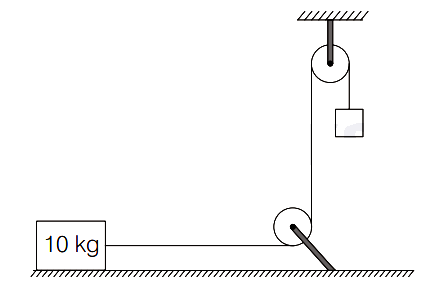
- A block of mass \(10 \mathrm{~kg}\) is placed on a horizontal frictionless surface and is attached to a cord which passes over two light frictionless pulleys as shown in the figure. The hanging block tied to the other end of the cord is initially at rest \(2 \mathrm{~m}\) above the horizontal floor.If the hanging block strikes the floor \(2 \mathrm{~s}\) after the system is released, then weight of the hanging block is ....... \(\left(g=10 \mathrm{~ms}^{-2}\right)\)
 AP EAMCET 2018 Hard
 - The ratio of ground state energy of \(\mathrm{Li}^{2+}, \mathrm{He}^{+}, \mathrm{H}\) isAP EAMCET 2024 Easy