


AP EAMCET · Maths · Inverse Trigonometric Functions
If \(\cos ^{-1}\left(\frac{x}{2}\right)+\cos ^{-1}\left(\frac{y}{2}\right)=\theta\), then \(9 x^2-12 x y \cos \theta+4 y^2=\)
- A \(36 \sin ^2 \theta\)
- B \(37 \sin ^2 \theta\)
- C \(39 \sin ^2 \theta\)
- D \(36 \cos ^2 \theta\)
Answer & Solution
Correct Answer
(A) \(36 \sin ^2 \theta\)
Step-by-step Solution
Detailed explanation
We have,…
See the Complete Solution
Get step-by-step explanations for this and 2.5 Lakh+ more JEE, NEET & CET questions.
- Unlock all solutions
- Practice the full chapter
- Track accuracy across PYQs
4.8 rated on Google Play · 14,000+ reviews
More questions from Maths
- If the roots of the equation \(4 x^3-12 x^2+11 x+k=0\) are in arithmetic progression, then \(k\) is equal toAP EAMCET 2004 Easy
- \(\mathrm{m}\) is the slope of a tangent to the curve \(\mathrm{e}^{\mathrm{y}}=1+\mathrm{x}^2\) at \(\mathrm{x}=1\) then \(\mathrm{m}=\)AP EAMCET 2022 Easy
- The value of \({ }^{34} C_5+\sum_{i=0}^4(38-i) C_4\) isAP EAMCET 2022 Medium
- In \(\triangle \mathrm{ABC}\), if \(\frac{1}{\mathrm{r}_1}, \frac{1}{\mathrm{r}_2}\) and, \(\frac{1}{\mathrm{r}_3}\) are in arithmetic progression, then \(\mathrm{r}_2: \mathrm{r}=\)AP EAMCET 2023 Hard
- Let \(f(x)=|x-3|+|x+5|\) and
\(A=\left\{a \in \mathbb{R} / \lim _{x \rightarrow a} \frac{f(x)-f(a)}{x-a}\right.\) exists \(\}\)
Then the number of real numbers which are in \((-\infty,-3)\) \(\cup(5, \infty)\) but not in \(A\) isAP EAMCET 2023 Medium - The normal drawn at a point \((2,-4)\) on the parabola \(y^2=8 x\) cuts again the same parabola at \((\alpha, \beta)\) then \(\alpha+\beta=\)AP EAMCET 2024 Medium
More PYQs from AP EAMCET
- The range of the function \(f(x)=x^2+\frac{1}{x^2+1}\) isAP EAMCET 2020 Easy
- \(\operatorname{sech}^2\left(\tanh ^{-1} \frac{1}{2}\right)+\operatorname{cosech}^2\left(\operatorname{coth}^{-1} 3\right)=\)AP EAMCET 2018 Medium
- Statement (I) The elimination of arbitrary constants from \(\alpha, \beta\) and \(\gamma\) from \(y=(\alpha+\beta+\gamma) x\) results in a differential equation of order three.
Statement (II) The elimination of arbitrary constants \(\alpha, \beta\) and \(\gamma\) from \(y=\alpha x+\beta \sin x+\gamma e^x\) results in a differential equation of order three.AP EAMCET 2019 Easy - The increasing order of acidity of the following carboxylic acids is
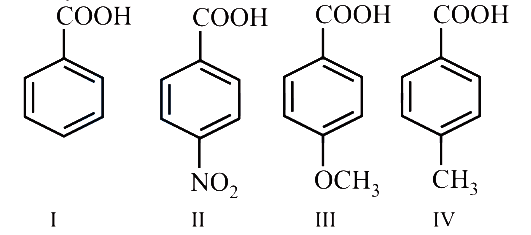 AP EAMCET 2017 Easy
 - If the equation of the pair of straight lines intersecting at \((a, b)\) and perpendicular to the pair of lines \(3 x^2-4 x y+5 y^2=0\) is \(l x^2+2 h x y+m y^2-32 x-26 y+c=0\), then \(\frac{a+b+c}{l+h+m}=\)AP EAMCET 2025 Hard
- Sugar present in DNA isAP EAMCET 2022 Easy