


AP EAMCET · Chemistry · Classification of Elements and Periodicity in Properties
Which of the following represents the correct order of increasing electron gain enthalpy with negative sign for the elements?
a. Nitrogen
b. Phosphorous
c. Chlorine
d. Fluorine
- A
- B
- C
- D
Answer & Solution
Correct Answer
(B)
Step-by-step Solution
Detailed explanation
So we know that Cl has high electron gain enthalpy because the small size of F and there is very high electronic repulsion among the electrons of fluorine. In Phosphorous and nitrogen the phosphorous has high electron gain enthalpy than nitrogen because of larger size and lower…
See the Complete Solution
Get step-by-step explanations for this and 2.5 Lakh+ more JEE, NEET & CET questions.
- Unlock all solutions
- Practice the full chapter
- Track accuracy across PYQs
4.8 rated on Google Play · 14,000+ reviews
More questions from Chemistry
- In which of the following reactions, benzaldehyde is formed from benzoyl chloride and hydrogen in the presence of \(\mathrm{Pd}-\mathrm{BaSO}_4 ?\)AP EAMCET 2018 Medium
- For the cell reaction, \(3 \mathrm{Sn}^{4+}+2 \mathrm{Cr} \longrightarrow 3 \mathrm{Sn}^{2+}+2 \mathrm{Cr}^{3+}, E_{\text {cell }}^{\circ}\) is \(0.89 \mathrm{~V}\). Then \(\Delta G^{\circ}\) for the reaction isAP EAMCET 2020 Hard
- The pair of xenon compounds, which have a same number of lone pairs of electrons on the central atom isAP EAMCET 2018 Medium
- Which among the following compound shows the highest lattice energy?AP EAMCET 2021 Easy
- If the uncertainty in velocity of electron \((\Delta \mathrm{v})\) is \(0.1 \mathrm{~m} / \mathrm{s}\), the uncertainty in its position \((\Delta x)\) is
(given: \(m_e=9.1 \times 10^{-31} \mathrm{~kg}\) )AP EAMCET 2023 Medium - Which of the following sequence of reagents convert propene to 1-chloropropane?AP EAMCET 2024 Easy
More PYQs from AP EAMCET
- A mixture of ethyl iodide and n-propyl iodide is subjected to Wurtz reaction. The hydrocarbon which will not be formed isAP EAMCET 2024 Medium
- How much current is required to produce \(\mathrm{H}_2\) gas at the rate of \(1 \mathrm{cc} / \mathrm{sec}\) under STP?AP EAMCET 2020 Medium
- Match the following
\(\begin{array}{ll}
\text{List - I} & \text{List - II} \\
\text{A) } \mathrm{Al}_2 \mathrm{O}_3+2 \mathrm{NaOH}+3 \mathrm{H}_2 \mathrm{O} \rightarrow 2 \mathrm{Na}\left[\mathrm{Al}(\mathrm{OH})_4\right] & \text{I) Roasting} \\
\text{B) } \mathrm{Ni}(\mathrm{CO})_4 \xrightarrow{230^{\circ} \mathrm{C}} \mathrm{Ni}+4 \mathrm{CO} & \text{II) Calcination} \\
\text{C) } \mathrm{Fe}_2 \mathrm{O}_3 \cdot 3 \mathrm{H}_2 \mathrm{O} \xrightarrow{\Delta} \mathrm{Fe}_2 \mathrm{O}_3+3 \mathrm{H}_2 \mathrm{O} & \text{II) Vapour phase refining} \\
\text{D) } 2 \mathrm{PbS}+3 \mathrm{O}_2 \rightarrow 2 \mathrm{PbO}+2 \mathrm{SO}_2 & \text{IV) Electrolysis} \\
& \text{V) Leaching}
\end{array}\)
The correct answer isAP EAMCET 2017 Medium - Suppose \(E\) and \(F\) are two events of a random experiment. If the probability of occurrence of \(E\) is \(1 / 5\) and the probability of occurrence of \(F\) given \(E\) is \(1 / 10\), then the probability of non-occurrence of atleast one of the events \(E\) and \(F\) isAP EAMCET 2004 Medium
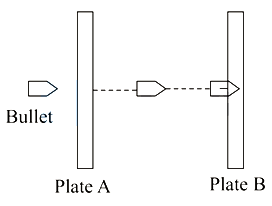
- A bullet of mass pierces through a plate of mass and then gets embedded into a second plate of mass as shown in the figure. Initially the two plates and are at rest and move with same velocity after collision. The percentage loss in the initial kinetic energy of the bullet when it is between the plates and is_______. (Neglect any loss of material of the plates during the collision)
 AP EAMCET 2018 Hard
 - Assuming \(x\) to be so small that \(x^2\) and higher powers of \(x\) can be neglected, the coefficient of \(x\) in \(\frac{(1-x)^{1 / 3}+(1-5 x)^2}{(16-x)^{1 / 4}}\) is equal toAP EAMCET 2020 Medium